
AI Product Manager Skills: How to Lead Useful AI Products Without Being a Data Scientist
The best AI product managers do not win by pretending to be machine learning researchers. They win by translating messy user problems into AI systems that are useful, measurable, safe, and economically sane.

AI Product Manager Skills: Quick Answer
AI product manager skills sit at the intersection of product discovery, technical AI fluency, evaluation design, risk management, and business communication. An AI PM does not need to train foundation models from scratch, but they do need to understand enough about model behavior to make better product decisions than a generic roadmap manager. The role is less about memorizing algorithms and more about asking sharper questions: what should the model do, how will we know it works, what can go wrong, who approves risky outputs, what data is allowed, and what user behavior proves the product is actually useful?
The search gap around this topic is clear. Many career pages say “learn prompt engineering, data, and machine learning.” That is not wrong, but it is incomplete. Employers do not hire AI PMs to admire AI. They hire them to reduce uncertainty. They need someone who can turn a vague idea such as “add an AI assistant” into a problem statement, workflow map, model choice, retrieval plan, evaluation set, risk register, launch metric, and iteration loop. That is a very different skill set from simply being excited about generative AI.
This guide is written for product managers, analysts, designers, founders, operators, marketers, engineers, and career transitioners who want to work closer to AI products. It uses live Singularity Journey analytics, search-gap review, and data-gap research. Recent site data showed thin organic search volume but consistent engagement around AI agents, guardrails, hallucinations, observability, portfolios, and resume proof. That means a Future Careers pillar should connect career advice with the practical AI system concepts readers already visit on this site.
Why AI Product Management Is Not Just Product Management With New Vocabulary
Traditional product management is already hard because users, markets, stakeholders, and engineering constraints rarely line up cleanly. AI adds a new layer: the product can behave probabilistically. A normal feature usually follows deterministic logic. If the user clicks a button, the system performs a defined action. An AI feature may summarize, classify, retrieve, reason, draft, recommend, route, or take action with outputs that vary across inputs and contexts. That makes product quality harder to define and harder to verify.
Microsoft’s Work Trend Index frames the workplace shift around AI and agents as a change in how execution gets distributed. As agents take on more execution, human agency expands only if organizations know how to design work around them. That is exactly where AI PMs matter. They are the people who decide whether an agent should answer, recommend, draft, escalate, update a record, call a tool, or stop and ask a human. The career opportunity is not merely “AI is popular.” The opportunity is that companies need practical translators between user need, model capability, risk, cost, and adoption.
The World Economic Forum’s Future of Jobs work describes technological change as one of the major drivers reshaping labour markets and skills. The useful takeaway for career planning is not panic. It is specificity. As AI becomes common, generic AI enthusiasm becomes less valuable. The premium skill is the ability to turn AI into trustworthy workflows. An AI PM who can explain eval design, hallucination risk, fallback behavior, human review, adoption metrics, and business value will stand out against candidates who only list tool names.
AI also changes the product manager’s relationship with engineering. You still need discovery, prioritization, roadmap discipline, and stakeholder management. But you also need enough technical empathy to avoid impossible requirements. “Make it accurate” is not a useful requirement. “For invoice extraction, reach agreed precision on the golden test set, route low-confidence cases to human review, log model version and source document, and measure correction rate after launch” is much closer to an AI product requirement.
The Core AI Product Manager Skill Matrix
A strong AI PM profile is not a random pile of buzzwords. It is a stack of capabilities that help a team answer five product questions: what user problem matters, what AI behavior is acceptable, what evidence proves quality, what risk is worth taking, and what business outcome justifies the cost. The matrix below is a practical way to audit your current skill level.
| Skill area | What it means in AI product work | Portfolio proof |
|---|---|---|
| Problem discovery | Finding workflows where AI reduces friction, improves decision quality, or handles repetitive cognitive work. | Interview notes, workflow map, pain ranking, before/after journey. |
| AI fluency | Understanding LLMs, retrieval, prompts, embeddings, agents, tool use, context windows, latency, and cost at a product-decision level. | Architecture sketch, model-choice memo, technical tradeoff explanation. |
| Evaluation design | Defining test cases, quality rubrics, acceptance thresholds, failure categories, and regression checks. | Golden dataset, eval table, error taxonomy, release gate. |
| Risk management | Identifying hallucination, privacy, bias, unsafe action, over-automation, prompt injection, and compliance risks. | Risk register, fallback plan, human approval flow, monitoring plan. |
| Metrics and economics | Measuring adoption, task completion, correction rate, cost per successful task, latency, retention, and business impact. | Dashboard mockup, KPI tree, experiment plan, decision log. |
| Communication | Explaining model uncertainty to executives, constraints to designers, requirements to engineers, and value to users. | AI PRD, launch narrative, FAQ, stakeholder briefing. |
Notice what is missing from this table: “become a data scientist overnight.” Some AI PM roles are highly technical and prefer coding or ML experience. Others are product-led roles where the PM works closely with ML engineers, data scientists, security teams, and legal reviewers. The right career strategy depends on your background. A software engineer moving into product should strengthen discovery and stakeholder judgment. A classic PM should build AI fluency and eval literacy. An analyst should turn measurement skill into product strategy. A designer should learn conversational UX, failure states, and trust cues.
If you want deeper background on model mistakes, read AI Hallucinations Explained. If you want the safety layer, read AI Guardrails Explained. Those concepts are not only technical; they are now career skills for anyone responsible for AI product decisions.
How an AI PRD Is Different From a Normal PRD
A product requirements document is traditionally used to communicate what a product release must include. ProductPlan describes a PRD as an artifact that tells development and testing teams what capabilities must be included in a release. That framing still matters, but an AI PRD needs additional sections because the product’s behavior is not fully captured by static functional requirements.
A normal PRD might say, “Users can upload a support ticket and receive a suggested reply.” An AI PRD must go further. What data can the model see? Should it retrieve from a knowledge base? What happens if the source content conflicts? Does the model provide citations? Can it send the reply automatically, or only draft it? What tone is acceptable? What confidence threshold triggers escalation? What personally identifiable information must be hidden? How will the team know whether the draft helped or created more work?
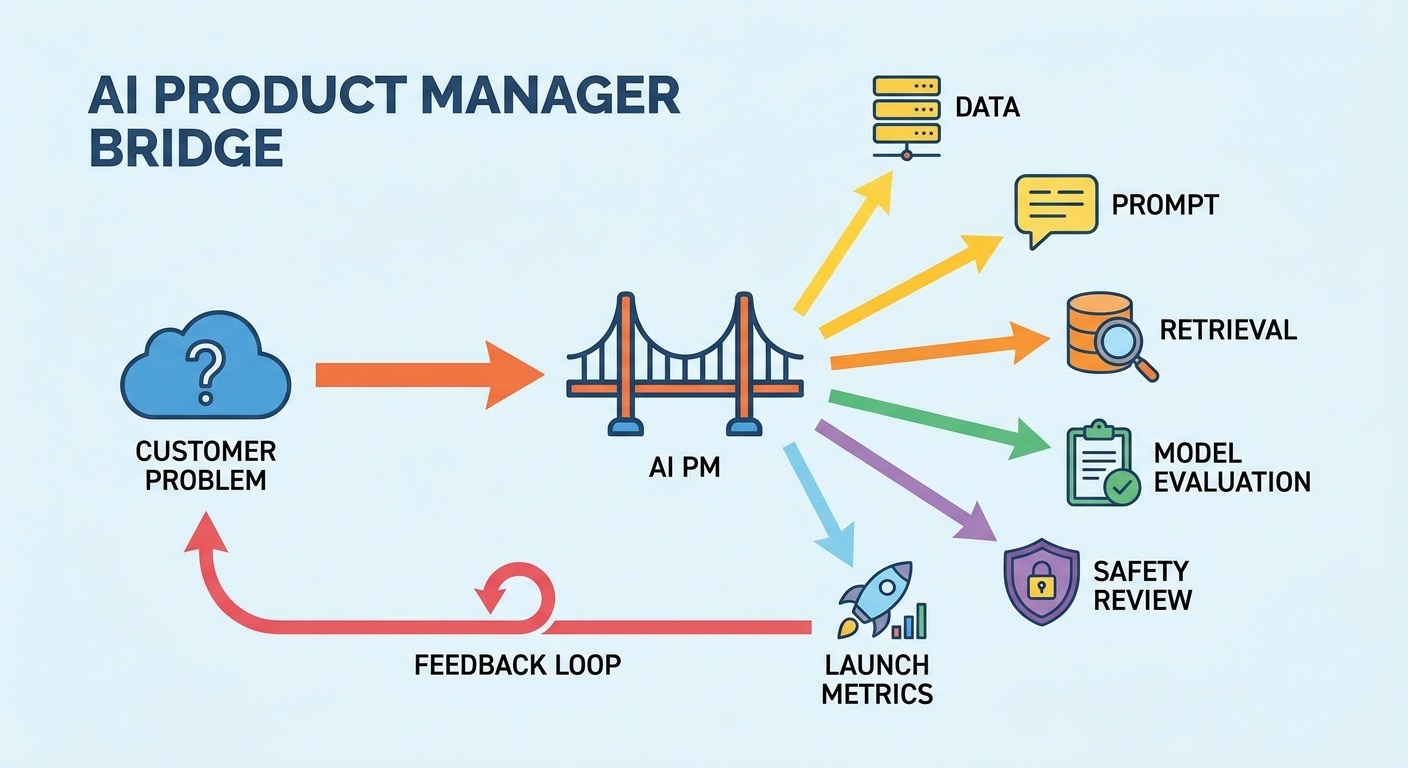
The AI PRD checklist
| PRD section | Questions the AI PM must answer |
|---|---|
| User problem | What human workflow is painful, frequent, valuable, and suitable for AI support? |
| AI role | Is the AI explaining, drafting, classifying, searching, summarizing, recommending, or taking action? |
| Inputs and context | What documents, tools, user data, prompts, and memory can the system access? |
| Quality definition | What does “good” mean, who judges it, and what examples define pass/fail? |
| Failure modes | Where can the model be wrong, biased, unsafe, expensive, slow, or overconfident? |
| Human control | When should the system ask permission, escalate, or refuse to act? |
| Launch metrics | Which adoption, quality, safety, cost, and business metrics decide whether to continue? |
The strongest AI PMs make ambiguity visible. They do not hide uncertainty under vague requirements. They write down what is known, what is assumed, what must be tested, and what cannot be automated yet. This makes the team faster because engineers are not forced to guess the product intent, designers are not forced to invent trust states alone, and leadership can see the actual risk profile before launch.
NIST’s AI Risk Management Framework is useful language here because it pushes teams to think about trustworthy AI through governance, mapping, measurement, and management. You do not need to turn every startup feature into a compliance ceremony. But you should borrow the habit: identify context, map risks, measure behavior, and manage outcomes. For an AI PM, that is not bureaucracy. It is product quality.
The Metrics AI Product Managers Must Understand
AI product metrics should not stop at “users tried it.” Curiosity is not value. A feature can get clicks because it is new, then quietly fail because users do not trust it. AI PMs need a balanced dashboard that covers adoption, usefulness, quality, safety, cost, latency, and retention. The exact metrics depend on the product, but the thinking pattern is reusable.
Start with the user job. If the AI product drafts customer replies, measure accepted drafts, edited drafts, time saved, escalation rate, customer satisfaction, and policy violations. If it summarizes meetings, measure summary usage, correction rate, missing action items, follow-up completion, and repeat usage. If it acts as an internal analytics assistant, measure successful answers with verified sources, query reformulation rate, unsupported-answer rate, and analyst time saved.
| Metric type | Examples | Why it matters |
|---|---|---|
| Adoption | Activation, repeat usage, feature discovery, user segment penetration. | Shows whether the feature fits real workflow demand. |
| Quality | Human rating, accuracy on golden set, correction rate, citation coverage. | Shows whether model behavior is good enough for the job. |
| Safety | Blocked unsafe actions, policy violations, escalation rate, sensitive-data incidents. | Shows whether the product can be trusted at scale. |
| Experience | Latency, abandonment, explanation clarity, perceived control. | AI that feels slow or mysterious often loses user trust. |
| Economics | Cost per successful task, token spend, human review time, saved hours. | AI value must survive the cost of inference, tooling, and review. |
| Business impact | Resolution time, conversion lift, support deflection, revenue influence, risk reduction. | Connects the AI feature to outcomes leadership cares about. |
The phrase “cost per successful task” is especially important. AI can look cheap at demo scale and expensive at production scale. A PM who ignores latency and model cost may ship something exciting that finance later questions. A PM who focuses only on cost may underinvest in quality and destroy trust. The job is to find the useful middle: enough model capability to solve the task, enough guardrails to manage risk, and enough measurement to know when the system is helping.
This is where Singularity Journey’s existing work on production agents becomes useful. AI Agent Observability explains why traces, tool calls, costs, and failures need to be visible. Product managers do not need to instrument every span themselves, but they should know what questions the monitoring system must answer.
How to Build an AI Product Manager Portfolio Employers Trust
The biggest mistake in AI career portfolios is showing only the surface of the product. A screenshot of a chatbot is not proof. A model demo is not proof. A prompt library is not proof. Employers need evidence that you can make decisions under uncertainty. Your portfolio should explain the problem, the users, the constraints, the AI behavior, the risks, the metrics, and the iteration plan.
Think of your portfolio as a product case study, not a gallery. You can build it without access to proprietary company data. Use a public dataset, a realistic synthetic workflow, an open knowledge base, or a personal productivity scenario. The point is not to fake enterprise scale. The point is to show mature thinking. A hiring manager should finish your case study believing, “This person would ask the right questions in a real AI product meeting.”
Strong portfolio evidence
- A clear user problem with research notes or assumptions.
- An AI PRD with requirements, constraints, and failure states.
- A workflow diagram showing where AI helps and where humans stay in control.
- A small evaluation set with pass/fail examples.
- A metrics dashboard mockup with adoption, quality, risk, and cost indicators.
- A decision log explaining tradeoffs and what you would test next.
Weak portfolio evidence
- A generic chatbot with no user problem.
- A list of AI tools without product context.
- Claims about accuracy without examples or measurement.
- No fallback plan for wrong or unsafe outputs.
- No explanation of cost, latency, or data privacy.
- No connection to business or user outcomes.
Five portfolio projects for aspiring AI PMs
1. Support reply assistant. Build a case study for an assistant that drafts support replies from a help center. Show retrieval design, citation requirements, escalation triggers, tone constraints, and metrics such as accepted draft rate and correction rate.
2. Meeting-to-action workflow. Design a system that turns meeting notes into tasks. Include ambiguity handling, owner confirmation, confidence states, and adoption metrics. This is a good project for non-technical PMs because the product judgment is obvious.
3. Internal analytics copilot. Create a prototype or detailed PRD for a natural-language analytics assistant. Focus on source verification, permissions, hallucination prevention, and when the system should say it cannot answer.
4. AI onboarding coach. Design a product that helps new employees learn internal processes. Show content governance, feedback loops, measurement, and privacy boundaries.
5. Agent approval workflow. Design a workflow where an AI agent prepares actions but needs human approval before sending messages, changing records, or triggering payments. Link it to human-in-the-loop AI agent approval principles.
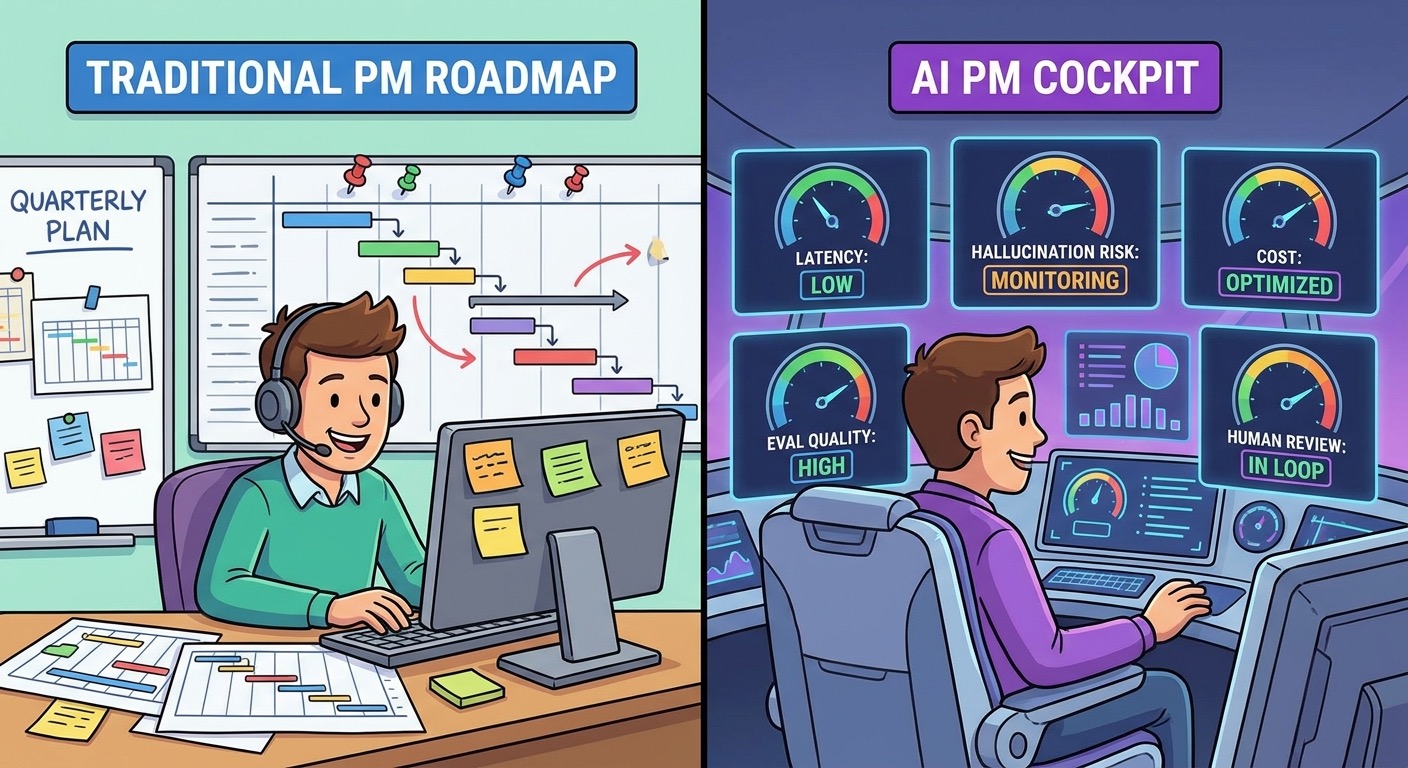
If you already have product experience, you do not need to start from zero. Take one feature you have worked on and rewrite the case study as if AI were introduced responsibly. What would change in requirements? What would become risky? Which metrics would no longer be enough? What new review process would be needed? That exercise alone can become a strong portfolio artifact.
A Practical Transition Plan for Different Backgrounds
The route into AI product management depends on where you begin. The wrong advice is to tell everyone to learn the same stack. A senior PM, a junior analyst, a UX designer, a developer, and a business operator have different assets. Your goal is to keep your unfair advantage while adding the missing AI layer.
| Your background | Keep strengthening | Add next | Best proof artifact |
|---|---|---|---|
| Product manager | Discovery, prioritization, stakeholder alignment, roadmap discipline. | AI fluency, evals, model failure modes, AI PRD structure. | AI PRD plus evaluation and launch metrics plan. |
| Business analyst | Process mapping, measurement, requirements, operational detail. | LLM workflows, retrieval basics, risk thresholds, adoption metrics. | Before/after workflow with cost-per-successful-task model. |
| Designer | User empathy, interaction design, trust cues, usability testing. | Conversational UX, uncertainty states, correction loops, fallback design. | AI user journey with error states and human review screens. |
| Engineer | Technical feasibility, APIs, system design, debugging. | Discovery, business framing, executive communication, roadmap tradeoffs. | Build-versus-buy decision memo with product launch plan. |
| Operations leader | Workflow knowledge, policy, handoffs, risk awareness. | AI capability mapping, vendor evaluation, instrumentation basics. | Agent approval workflow and governance checklist. |
For the first month, study the vocabulary and rebuild your mental model. Learn the difference between prompting, retrieval, fine-tuning, agents, tool calls, embeddings, evals, and guardrails. Read product teardowns of AI features and ask what could fail. Do not drown yourself in every framework. You are building decision fluency.
For the next month, create one serious artifact. Choose a workflow you understand and write an AI PRD. Include user problem, AI role, data sources, excluded use cases, quality rubric, risk register, launch metrics, and open questions. Share it with someone technical if possible and revise based on feedback. The quality of the revision matters because AI PM work is iterative.
For the following month, turn the artifact into a portfolio case study. Add diagrams, a small eval table, a dashboard mockup, and a decision log. Write it in plain English. If you built a prototype, include it, but do not let the prototype replace the product thinking. A simple prototype with a strong evaluation plan is often more impressive than a flashy demo with no risk model.
Finally, update your resume language. Do not write “AI enthusiast.” Write outcomes and artifacts. For example: “Designed an AI support-assistant PRD with retrieval requirements, human escalation rules, quality rubric, and launch metrics for accepted draft rate, correction rate, and cost per successful resolution.” That sentence shows PM judgment, AI fluency, and measurement discipline in one line. For more examples, use AI Resume Skills as a companion guide.
Common Mistakes That Make AI PM Candidates Look Junior
Mistake one: treating AI as magic. If your roadmap assumes the model will simply “understand users,” you are not managing the product. You are outsourcing the hard part to hope. Strong PMs define the job, the context, the success criteria, and the failure boundary.
Mistake two: ignoring evaluation. AI products need examples. A team cannot improve what it cannot judge. Even a small handcrafted test set is better than vague opinion. Your eval set should include easy cases, hard cases, edge cases, and cases where the system should refuse or escalate.
Mistake three: forgetting user trust. Users do not trust AI because a landing page says “powered by AI.” They trust it when the product explains its sources, admits uncertainty, provides control, and makes correction easy. Trust is a product feature.
Mistake four: skipping economics. A feature may be technically possible and still not worth shipping if it costs too much per useful output. AI PMs should understand model cost, latency, review burden, and operational overhead well enough to ask uncomfortable questions early.
Mistake five: using too much jargon. Hiring managers are not impressed by vocabulary if it is detached from decisions. Say fewer buzzwords and show stronger artifacts. Explain why you chose retrieval instead of fine-tuning. Explain why a human approves certain actions. Explain how the team knows quality improved.
Final Recommendation: Become the Person Who Makes AI Useful
The future-career opportunity in AI product management is not reserved only for people with PhDs or deep ML engineering backgrounds. Those skills are valuable, but the market also needs people who can make AI practical. The rare profile is a product leader who understands users, speaks enough AI to make good tradeoffs, respects risk, measures quality, and communicates clearly across teams.
If you are early, start with one workflow and one artifact. If you are already a PM, upgrade your PRDs and metrics to include AI behavior. If you are technical, practice explaining product value without hiding behind implementation detail. If you are non-technical, do not apologize for that; prove that you can identify the right problem, define responsible behavior, and lead a team toward measurable value.
The best AI PMs will not be the loudest AI optimists. They will be the people who can sit in a room with users, engineers, executives, security reviewers, and designers, then turn confusion into a product plan everyone can trust. That is a career moat worth building.
Keep Learning on Singularity Journey
- AI Resume Skills — turn AI experience into credible resume evidence.
- AI Hallucinations Explained — understand why AI products need verification and fallback design.
- AI Guardrails Explained — learn the safety controls product teams should consider.
- AI Agent Observability — see how production AI teams monitor quality, traces, costs, and failures.
- Enterprise AI Agents — understand the business workflow trend behind many AI PM roles.
Sources and References
- World Economic Forum: The Future of Jobs Report
- Microsoft Work Trend Index
- NIST AI Risk Management Framework
- Stanford HAI AI Index
- ProductPlan: Product Requirements Document glossary
Career markets, role titles, and tool stacks change quickly. This guide avoids time-limited title language and focuses on durable skills: problem framing, evaluation, risk management, metrics, and product judgment.
FAQ: AI Product Manager Skills
What skills does an AI product manager need?
An AI product manager needs product discovery, AI fluency, evaluation design, risk management, metrics, stakeholder communication, and enough technical understanding to make tradeoffs with engineering and data teams.
Do AI product managers need to code?
Not always. Some roles require technical depth or coding, especially platform and developer-tool roles. Many AI PM roles value product judgment, AI literacy, evaluation thinking, and communication more than hands-on model training.
How is an AI PM different from a regular PM?
An AI PM manages probabilistic model behavior, evals, guardrails, data constraints, latency, cost, hallucination risk, and human approval flows in addition to normal product work such as discovery, prioritization, roadmaps, and metrics.
What should I put in an AI product manager portfolio?
Include an AI PRD, workflow map, user problem, model behavior definition, evaluation set, risk register, metrics dashboard, and decision log. Show how you think, not just what tool you used.
Is prompt engineering enough for an AI PM career?
No. Prompting is useful, but AI PMs need broader product skills: deciding what to build, defining quality, managing risk, measuring outcomes, and coordinating teams.
What is the best first project for an aspiring AI PM?
A support reply assistant, meeting-to-action workflow, analytics copilot, onboarding coach, or human-approval agent workflow can all work well if you include requirements, evals, risks, and metrics.
How can non-technical professionals move into AI product management?
Start with AI concepts, then create a portfolio artifact for a workflow you understand. Prove you can define the user problem, responsible AI behavior, launch metrics, and risk controls even if you do not build the full system yourself.
