
AI Citation Verification Checklist: How to Check Sources Before You Trust an Answer
AI can produce confident answers with fake links, invented papers, misquoted reports, and real sources used in the wrong context. This practical checklist shows how to verify citations before you publish, study from, or act on an AI-generated answer.
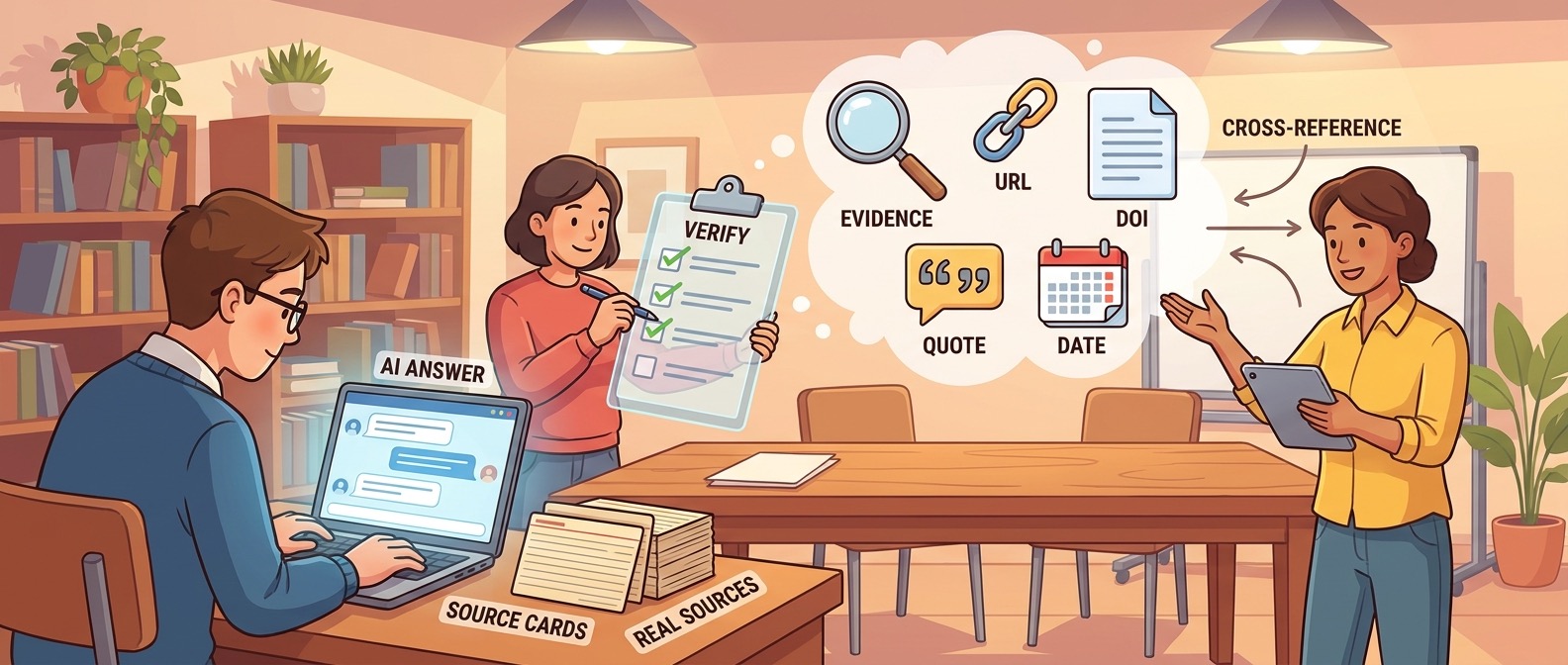
Quick Answer: Do Not Trust an AI Citation Until It Survives Three Checks
An AI citation is safe to use only after you verify that the source exists, the cited claim actually appears in that source, and the source is strong enough for the decision you are making. If any one of those checks fails, treat the citation as unverified. Do not paste it into a report, essay, policy document, product page, legal memo, health note, investor deck, or classroom material just because the AI answer sounds polished.
This article is a focused cluster guide for our broader pillar article, AI Hallucinations Explained. The pillar explains why models make things up and how to think about hallucination risk. This page zooms into one practical subproblem: source and citation hallucinations. These are especially dangerous because they make an answer look more trustworthy than it really is.
The simplest rule is: AI can help you find candidate sources, but it cannot be the final proof that those sources are real or correctly used. A model may invent an author, attach a real URL to the wrong claim, summarize a report too broadly, quote language that never appears, or cite a paper that exists but does not support the sentence beside it. Verification is not a formality. It is the work that turns a plausible draft into evidence you can responsibly use.
Why AI Citation Hallucinations Happen
Large language models are optimized to generate likely text, not to maintain a perfect library catalog in their heads. When a prompt asks for evidence, the model may produce the kind of citation that often appears near similar text. Sometimes that citation is real. Sometimes it is a convincing blend of real names, plausible titles, partial URLs, and familiar publication patterns. The result can look professional while still being wrong.
IBM describes AI hallucinations as outputs that sound plausible but are factually wrong, irrelevant, or fabricated, including invented studies, nonexistent URLs, and incorrect details about real entities. That definition matters because citation hallucinations are not rare edge cases in the user experience. They are a predictable failure mode when a system is asked to fill evidence gaps without reliable grounding.
Research on truthfulness also shows why confidence is not enough. The TruthfulQA benchmark was designed to test whether models avoid false answers that imitate common human misconceptions. Its core lesson for everyday users is practical: a fluent answer can copy patterns from text without being anchored to reality. If that can happen with simple factual questions, it can also happen with references, statistics, and quote-like language.
There is another subtle problem: a source can be real and still be misused. A model might cite a reliable report for a claim the report does not make. It might cite a blog post as if it were a peer-reviewed paper. It might cite a paper about one domain and use it to support a claim in another domain. That is why citation verification is not only a broken-link check. It is a claim-to-source matching process.
The AI Citation Verification Checklist
Use this checklist any time an AI tool gives you citations, links, references, statistics, named reports, quote fragments, legal cases, academic papers, benchmarks, or source-backed recommendations. You do not need to perform every step for a casual personal question. You should perform every step when the answer will influence other people, public content, money, safety, health, legal interpretation, reputation, hiring, education, or product decisions.
| Check | What to do | Reject the citation if... |
|---|---|---|
| 1. Source existence | Search the exact title, author, organization, DOI, or quoted phrase outside the AI tool. | You cannot find the source through the publisher, archive, official site, library index, or reputable search result. |
| 2. Link integrity | Open the link directly. Remove tracking parameters if needed and check the final domain. | The URL is broken, redirects somewhere unrelated, uses a suspicious domain, or only appears inside AI-generated pages. |
| 3. Claim match | Find the specific sentence, chart, table, page, or section that supports the AI answer. | The source discusses a related topic but does not actually support the claim being made. |
| 4. Quote accuracy | If the AI uses quotation marks, search the exact phrase on the source page or PDF. | The quote is paraphrased as exact language, altered in meaning, or absent from the source. |
| 5. Publisher quality | Check who published it: official body, academic venue, reputable newsroom, company blog, forum, or unknown site. | The source quality is too weak for the seriousness of the claim. |
| 6. Date and version | Check publication date, revision date, report edition, model version, policy version, or dataset version. | The answer uses an old source for a fast-changing claim without saying so. |
| 7. Scope and context | Look for caveats: geography, sample size, definitions, benchmark setup, population, and exclusions. | The AI answer turns a narrow finding into a broad universal claim. |
| 8. Independent support | For important claims, confirm with a second reputable source or original source. | Only one weak or ambiguous source supports a high-impact conclusion. |
The most important row is claim match. Many people stop after a link opens, but a working link does not prove the claim. The link might be real, reputable, and still irrelevant. Good verification asks: Which exact claim is this citation supporting, and where does the source say that?
A Practical Workflow for Checking AI Sources
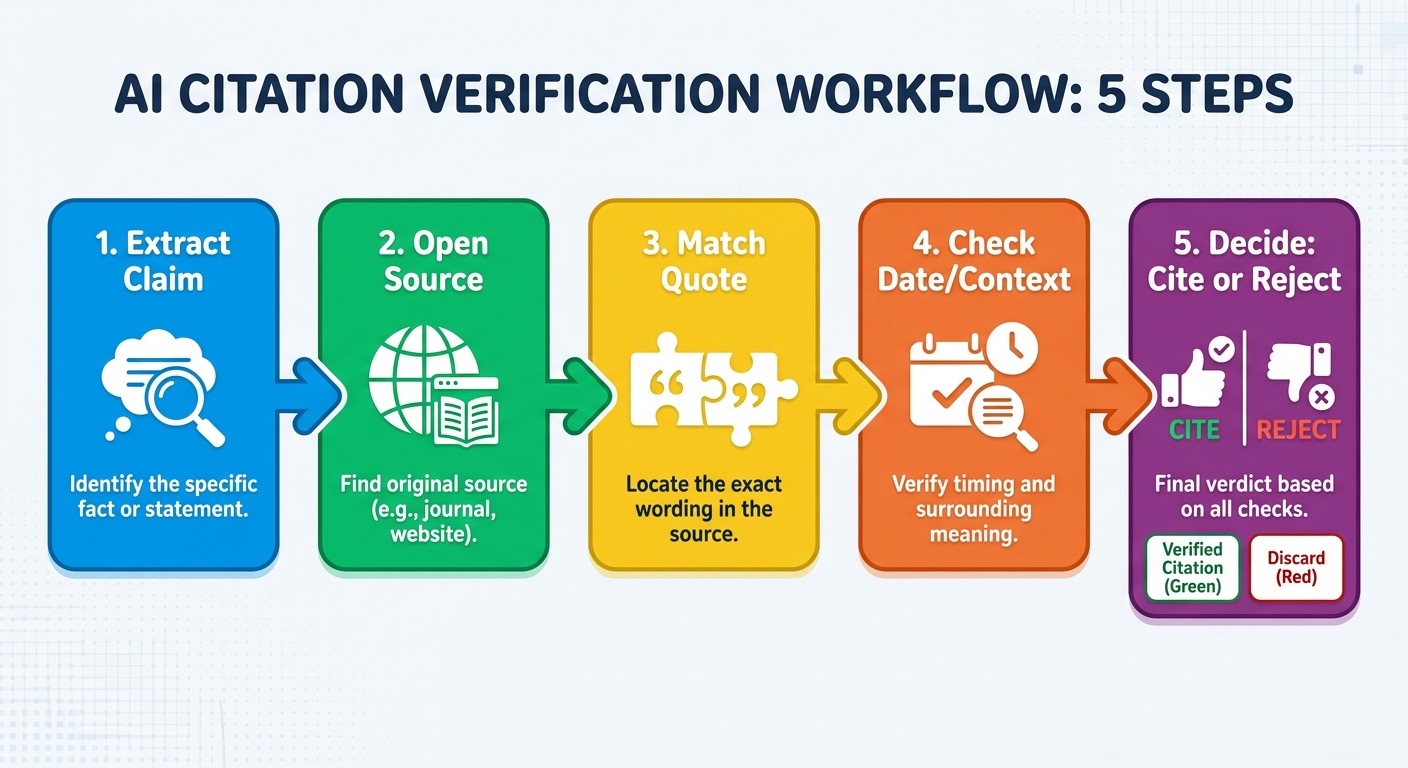
Step 1: Extract the claim before checking the citation
Do not start by judging the whole paragraph. Pull out the exact claim that needs evidence. For example: “RAG systems reduce hallucinations,” “a specific benchmark measures truthfulness,” “a named report found a trend,” or “a tool supports a feature.” The more precise the claim, the easier it is to verify. Vague claims create vague citations, and vague citations are where hallucinations hide.
Rewrite each claim as a testable sentence. If the AI wrote, “Studies show that models often hallucinate citations,” ask: which studies, which models, what kind of citations, under what conditions, and what does “often” mean? If the answer cannot name the evidence clearly, do not let the citation decorate the sentence. Either verify the source or soften the claim.
Step 2: Open the source from the original publisher when possible
Prefer original sources over summaries. If the AI cites NIST, open the NIST page. If it cites an arXiv paper, open the arXiv abstract or paper page. If it cites a company report, open the company’s report page. Summaries can be useful, but they add another layer where mistakes can enter. When the claim is important, go as close to the original source as practical.
Watch the domain carefully. A suspicious mirror, scraped PDF site, shortened link, or unknown download page should not become your source of truth. This is partly an accuracy rule and partly a security rule. You should not download files, enter personal information, or follow strange redirects just to rescue a citation that the AI invented or mangled.
Step 3: Use find-on-page and search within PDFs
Once the source opens, search for the key phrase, statistic, author name, dataset, or concept. If the AI gave a quotation, search the exact quote. If the AI gave a statistic, search the number. If the source is long, use the table of contents, headings, and PDF search. A citation that cannot be located inside the source is not verified.
This step catches a common failure: the model cites a real source that is merely adjacent to the topic. For example, a RAG evaluation paper may support a claim about evaluating retrieval and faithfulness, but it may not support a sweeping claim that RAG “solves” hallucinations. The source can be useful while the AI’s interpretation is too strong.
Step 4: Preserve caveats instead of flattening them
Good sources include caveats. They define terms, describe samples, limit conclusions, and explain uncertainty. AI summaries often compress those caveats away because the user asked for a clean answer. Your job is to put the caveats back where they matter. If a benchmark measures a narrow task, do not cite it as proof of general intelligence. If a survey covers one country, do not cite it as a global result. If a report is about enterprise adoption, do not cite it as evidence about student behavior.
Step 5: Decide whether to cite, revise, or reject
After checking, choose one of three outcomes. Cite the source if it directly supports the claim. Revise the sentence if the source supports a narrower or softer version. Reject the citation if the source does not exist, does not match, is too weak, or creates security concerns. This decision step is what prevents verification from becoming a time sink. You are not trying to prove the AI right. You are trying to make your final work accurate.
AI Citation Decision Matrix: Cite, Revise, or Reject?
The table below turns the checklist into a fast decision system. Use it when you are reviewing an AI-generated draft with many references.
| What you find | Risk level | Best action | Example rewrite |
|---|---|---|---|
| The source exists and directly supports the claim. | Low | Cite it, but keep the claim precise. | “The Ragas paper frames RAG evaluation around retrieval, faithfulness, and answer quality.” |
| The source exists but supports a narrower claim. | Medium | Revise the sentence to match the source. | Change “RAG prevents hallucinations” to “RAG can reduce some hallucination risk, but still needs evaluation.” |
| The source exists but is a vendor blog or marketing page. | Medium | Use it for product facts, not broad independent claims. | “The vendor describes this feature as...” rather than “Research proves...” |
| The quote does not appear in the source. | High | Remove quotation marks or reject the citation. | Use a paraphrase only if the idea is actually supported. |
| The URL is broken or redirects to an unrelated page. | High | Search for an official source; otherwise reject. | “I could not verify the cited source, so I removed the claim.” |
| The source cannot be found anywhere reputable. | Critical | Reject the citation and audit nearby claims. | Delete the reference and ask the AI for verifiable alternatives, then check them manually. |
This matrix is also useful for teams. Editors, students, analysts, and developers can agree on the same review language: cite, revise, or reject. That avoids long debates about whether an AI answer “feels right.” The only question is whether evidence supports the exact claim.
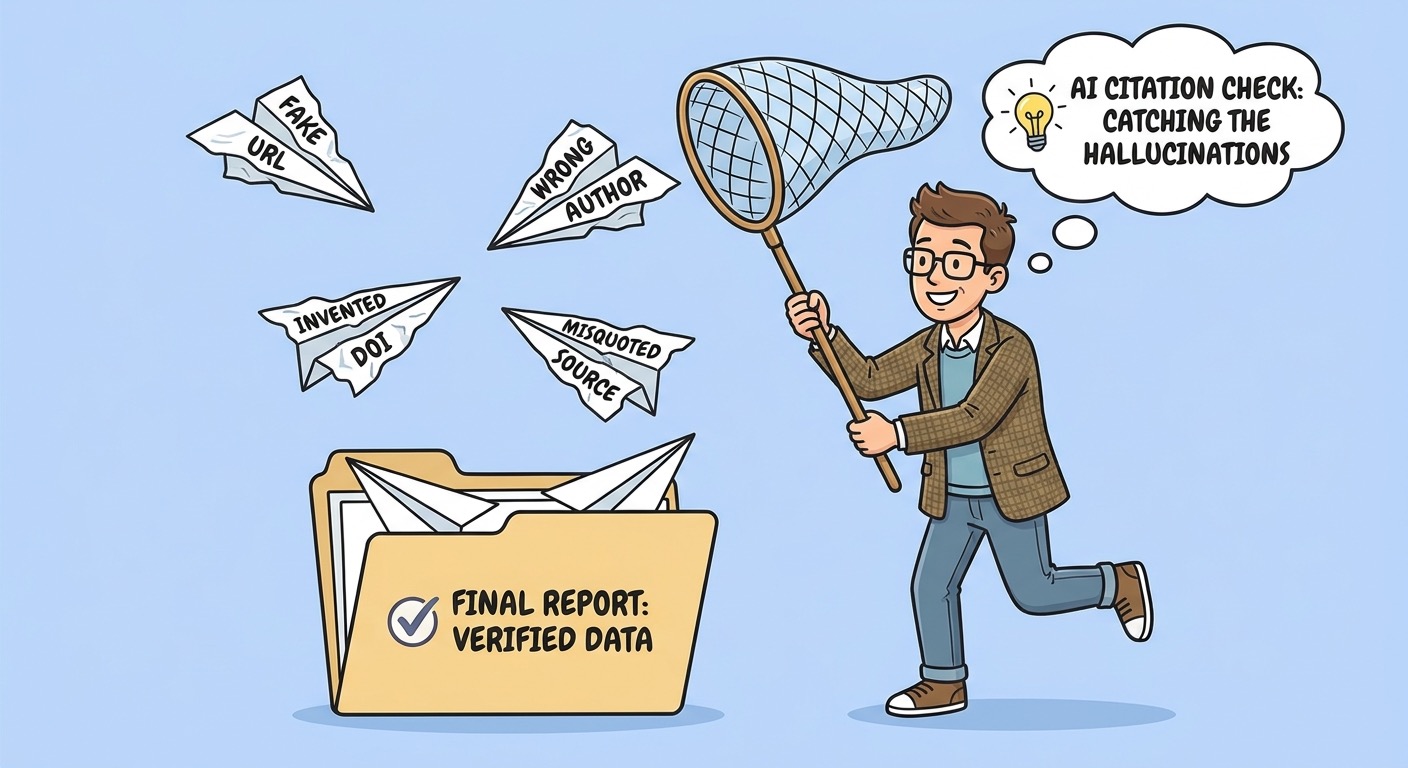
Does RAG Fix AI Citation Hallucinations?
Retrieval-augmented generation, usually called RAG, can reduce some citation problems because the model receives external context instead of relying only on its learned patterns. But RAG is not magic. It can retrieve the wrong document, miss the best document, quote the right document incorrectly, or answer beyond the retrieved context. The Ragas paper is useful here because it frames RAG evaluation across retrieval quality, faithfulness to context, and generation quality. That is exactly the triangle citation verification needs.
For everyday readers, the lesson is simple: a source-backed AI answer is better than an ungrounded answer, but it is still not automatically true. Ask three RAG-specific questions. Did the system retrieve a relevant source? Did the answer stay faithful to that source? Did the final wording preserve the source’s context and caveats? If the answer cannot show its evidence clearly, treat it as a draft.
For builders, citation verification should become part of product design. If an AI app displays sources, it should make the claim-source relationship easy to inspect. A list of links at the bottom is weaker than source snippets attached to specific claims. A confidence score is weaker than a visible quote, section, timestamp, or page number. A useful AI interface should help users verify, not merely reassure them.
What RAG helps with
- Grounding answers in retrieved documents.
- Making source inspection easier.
- Reducing reliance on model memory.
- Supporting domain-specific knowledge.
What still needs checking
- Whether retrieval found the right source.
- Whether the answer stays faithful to that source.
- Whether the quoted sentence exists.
- Whether the source is current and authoritative.
Examples of AI Citation Problems and Better Responses
Example 1: The invented report
An AI answer says, “According to the Global AI Trust Survey, most employees distrust AI-generated reports.” The title sounds plausible, but searching the exact report name finds no official source. The correct action is to reject the citation, not to keep the sentence with softer wording. If you still want to make a claim about trust, find a real survey from a reputable organization and rewrite the sentence around what it actually says.
Example 2: The real paper used too broadly
An AI answer cites TruthfulQA to claim that “larger models always hallucinate more.” That is too broad. TruthfulQA tested specific models and questions designed around false beliefs and misconceptions. A better sentence would say that TruthfulQA illustrates how models can generate false answers learned from training data, so model fluency should not be confused with truthfulness. The revised claim is more careful and more useful.
Example 3: The RAG overclaim
An AI answer says, “RAG eliminates hallucinations because the model has documents.” That is not safe. RAG can reduce risk when retrieval and generation work well, but it does not remove the need for evaluation. A better answer says that RAG can give models relevant context and reduce some hallucination risk, but teams still need to evaluate retrieval relevance, answer faithfulness, and source accuracy.
Example 4: The quote that became a paraphrase
An AI draft includes a sentence in quotation marks from a government framework. You open the source and find the idea, but not the exact words. Do not keep the quotation marks. Either paraphrase accurately and cite the source, or replace the quote with exact language from the document. Quotation marks create a stronger claim than paraphrase; they require exact verification.
Example 5: The broken link that hides a weak claim
An AI tool provides a URL that returns a 404 page. Sometimes the source moved. Sometimes the model invented the path. Search the title and publisher. If you find the official page, use the correct link and verify the claim. If you cannot find it, remove the citation. Do not replace it with a random page that merely discusses the same topic.
How Teams Should Review AI-Generated Citations
For teams, citation checking should not depend on one careful person at the end of the workflow. It should be built into the process. Writers, analysts, marketers, researchers, product managers, educators, and developers all need a shared standard for what counts as verified evidence.
A lightweight team workflow can look like this. First, label AI-generated references as unverified by default. Second, require the author to attach the exact source location for every important claim. Third, ask reviewers to spot-check high-risk claims rather than every harmless sentence. Fourth, keep a short record of rejected citations so patterns become visible. Fifth, update prompts and templates to demand source excerpts, not just source names.
This approach matches the spirit of the NIST AI Risk Management Framework: manage AI risk through mapping, measuring, managing, and governing rather than hoping tools behave perfectly. You do not need a heavy compliance program for every blog post or classroom note. You do need a proportionate process when AI output affects real decisions.
| Use case | Minimum verification standard | Extra safeguard |
|---|---|---|
| Personal learning | Check source existence and broad claim match. | Compare with one additional source for unfamiliar topics. |
| Blog or newsletter | Verify every cited claim and link. | Keep a source log with notes on claim support. |
| Academic work | Use original papers, official datasets, and exact page references where required. | Follow institution citation rules and disclose AI use when required. |
| Business decision | Verify data, dates, methodology, and relevance to the decision. | Have a human owner sign off on critical assumptions. |
| Legal, medical, financial, or safety content | Do not rely on AI citations alone. | Use qualified professional review and original authoritative sources. |
Prompting Tips That Make Citation Checking Easier
Better prompts do not replace verification, but they can make verification faster. Ask the model to separate claims from sources. Ask it to include exact source titles, publishers, publication dates, and URLs. Ask it to say when it is uncertain. Ask it to avoid citations unless it can provide enough information for you to verify them. Then still check the output.
A useful prompt is: “Create a source table with one row per claim. Include the exact claim, the source title, publisher, URL, publication date, and the reason the source supports the claim. Mark any uncertain source as unverified.” This forces structure. It also makes fake confidence easier to spot because vague source rows stand out.
A weaker prompt is: “Give me sources.” That invites a decorative bibliography. The model may produce a list of links that look impressive but are not tied to specific claims. Citation lists are only useful when each source has a job.
Keep Learning on Singularity Journey
- AI Hallucinations Explained — the broader pillar guide on why models make things up and how to reduce risk.
- AI Output Review Checklist — a related workflow for proving human judgment in AI-assisted work.
- AI Guardrails Explained — how safe AI systems prevent mistakes, misuse, and runaway actions.
- AI Agent Context Explained — why context quality affects AI answers.
Sources and References
- IBM Think: What Are AI Hallucinations?
- NIST AI Risk Management Framework
- TruthfulQA: Measuring How Models Mimic Human Falsehoods
- Ragas: Automated Evaluation of Retrieval Augmented Generation
- Stanford HAI AI Index Report
Source links were included only when they were directly relevant and from reputable domains. Do not download files or enter personal information on unfamiliar sites when verifying citations.
FAQ: AI Citation Verification
Can AI invent citations?
Yes. AI tools can invent paper titles, authors, reports, URLs, legal cases, quotes, and statistics. They can also cite a real source for a claim that source does not support.
Is a citation safe if the link opens?
No. A working link only proves that a page exists. You still need to confirm that the page supports the exact claim, quote, statistic, or recommendation in the AI answer.
What is the fastest way to check an AI citation?
Extract the exact claim, open the source, search for the key phrase or statistic, and decide whether the source directly supports the sentence. If it does not, revise or reject the citation.
Does RAG prevent hallucinated citations?
RAG can reduce some risk by giving the model retrieved context, but it does not guarantee source accuracy. Retrieval quality, faithfulness to context, and answer wording still need evaluation.
Should I use AI-generated citations in academic work?
Only after verifying them through original sources and following your institution’s rules. Treat AI references as leads, not finished citations.
What should I do when an AI source is broken?
Search for the original title, publisher, author, or DOI. If you cannot find a reputable original source, remove the citation and do not rely on the claim.
How many sources should support an important AI-generated claim?
For high-impact claims, use at least one original authoritative source and, when possible, a second reputable source. The higher the consequence, the stronger the evidence should be.
