
Frontier AI Safety Case Checklist: What Evidence Should Come Before Deployment
A practical guide to building a frontier AI safety case: the claims, evaluations, safeguards, reviewers, deployment limits, and monitoring evidence that should sit behind a serious launch decision.
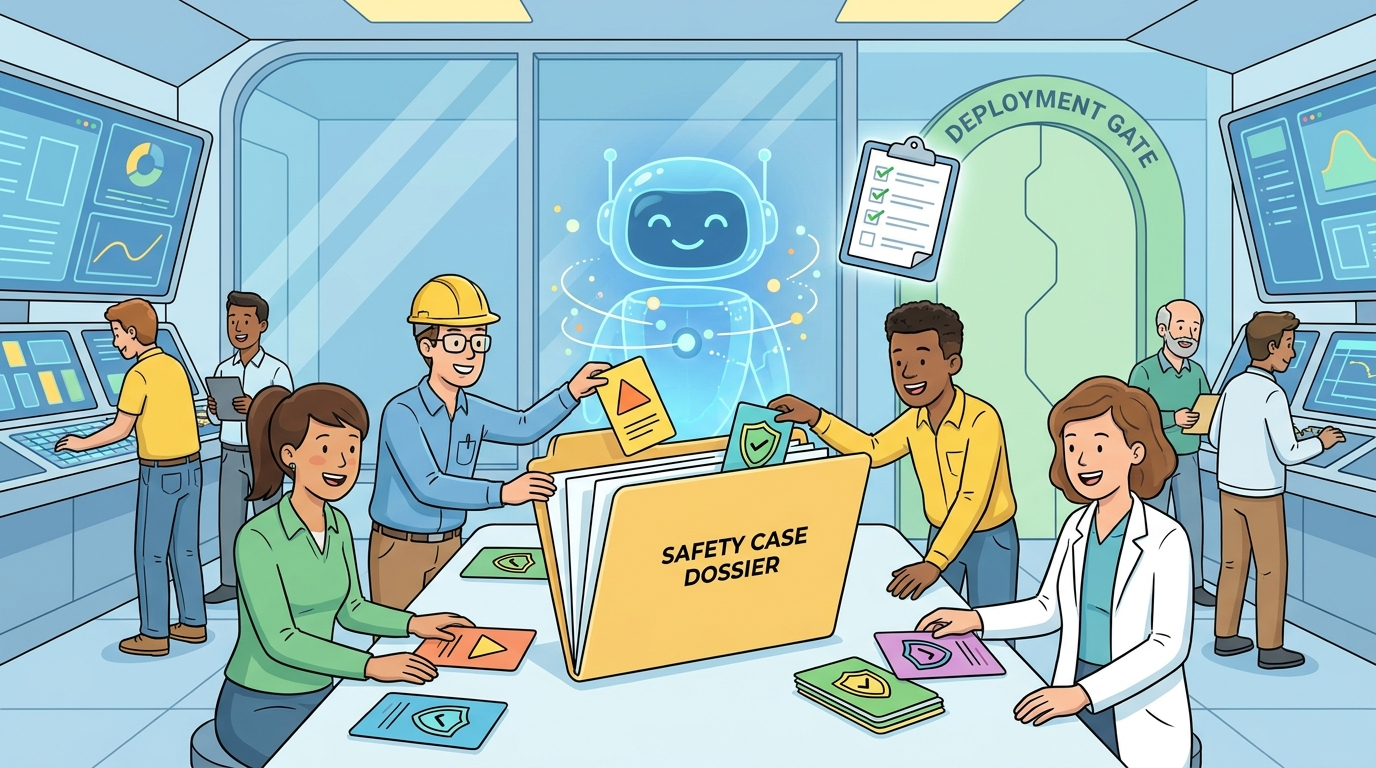
Quick Answer: What Is a Frontier AI Safety Case?
A frontier AI safety case is a structured argument that a powerful AI system is safe enough for a specific deployment, under specific limits, because specific evidence supports that decision. It is not a slogan, a press release, or a single benchmark score. It is closer to an evidence dossier: here are the risks we considered, here are the evaluations we ran, here are the results, here are the safeguards, here are the remaining uncertainties, and here is why this release path is acceptable or not acceptable.
This article is a cluster guide for the Singularity Journey pillar article AI Risk Thresholds Explained. The pillar explains when stronger safeguards should be triggered. This supporting article narrows the question: once a threshold matters, what evidence should decision-makers expect before a frontier model is trained further, deployed more widely, connected to tools, or given more autonomy?
A good safety case does three things. First, it makes the claim visible: “this model can be deployed in this way with these safeguards.” Second, it connects the claim to evidence: capability evaluations, red-team findings, misuse analysis, security controls, monitoring plans, and incident response. Third, it makes the decision reviewable: independent experts, executives, regulators, customers, or the public can see what the organization believed and what would cause the decision to change.
The phrase matters because frontier AI systems are becoming harder to govern with intuition alone. A chatbot with no tools, no sensitive data, and limited capability is one thing. A model that can write code, search the web, call tools, assist research, persuade users, manipulate files, or operate through an agent scaffold needs a stronger chain of evidence. If the organization cannot explain the chain, it is asking people to trust a launch decision that even insiders may not have fully stress-tested.
Why Safety Cases Matter After a Model Crosses a Risk Threshold
The previous pillar article argued that AI risk thresholds should trigger stronger safeguards when capability, exposure, autonomy, or misuse potential rises. That still leaves a practical gap. Teams can agree that a threshold has been crossed and still disagree about what counts as enough evidence. One person may say, “We red-teamed it.” Another may ask, “Which red team, against which threat model, with what success criteria, and what changed after failures?” A safety case turns that vague debate into a structured review.
The need is visible in public frontier AI governance. OpenAI’s Preparedness Framework describes tracked capability categories, high and critical capability levels, and operational commitments when severe-harm risks are plausible, measurable, severe, net new, and instantaneous or irremediable. Anthropic’s Responsible Scaling Policy connects AI Safety Levels with stronger safety, security, and operational standards as catastrophic-risk potential rises. NIST’s AI Risk Management Framework gives organizations a broader language for governing, mapping, measuring, and managing AI risk. The UK AI Security Institute and METR contribute evaluation and measurement approaches for advanced systems. These sources do not use identical terminology, but they all push toward a similar discipline: serious AI claims require serious evidence.
The safety-case idea also helps readers avoid a common trap. A benchmark result is evidence, but it is not the whole case. A policy is evidence, but it is not the whole case. A model card is evidence, but it is not the whole case. A safety case connects many pieces and explains how they support the actual deployment decision. For frontier AI, that decision might include training continuation, staged release, API access, open weights, tool use, enterprise pilots, autonomous agent features, or access to sensitive domains.
That distinction matters because deployment context can change risk as much as raw capability does. A model that can answer biological questions in a locked-down research environment is different from the same model widely available through an API. A model that can solve cyber exercises in a sandbox is different from a tool-connected agent operating against live systems. A model that can write persuasive text is different from a system that can target, personalize, send, and optimize messages at scale. A safety case should be about the model-plus-deployment, not the model in isolation.
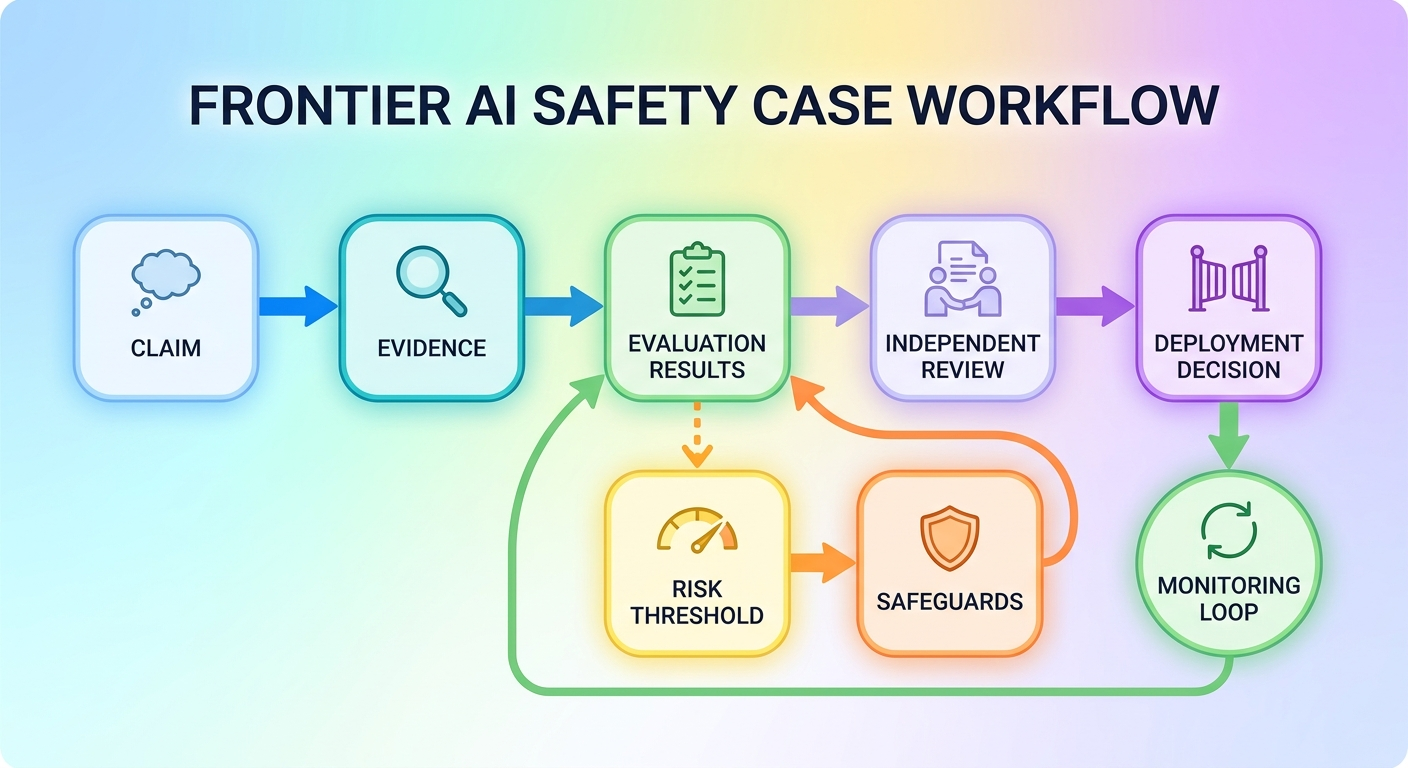
The Seven Core Elements of a Frontier AI Safety Case
A useful safety case does not need to be mysterious. It should have a clear structure that a technical reader, policy reader, or product leader can inspect. The details will vary by organization, but seven elements are especially important for frontier systems.
The order matters. A safety case should start with the claim because “safe” is not a free-floating property. Safe for what? Safe for whom? Safe under which limits? A system may be acceptable for a narrow internal evaluation but not for public release. It may be acceptable for read-only assistance but not for write-access tools. It may be acceptable for adults in a professional context but not for vulnerable users or high-stakes advice. Without a precise claim, the evidence cannot be judged.
The threat model matters because frontier AI risk is not one bucket. OpenAI’s public update separates tracked categories such as biological and chemical capabilities, cybersecurity capabilities, and AI self-improvement from research categories such as long-range autonomy and autonomous replication and adaptation. Anthropic’s RSP focuses on catastrophic risks from misuse and autonomous behavior, while NIST’s framework is broader and applies across many AI systems. A safety case should say which risk classes it is actually addressing and which ones are out of scope. Otherwise, readers may assume a broad safety claim when the evidence only covers a narrow hazard.
The uncertainty record may be the most underused part. Strong organizations should not pretend their tests are perfect. Evaluations can miss rare failure modes, red-team prompts can become outdated, automated graders can make mistakes, and agent scaffolds can create behavior that was not visible in ordinary chat tests. A credible safety case says, “Here is what we still do not know, here is why we think the residual risk is acceptable under these limits, and here is what would make us change our mind.” That honesty is not weakness. It is evidence of mature risk management.
The Evidence Checklist: What Should Be in the Dossier?
The phrase “safety case” can sound abstract, so this section turns it into a practical checklist. The goal is not to demand the same document from every product team. The goal is to show what evidence should exist before high-risk frontier AI deployment decisions, especially when a model touches domains where severe harm, misuse, or loss of control is plausible.
| Evidence area | What to include | Why it matters |
|---|---|---|
| Capability evaluations | Task suites, expert-written questions, benchmark results, agent task completion, long-horizon task tests, cyber/bio/chemical/autonomy evals where relevant. | Shows what the model can do, not merely what the team hopes it can or cannot do. |
| Misuse evaluations | Adversarial prompts, jailbreak testing, dual-use scenario analysis, abuse simulations, refusal reliability, access-control tests. | Tests whether the system can be pushed toward harmful assistance or policy bypasses. |
| Safeguard validation | Before-and-after mitigation results, false positive/false negative analysis, monitoring coverage, tool permission tests, rate limits, human approval success criteria. | Demonstrates that safeguards are not just listed, but actually reduce identified risk. |
| Deployment limits | User eligibility, rate limits, geography, domain restrictions, tool restrictions, staged rollout plan, pilot boundaries, rollback paths. | Connects risk evidence to a bounded release rather than a vague “ship it” decision. |
| Security controls | Model weight protection, access controls, infrastructure hardening, insider-risk controls, incident response, logging and audit trails. | Frontier systems can be risky not only through normal use, but also through theft, misuse, or unauthorized deployment. |
| Independent review | External evaluator findings, expert red-team notes, board or safety committee review, regulator or institute engagement where applicable. | Reduces the chance that internal incentives and blind spots dominate the decision. |
| Post-release monitoring | Misuse detection, jailbreak tracking, user reports, incident taxonomy, escalation thresholds, re-evaluation cadence, public update process. | Risk changes after release; the safety case should survive contact with real users. |
Notice what this checklist does not require: fake precision. It does not say a model is safe because it scored 87.3 on a single benchmark. It asks whether multiple forms of evidence point in the same direction. For example, a model may show modest risky capability in internal evaluations, strong safeguards in ordinary refusal tests, but poor resistance to simple jailbreaks when connected to a tool scaffold. That mixed result should not be flattened into a reassuring headline. It should lead to a narrower release, stronger mitigations, or more testing.
Data-gap research for this article found that many public explanations of frontier AI safety frameworks explain the policy labels but do not show how evidence should be assembled. That is the linkable opportunity: readers need a practical checklist that sits between high-level AI governance frameworks and raw technical papers. The article fills that gap by translating safety-case thinking into questions a reader can ask about any frontier model announcement.
Search-gap research also supports this narrow angle. Broad searches for AI safety, AI risk, and AI regulation are competitive and often dominated by official sources, research organizations, or news coverage. The long-tail intent around “frontier AI safety case,” “AI deployment evidence,” and “AI safety case checklist” is more specific. It asks for a structured answer, not another overview of why AI is risky. That makes it a strong supporting cluster article for the risk-threshold pillar.
A Practical Workflow for Writing a Safety Case
If a team had to write a frontier AI safety case from scratch, the workflow should start long before launch week. Waiting until a model is ready to ship creates pressure to justify the decision instead of test it. A stronger process begins with threat modeling, turns risk thresholds into evaluation plans, connects evaluations to safeguards, and keeps a record of what changed.
| Stage | Main question | Useful output |
|---|---|---|
| 1. Define the release | What deployment is being considered? | Clear claim: limited research access, staged API, tool-connected agent, public product, or no release. |
| 2. Map the risk domains | Which harms are plausible for this model and use case? | Threat model covering capability, access, autonomy, tool use, user population, and misuse routes. |
| 3. Set thresholds | Which signals would require stronger safeguards or a pause? | Decision rules aligned with the source pillar’s risk-threshold logic. |
| 4. Run evaluations | What does the model actually do under ordinary, adversarial, and tool-enabled conditions? | Capability results, misuse results, red-team findings, failure examples, and confidence limits. |
| 5. Test safeguards | Do controls reduce the specific risks found? | Mitigation evidence for refusals, monitoring, access limits, tool permissions, human approval, and rollback. |
| 6. Review the case | Who challenges the evidence before deployment? | Internal safety review, external expert review where risk warrants it, leadership decision record. |
| 7. Monitor and reopen | What post-release evidence changes the decision? | Incident triggers, re-evaluation cadence, public communication plan, and escalation process. |
The workflow should be iterative. A failed evaluation is not automatically a reason to abandon a model, but it is a reason to update the case. Maybe the deployment should be narrower. Maybe the safeguard is not strong enough. Maybe tool access should move from execute mode to draft mode. Maybe an external reviewer should examine the evidence. Maybe a capability threshold has been crossed and broader release should pause. A safety case is useful precisely because it forces the team to record those changes instead of letting them disappear into chat threads and meetings.
For smaller AI builders, this process may sound too heavy. The scaled-down version is still valuable. If your AI agent can send email, change customer records, run commands, access private files, or publish content, write a mini safety case. What is the claim? What can the agent do? What can go wrong? Which tests show it handles risky requests? Which actions require human approval? What logs will you review? What incident would disable the feature? The same pattern applies even when the stakes are smaller.
Review Gates: Who Should Be Able to Say No?
A safety case is weak if nobody has authority to act on it. Review gates turn evidence into a decision. For low-risk AI features, a product owner and safety reviewer may be enough. For frontier systems with severe-risk potential, the review gate should include technical safety experts, security leaders, policy/legal specialists, senior leadership, and external reviewers where the evidence warrants it. The higher the possible harm, the less credible a purely internal rubber stamp becomes.
OpenAI’s public Preparedness Framework update describes a Safety Advisory Group that reviews whether safeguards sufficiently minimize severe risk and makes targeted recommendations to leadership. Anthropic’s Responsible Scaling Policy describes board-approved governance and increasingly strict demonstrations of safety and security at higher AI Safety Levels. The exact structure is less important than the principle: when capability increases, review authority should become more formal, more documented, and harder to bypass.
External review is especially important when the safety case depends on specialized expertise. A biology-related risk evaluation should involve people who understand the domain. Cyber evaluations need security expertise. Long-horizon autonomy tests need evaluators who understand agent scaffolds, task design, and measurement failure modes. Security hardening needs people who can assess whether model weights, infrastructure, and access controls are actually protected. A general AI policy meeting cannot substitute for domain-specific review.
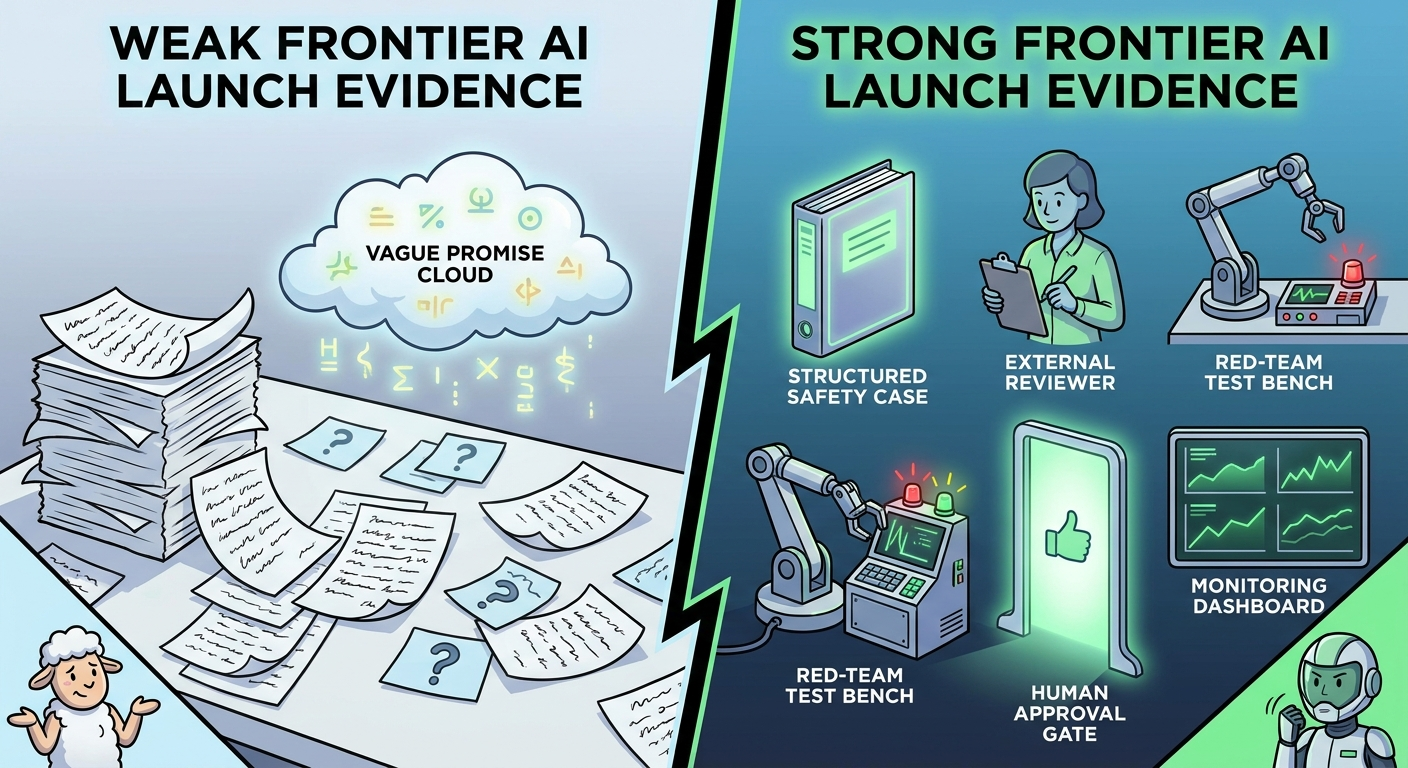
Signals of a strong review gate
- The claim is specific enough to approve, limit, or reject.
- Risk thresholds are written before launch pressure peaks.
- Evaluators can see failures, not only polished summaries.
- Safeguards are tested against the risks they claim to reduce.
- Decision-makers record conditions for rollout, pause, or re-evaluation.
Signals of a weak review gate
- “Safety reviewed” appears with no threat model or evidence trail.
- Benchmarks are cherry-picked and failure examples are hidden.
- External review is absent for severe-risk capability claims.
- Deployment limits are vague, temporary, or unenforced.
- No one can explain what evidence would stop the launch.
The strongest review gates also avoid binary thinking. The answer is not always “ship” or “cancel.” A review may approve an internal pilot, deny public release, require read-only tools, restrict high-risk domains, add monitoring, delay a launch until mitigations pass, or demand another external evaluation. Good governance gives decision-makers more options than public hype or private panic.
Common Mistakes in Frontier AI Safety Cases
The first mistake is treating a safety case as a compliance form. If the document is written after the deployment decision has already been made, it becomes a justification exercise. A real safety case should be capable of changing the decision. It should make people uncomfortable when evidence is thin, safeguards are untested, or risk thresholds are crossed.
The second mistake is confusing breadth with strength. A 100-page safety document can still be weak if it does not connect claims to evidence. Conversely, a shorter case can be strong if it clearly states the deployment claim, threat model, evaluation results, safeguard tests, review process, and monitoring triggers. The value is not page count. The value is traceability.
The third mistake is hiding uncertainty. Frontier AI evaluation is a moving target. Models may behave differently under distribution shift, tool use, multi-agent settings, adversarial prompts, or new jailbreak methods. A credible case should say where confidence is strong, where evidence is weak, and what post-release signals would reopen the decision. If every uncertainty is smoothed away, the case reads like marketing.
The fourth mistake is failing to test the safeguards. A team may list policies, filters, monitoring, rate limits, and approval steps, but the key question is whether those controls actually reduce the risk found in evaluations. If jailbreak testing shows bypasses, did mitigations improve resistance? If agent tests show unsafe tool calls, did permissioning and human approval reduce that failure mode? If security review finds sensitive access paths, were they closed? Safeguards without validation are promises.
The fifth mistake is ignoring the source-pillar threshold logic. If a model crosses a serious risk threshold but the safety case recommends the same deployment path as before, something is wrong. Thresholds should change the burden of proof. They should require stronger evidence, narrower deployment, additional review, or a pause. Otherwise, the threshold is decorative.
A Reader-Friendly Safety Case Checklist
Use this checklist when reading frontier AI announcements, model cards, system cards, safety frameworks, or policy claims. It will not tell you whether a model is safe. It will tell you whether the organization is making a serious evidence-based argument or asking for trust without enough structure.
| Question to ask | Weak answer | Stronger answer |
|---|---|---|
| What deployment is being justified? | “The model is safe.” | “The model is acceptable for limited API access without autonomous tool execution under these controls.” |
| Which risks are in scope? | “We considered safety broadly.” | Named domains such as cyber, bio/chemical, autonomy, persuasion, privacy, model security, and tool misuse. |
| What evidence supports the claim? | One benchmark or a general red-team statement. | Multiple evaluations, expert review, adversarial testing, safeguard validation, and documented limits. |
| What changed after failures? | Failures are not described. | Failures are summarized, mitigations are tested, and deployment conditions are adjusted. |
| Who reviewed the decision? | Only the product team or unnamed internal reviewers. | Relevant technical, safety, security, legal, leadership, and external reviewers where risk warrants it. |
| What would reopen the decision? | No clear trigger. | Incident thresholds, misuse patterns, eval regressions, safeguard bypass rates, or new capability signals. |
For Singularity Journey readers, this is the useful bridge between AI risk theory and deployment reality. The risk-threshold pillar explains when stronger safeguards should be triggered. This checklist explains what should happen next: build the case, test the safeguards, invite review, limit deployment, and keep watching for signals that change the decision.
Related Singularity Journey Guides
- AI Risk Thresholds Explained — the source pillar for this safety-case checklist.
- AI Capability Evaluations Explained — how frontier models are tested before release.
- AGI Warning Signs — capability signals that may deserve threshold review.
- AI Risk Register: NIST AI RMF Checklist — a practical risk register for AI systems.
- AI Guardrails Explained — the controls that help turn safety claims into operational safeguards.
Sources and References
- OpenAI: Our updated Preparedness Framework
- Anthropic: Responsible Scaling Policy
- NIST AI Risk Management Framework
- UK AI Security Institute: Advanced AI evaluations update
- International AI Safety Report
- METR: Model Evaluation and Threat Research
External references were checked for relevance and credibility. Broken, promotional, unrelated, or uncertain links were excluded.
FAQ: Frontier AI Safety Cases
What is a frontier AI safety case?
A frontier AI safety case is a structured argument that a powerful AI system is safe enough for a specific deployment because specific evidence supports the claim. It links risks, evaluations, safeguards, review authority, deployment limits, and monitoring triggers.
How is a safety case different from an AI risk threshold?
An AI risk threshold is a decision trigger. A safety case is the evidence dossier that explains whether the system can proceed after that trigger, under which safeguards, and with which limits.
What evidence should be included in an AI safety case?
Useful evidence includes capability evaluations, misuse testing, red-team results, safeguard validation, deployment limits, security controls, independent review, incident response plans, and post-release monitoring triggers.
Who should review a frontier AI safety case?
Review should include technical safety experts, security teams, product leaders, legal and policy specialists, senior decision-makers, and external evaluators when the risk is severe or domain-specific expertise is needed.
Can a safety case prove that an AI model is completely safe?
No. A safety case cannot prove zero risk. Its purpose is to make the evidence, assumptions, limits, uncertainties, and decision logic explicit enough to review and challenge.
Do smaller AI teams need safety cases?
Smaller teams can use a lightweight version. If an AI system uses tools, handles sensitive data, makes consequential decisions, or can take external actions, documenting claims, tests, safeguards, approval gates, and incident triggers is still valuable.
Conclusion: Safety Cases Turn Thresholds Into Accountability
Frontier AI governance should not depend on reassuring language alone. As systems become more capable, decision-makers need clear claims, credible evaluations, tested safeguards, review authority, deployment limits, and monitoring triggers. That is what a safety case provides. It turns “we think this is safe enough” into “here is the evidence, here are the limits, here is who reviewed it, and here is what would make us stop.”
The strongest safety cases will not eliminate uncertainty, but they will make uncertainty harder to ignore. They will show where evidence is strong, where safeguards are proven, where deployment must remain narrow, and where a pause is the responsible option. For readers watching the path toward more capable AI, that discipline is one of the clearest signs that an organization is treating frontier deployment as a serious public responsibility rather than a race to ship.
Next step: read the source pillar on AI risk thresholds, then use this safety-case checklist to evaluate the next frontier model launch announcement you see.
