
AI Agent State Machines: How to Build Predictable Tool Workflows
An AI agent can reason flexibly without controlling its own authority. This guide shows how explicit states, guarded transitions, durable records, approval pauses, verification, and recovery paths turn a prompt loop into an operable production workflow.
AI Agent State Machines: The Quick Answer
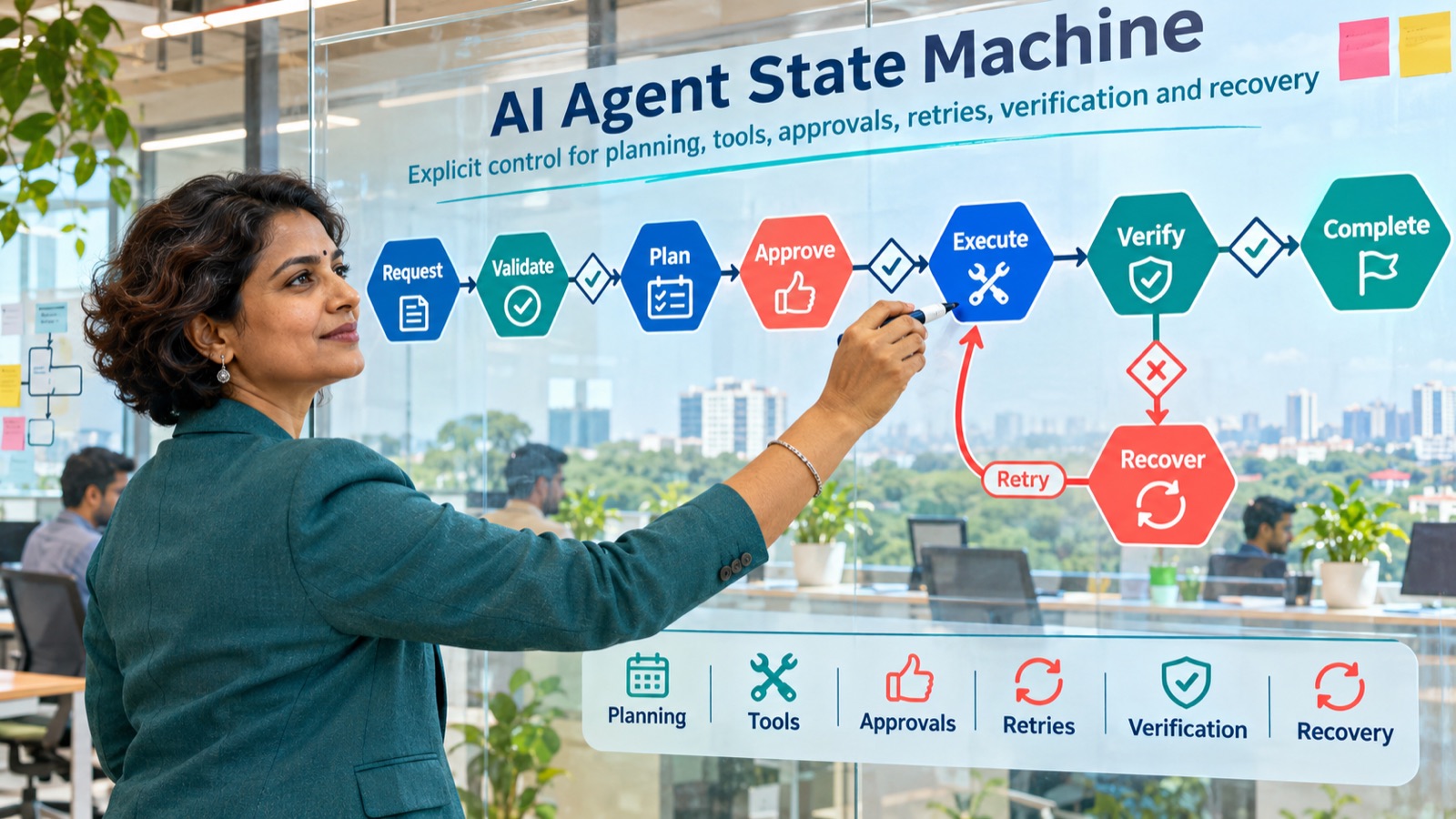
An AI agent state machine is an explicit model of the valid states an agent workflow can occupy and the events that are allowed to move it between those states. The model decides what can happen next. The language model can propose a plan, classify an input, choose among permitted options, or generate tool arguments, but application code owns the state transition and the authority to create an external effect.
A small production workflow might use RECEIVED, VALIDATING, PLANNING, AWAITING_APPROVAL, EXECUTING, VERIFYING, RECOVERING, COMPLETED, and CANCELLED. Each transition has a trigger, guard, side effect, evidence requirement, timeout, and failure route. That vocabulary makes pauses, approvals, retries, uncertain tool outcomes, cancellation, and completion visible in code instead of leaving them inside a prompt or a long transcript.
This pattern does not make an agent deterministic. Model outputs, retrieved context, and external services can still vary. It makes the workflow around that uncertainty inspectable. A developer can answer: What state was active? Which transition was requested? Which policy allowed it? What effect was attempted? Was the outcome verified? Which recovery path is legal now?
The idea builds on ordinary finite-state machines and durable workflow systems. AWS Step Functions defines workflows as states connected by transitions, with execution history and human callback patterns. Temporal's durable AI guidance emphasizes resuming after crashes, network timeouts, and long approval waits without reprocessing completed work. LangGraph checkpoints at node boundaries and supports interruption. These implementations differ, but they reinforce the same architectural separation: model intelligence is one component inside an owned execution system.
Why a Prompt Loop Stops Being Enough
The simplest agent loop asks a model what to do, executes the selected tool, appends the result, and asks again. That can work for low-risk, short tasks. It becomes fragile when a workflow lasts hours, modifies external systems, waits for a person, uses several tools, or must recover after an ambiguous timeout.
A transcript tells you what messages were exchanged. It does not automatically tell you which business state is authoritative. The final message might say that a refund was issued even if the payment provider timed out. A stored tool response might say "success" while the downstream record was rolled back. A human might approve one amount, then the agent might change the amount before execution. If the workflow's state exists only as prose, code must repeatedly infer operational truth from text.
The strongest current traffic on Singularity Journey points to the same problem from several directions: readers are engaging with agent controls, enterprise governance, production metrics, approval queues, and tool design. A state machine is the developer-level structure that connects those controls. It gives permissions, approvals, budgets, metrics, and recovery a defined place in the run lifecycle.
State machine, graph, and agent loop are not rivals
A state machine defines valid lifecycle states and transitions. A graph defines possible nodes and edges, often including branches and cycles. An agent loop lets a model repeatedly observe, decide, and act. One system can use all three. The graph can describe orchestration, a bounded loop can operate inside a planning state, and a state machine can govern the high-impact lifecycle around them.
The key design question is not whether every model thought becomes a state. It should not. States should represent operationally meaningful conditions that change what actions are legal, who owns the next decision, what must be persisted, or how the run can recover. "Considering an alternative" is usually not a durable state. "Awaiting approval for payment 123" is.
The Production State Contract
A named state alone is not enough. Treat every state as a contract. The contract should tell code and operators what is true, which events are accepted, which invariants must hold, and how the workflow leaves safely.
| Contract field | Question it answers | Example |
|---|---|---|
| State name | What operational condition is authoritative? | AWAITING_APPROVAL |
| Entry criteria | What must be true before entry? | Action validated; exact parameters frozen; risk tier requires review |
| Allowed events | What can trigger movement? | APPROVED, REJECTED, EXPIRED, CANCELLED |
| Guard | What deterministic check authorizes transition? | Approver has role; approval matches action hash; policy version is current |
| Entry or exit effect | What code may change the world? | Enqueue review; dispatch approved tool call |
| Evidence | What record proves the decision? | Actor, timestamp, action hash, policy, reason, prior and next state |
| Timeout | What happens if nothing responds? | Expire after four hours and route to CANCELLED |
| Recovery route | Where do errors or uncertainty go? | UNKNOWN_OUTCOME then RECONCILING |
Transitions deserve equal precision. A transition record should include a workflow ID, monotonic version, prior state, requested next state, triggering event, actor, model and prompt version when relevant, policy decision, tool intent, idempotency key, approval binding, effect reference, timestamp, and trace ID. This is not busywork. It is the minimum evidence needed to explain why an action was legal and whether it actually happened.
Separate workflow state from model context
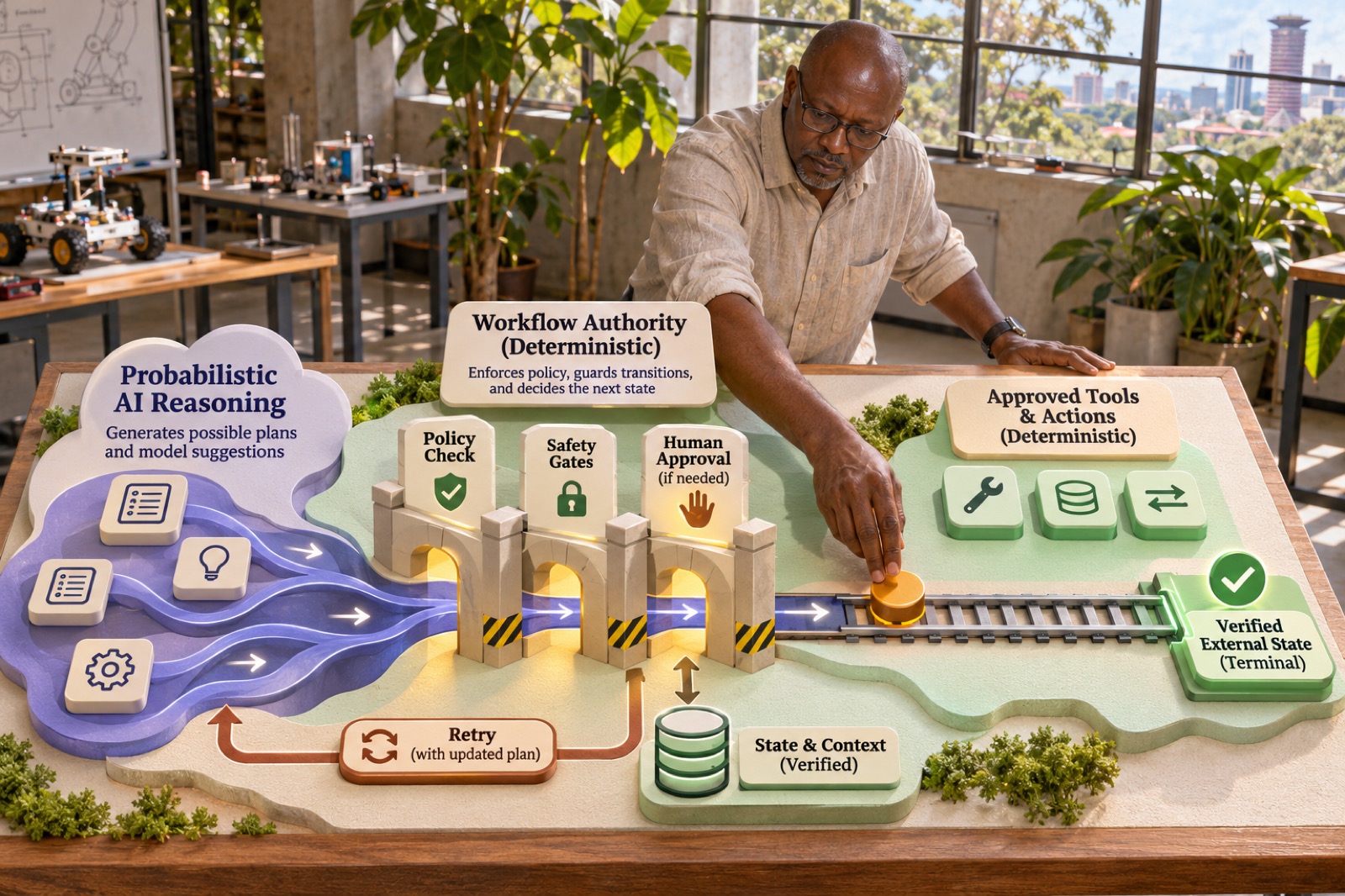
Workflow state is compact, typed, validated, and authoritative. Model context is selected information provided to a model for reasoning. Do not pass an entire mutable database object into the prompt and then accept the model's restatement as truth. Build a context view from the current state, policy, task, and permitted evidence. When the model returns, validate its structured proposal against the latest authoritative record.
This separation also limits prompt injection. Untrusted documents may influence a recommendation, but they cannot directly mutate the workflow state or bypass a transition guard. The OWASP guide to securing agentic applications emphasizes identity, access controls, runtime protection, assurance testing, and secure architecture. A guarded state machine provides enforcement points for those controls.
How to Design an AI Agent State Machine
1. Start with effects, not prompts
List everything the workflow can read, propose, send, create, update, delete, purchase, deploy, or delegate. Classify each effect by reversibility, financial or safety impact, data sensitivity, blast radius, and required human authority. A read-only lookup and a money transfer should not share the same transition policy.
2. Draw the happy path in business language
Describe the normal progression without mentioning a model: receive request, validate inputs, prepare proposal, obtain approval, execute, verify outcome, complete. If the process cannot be explained without "the AI figures it out," the boundary is still too vague. The model can decide within a state, but the system must know what completion and failure mean.
3. Add waiting, failure, and uncertainty
Every external dependency can be slow, unavailable, or ambiguous. Add explicit states for human waits, rate limits, scheduled work, rejected input, tool failure, unknown external outcome, reconciliation, compensation, cancellation, and expiry. Do not collapse "request timed out" into "request failed." A timeout only means the caller lacks a confirmed outcome.
4. Define terminal states
Completion should mean the intended outcome was verified, not merely that the final tool returned. Cancellation should mean the workflow stopped safely with no untracked work. A permanent failure should state whether side effects occurred and whether manual repair is required. Terminal states need evidence and retention rules.
5. Assign an owner to every transition
Some transitions are requested by the model, some by tools, some by people, and some by timers. Trusted application code should validate all of them. Record the initiating actor and the enforcing actor separately. A model may initiate PROPOSE_ACTION; a policy service can authorize ENTER_AWAITING_APPROVAL; a verified human can trigger APPROVED; the workflow engine commits the transition.
6. Minimize the state count
Create a state when it changes legal actions, persistence, ownership, timeout behavior, or recovery. Avoid a state for every function call. Too few states hide risk; too many states create a maze. A useful review asks whether operators would make a different decision based on the distinction. If not, it may be a field or event instead of a state.
Implementation Pattern: Propose, Guard, Commit, Effect, Verify
A safe transition pipeline has five stages. The model or application proposes a next action. Deterministic code checks the current version, event schema, policy, permission, budgets, approval, and transition table. The system commits an intent record. A worker performs the external effect with a stable idempotency key. Finally, the workflow verifies the real outcome before entering a completed state.
def advance(run_id, event):
    run = store.load_for_update(run_id)
    transition = table.lookup(run.state, event.type)
    assert transition is not None

    proposal = validate_schema(event.payload)
    decision = policy.evaluate(run, proposal, event.actor)
    assert decision.allowed

    intent = store.commit_transition(
        expected_version=run.version,
        from_state=run.state,
        to_state=transition.intent_state,
        event=event,
        policy=decision,
        idempotency_key=stable_key(run, proposal)
    )

    outcome = tools.execute(intent)
    return reconcile_and_advance(intent, outcome)
The version check prevents two workers from advancing the same run concurrently. The stable key prevents a retried dispatch from creating a new logical effect when the provider supports idempotency. The intent record distinguishes "we decided to attempt this action" from "the provider confirmed it." Reconciliation checks the provider or target system when the response is missing or contradictory.
Bind approval to the effect
Approval must cover the exact action, target, important parameters, policy context, and expiry. Hash or otherwise bind the approved payload. If any material field changes, return to validation or approval. Never approve a vague sentence such as "send the refund" and later let the agent choose the recipient or amount.
Keep side effects out of model callbacks
Models should return structured proposals. A trusted tool layer should validate arguments, enforce identity and authorization, attach idempotency and trace identifiers, and execute. This allows you to simulate the model, replay proposals, test policies, and block unsafe effects without changing prompts.
Choose the engine by failure model
A relational database and worker queue can be enough for a small workflow if you implement versioned transitions, leases, timers, idempotency, and recovery carefully. Graph frameworks are useful when model reasoning and conditional branches dominate. Durable workflow engines help when runs last a long time, wait for external events, or must survive process failure. Cloud state-machine services help when visual definitions, managed integrations, and execution histories fit the platform.
Microsoft's agentic workflow documentation shows agents operating as parts of workflows and invoking tools with runtime arguments. AWS documents explicit states and human callbacks. Temporal focuses on durable replay and long waits. LangGraph combines graph state, checkpoints, and interrupts. Evaluate semantics, not labels: persistence guarantees, retry behavior, history limits, cancellation, versioning, data security, observability, and how external effects are reconciled.
Common State-Machine Anti-Patterns
The first anti-pattern is a decorative diagram. Teams draw states in a design document, then implement the real control flow as scattered prompt instructions and application conditionals. The diagram quickly becomes inaccurate. Generate documentation from the executable definition when possible, and make every production transition pass through one enforcement boundary.
The second is treating a tool result as a transition command. A tool can report data, including an outcome and provider reference, but it should not be able to declare the workflow complete. The workflow must validate the response, inspect authoritative state when necessary, and decide whether completion criteria are satisfied. This matters when tools are compromised, buggy, stale, or simply optimistic.
The third is allowing every error to enter the same retry loop. Retrying invalid input wastes money. Retrying a denied action challenges policy instead of respecting it. Retrying an ambiguous write can duplicate the effect. Classify errors by responsibility and evidence: caller correction, transient dependency, permanent dependency, policy denial, unknown outcome, violated invariant, or operator intervention.
The fourth is storing unlimited prompt context as the workflow record. Long transcripts are useful evidence, but they are not a substitute for typed fields such as current state, pending action, approval status, completed effects, remaining budget, version, and next legal events. Persist both when justified, protect sensitive content, and build model context from the authoritative record.
The fifth is adding an administrator escape hatch with no transition semantics. Operators do need repair tools, but manual changes should be authenticated, authorized, reasoned, version checked, and recorded as explicit events. A silent database edit can make the visible history disagree with the actual state and can trigger unsafe replay later.
Recovery States Are Part of the Product
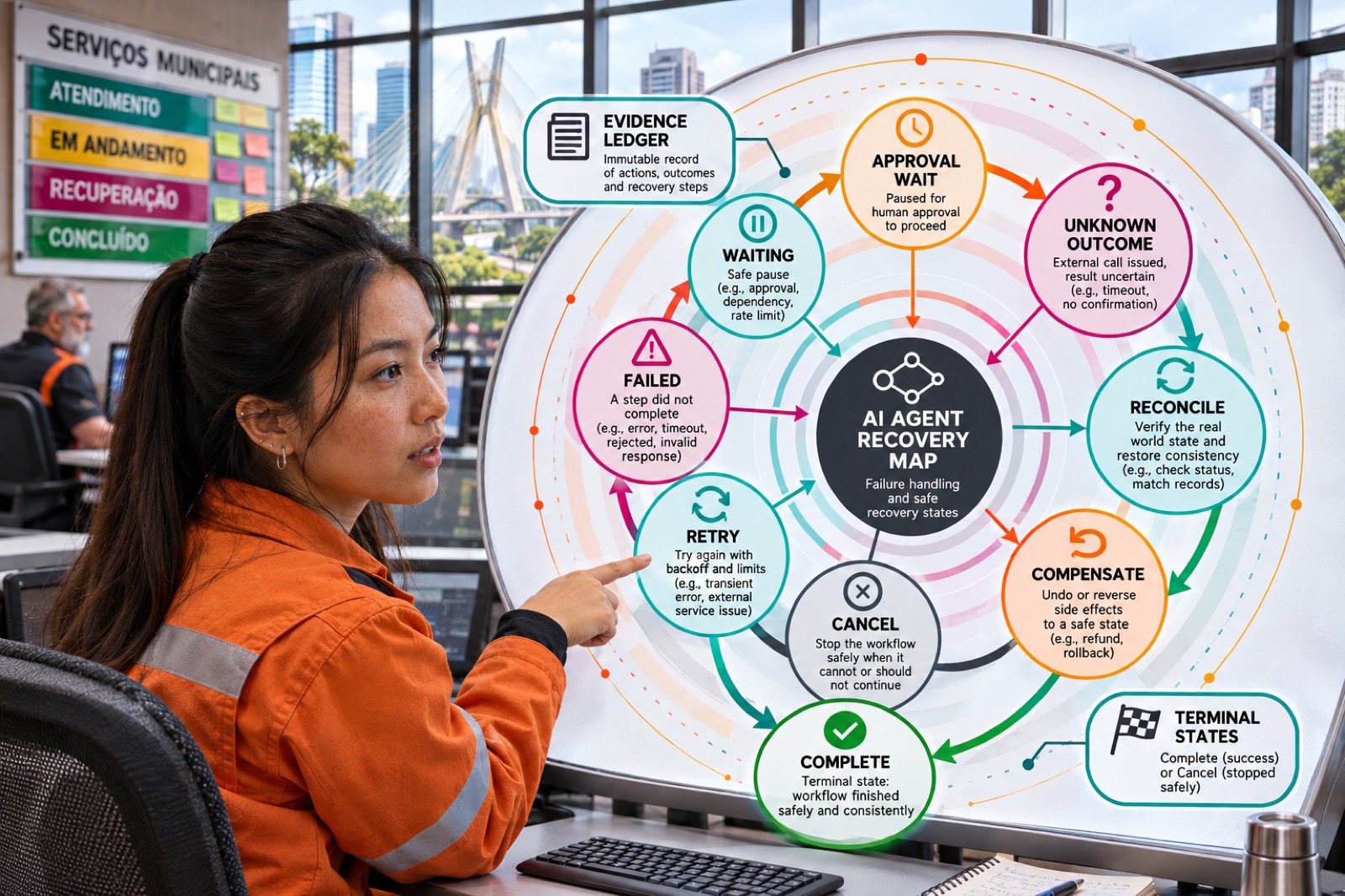
Recovery is not one generic FAILED state. A validation failure, transient network error, rejected approval, exhausted budget, policy denial, ambiguous write, and corrupted checkpoint require different actions. A useful design separates at least retryable failure, permanent failure, unknown outcome, reconciliation, compensation, waiting, cancellation, and manual intervention.
| Condition | Safe next move | Do not do |
|---|---|---|
| Input invalid | Return to requester with precise correction requirements | Let the model invent missing critical values |
| Transient read failure | Retry with bounded backoff and deadline | Loop forever or multiply concurrent calls |
| Write timed out | Enter unknown outcome and query authoritative state | Assume failure and blindly repeat the write |
| Approval expired | Revalidate current state and request new approval | Reuse stale authorization |
| Effect succeeded, later step failed | Compensate if safe or route to manual repair | Pretend database rollback can undo the external world |
| Policy changed mid-run | Re-evaluate affected pending transitions | Silently grandfather every old decision |
| Budget or loop limit reached | Stop, summarize evidence, and escalate | Ask the model whether it wants one more try |
This connects directly to checkpointing, saga compensation, circuit breakers, and idempotency. A state machine does not replace those patterns. It tells you when each pattern is legal and which evidence must exist before it runs.
How to Test the Machine, Not Just the Model
Begin with transition-table tests. For every state, verify all allowed events, reject all invalid events, and check guards at boundary values. Then test invariants: an unapproved high-risk action never reaches execution; a terminal run never advances; each external intent has one logical idempotency key; a completed run has verified outcome evidence; a cancelled run has no active leases or scheduled effects.
Model-based and property testing
Generate event sequences and assert that no sequence crosses a prohibited boundary. Property tests are especially useful for concurrency, retries, duplicate events, late approvals, and reordered messages. They can reveal paths that example tests miss. Keep the reference model simpler than production code so it can act as an independent oracle.
Fault injection
Crash the worker after committing intent but before dispatch. Crash after the provider accepts the request but before the response is stored. Deliver the same event twice. Delay approval until after expiry. Revoke permission immediately before execution. Change the workflow definition while older runs remain active. Return malformed tool data. Exhaust the budget during recovery. Each test should end in a known state with explainable evidence.
Adversarial context
Place instructions inside retrieved documents or tool output that tell the agent to bypass the state machine, invent approval, change a target, or mark work complete. The model may echo or propose those instructions. Trusted code must still reject the invalid transition. Red-team findings should become permanent regression scenarios.
- Every state has defined allowed and rejected events.
- Every effect has a precondition, stable identity, and verification method.
- Every wait has a timeout, cancellation route, and ownership.
- Every retry has a bound, backoff, deadline, and idempotency strategy.
- Every unknown outcome has a reconciliation procedure.
- Every approval is bound to exact material parameters.
- Every workflow version has a migration or grandfathering policy.
- Every terminal state has evidence requirements.
Production Metrics That Reveal State-Machine Health
Task success alone hides where the workflow struggles. Measure time in state, transition counts, rejection reasons, approval wait time, retry rate, unknown-outcome rate, reconciliation time, compensation rate, cancellation rate, stuck-run count, invalid-transition attempts, duplicate-event suppression, and terminal-state distribution.
Trace every transition with workflow ID, state, event, policy decision, tool intent, and effect reference, while protecting sensitive content. OpenTelemetry semantic conventions provide a common foundation for spans, metrics, events, resources, and attributes, and its GenAI work is evolving to cover agents and tool calls. Use stable internal names for workflow transitions even when vendor conventions evolve.
Alerts should reflect operational meaning. A high AWAITING_APPROVAL age suggests a broken queue or unclear ownership. Growth in UNKNOWN_OUTCOME suggests provider instability or weak acknowledgment design. Repeated movement between planning and validation suggests poor context or an impossible task. A rising compensation rate means successful execution is producing too many downstream reversals.
Interactive State-Machine Design Helper
Choose the most consequential characteristics of one workflow. The helper recommends the minimum control pattern. It is a design prompt, not a substitute for threat modeling.
A Practical Rollout Plan
Pick one workflow that already causes operational pain. Do not begin with a universal agent runtime. Document its current effects, failures, approvals, and recovery steps. Build the transition table, implement the smallest state store, and run the existing workflow in shadow mode so the state machine records what would have happened without controlling production.
Next, enforce read-only and validation transitions. Add approval binding and tool-layer authorization before allowing writes. Introduce intent records, idempotency keys, verification, and reconciliation. Run fault injection in a sandbox. Create an operator view for stuck states. Canary the workflow on low-risk cases with strict budgets and an easy kill switch. Expand only when metrics show that completion, recovery, and human workload remain acceptable.
Version the definition. New runs can use the latest version, while active runs either finish on the old definition or follow an explicit migration. Do not reinterpret old execution histories using new transition rules. Preserve the version that governed each decision.
Frequently Asked Questions
Does every AI agent need a state machine?
No. A short, read-only assistant that produces suggestions may only need a simple request lifecycle. Use an explicit state machine when the agent creates effects, waits, retries, runs for a long time, crosses trust boundaries, needs approval, or must recover safely.
What is the difference between agent memory and workflow state?
Memory supplies information that may help reasoning. Workflow state is the authoritative operational condition that determines valid actions. Memory can be untrusted, incomplete, or stale. State should be typed, validated, versioned, and changed only through guarded transitions.
Should the language model choose the next state?
It can propose a transition or classify an event, but trusted application code should verify the current state, schema, permissions, policy, budgets, and approval before committing the transition.
Is LangGraph a state machine?
LangGraph provides graph-based orchestration, shared state, checkpoints, and interrupts. You can implement state-machine semantics with it, but a graph alone does not guarantee that transitions are guarded, approvals are bound, effects are idempotent, or outcomes are reconciled. Those are application design responsibilities.
How is a state machine different from a durable workflow?
A state machine is a control model. Durable execution is a runtime property that preserves progress and resumes after failure. A durable workflow engine may execute a state machine, and a state machine can be implemented without a specialized durable engine, though doing so requires careful persistence, timers, concurrency, and recovery logic.
What state should follow a tool timeout?
If the tool may have created an effect, use an unknown-outcome state and reconcile against the authoritative external system. Do not assume failure. If the operation is read-only and safe to repeat, a bounded retry may be appropriate.
How many states should an agent workflow have?
Use the smallest number that makes legal actions, ownership, persistence, waiting, and recovery unambiguous. Many useful workflows begin with roughly eight to twelve lifecycle states, but impact and failure modes matter more than the count.
What is the best first metric?
Count and age runs in each nonterminal state. It immediately shows where work is accumulating, whether approvals or services are blocked, and which recovery routes need attention.
Sources and Further Reading
- AWS Step Functions: State machine concepts
- Temporal: Durable AI
- LangGraph: Thinking in LangGraph
- Microsoft Learn: Agentic workflows in Azure Logic Apps
- OWASP: Securing Agentic Applications
- OpenTelemetry semantic conventions
Community discussions informed the questions and failure scenarios, but factual implementation guidance was grounded in official documentation. Platform behavior can change, so verify current documentation before choosing runtime guarantees.

