
AI Agent Saga Pattern: How to Roll Back Multi-Step Tool Workflows Safely
The AI agent saga pattern gives tool-using systems a disciplined recovery path when a workflow changes several external systems and then fails halfway through. This guide shows how to define compensations, pivot points, durable receipts, idempotent retries, human approvals, and recovery tests without trusting the model to improvise an undo plan.

AI Agent Saga Pattern: The Quick Answer
An AI agent saga pattern is a reliability design for long-running, multi-step agent workflows that cannot be protected by one database transaction. Each successful external action is recorded as a durable step. If a later step fails, a deterministic orchestrator runs predefined compensating actions to bring the overall business process back to an acceptable state.
Suppose an agent plans a customer trip. It reserves a flight, holds a hotel room, charges a card, and sends an itinerary. If the hotel confirmation fails after the payment succeeds, “roll back everything” is not a real database command. The workflow may need to release the flight hold, refund or void the payment, mark the task as partially recovered, and ask a human what to do about any irreversible message already sent. A saga makes those decisions explicit before the incident occurs.
The saga pattern comes from distributed systems. Microsoft’s Azure architecture guidance defines a saga as a sequence of local transactions, with compensating transactions used when a later step fails. For AI agents, the same pattern matters because tool calls cross boundaries: payment APIs, CRM records, cloud infrastructure, email systems, calendars, and internal databases do not share one atomic commit.
Why Tool-Using AI Agents Need Compensation, Not Magical Rollback
Traditional application code can fail halfway through a distributed workflow. Agents add more uncertainty. The model can replan, call a tool twice, choose a slightly different argument on retry, resume from stale context, or misunderstand an ambiguous timeout. None of those behaviors are fixed by a better system prompt alone.
A database rollback works only while changes remain inside the same transaction boundary. Once an agent creates a calendar event, captures a payment, opens a support ticket, sends a message, or starts a deployment, the effects have escaped. Some can be reversed by another API call. Some can only be offset by a new action. Others are irreversible. A sent email cannot be unsent in the general case; a public announcement may be deleted, but recipients may already have copied it.
That distinction is why “rollback” can be misleading. A compensating action creates a new fact: refund a payment, release a reservation, close a ticket, restore an earlier configuration, or send a correction. The system does not erase history. It moves the workflow toward a valid business state while preserving an audit trail.
The risk is especially high after an ambiguous failure. The tool may complete its side effect but lose the response. From the agent’s perspective, the call failed. Retrying could duplicate the action; giving up could abandon required work. AWS’s guidance on making retries safe with idempotent APIs explains why caller-provided request identifiers are so useful: the receiver can recognize repeated intent and return a semantically equivalent result.
Recent research makes the agent-specific problem harder to dismiss. The preprint Where Does Exactly-Once Live? evaluates duplicate side effects under faults such as late commits and redelivery. Its findings support a practical conclusion: model reasoning can help when an outcome is immediately observable, but ambiguous in-flight operations require a stronger tool contract. Treat that paper as emerging evidence rather than settled consensus, but its architectural lesson matches decades of distributed-systems practice.
This article extends the ideas in our guides to durable AI agent workflows and AI agent idempotency. Idempotency prevents a repeated step from producing another copy of the same effect. A saga coordinates what to do when several different steps have already succeeded and the workflow as a whole can no longer complete normally.
Anatomy of an AI Agent Saga
A production saga needs more than an array of functions with matching “undo” callbacks. It needs a durable definition of intent, a state machine, reliable operation identifiers, forward and compensating contracts, stored results, and a policy for ambiguous or irreversible outcomes.
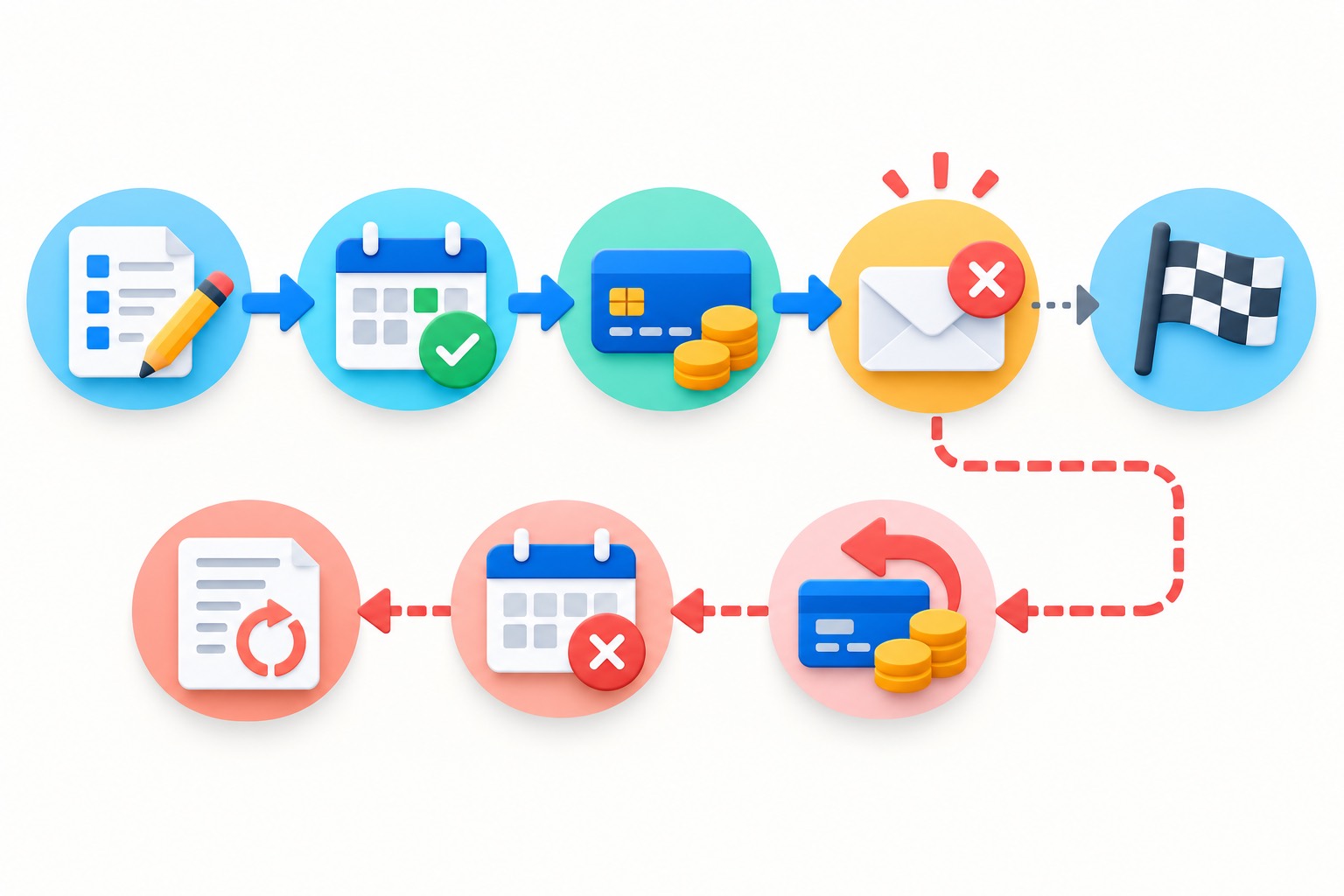
Forward steps create durable receipts. On failure, the orchestrator walks an explicit compensation path instead of asking the model to invent one.
1. Stable workflow intent
Assign the overall business operation a durable workflow_id. Store the user’s approved goal, the plan version, policy context, actor, tenant, and relevant authorization. The identifier must survive process restarts and model retries. A conversational turn ID is rarely enough because the agent may fork, resume, or replan.
2. Deterministic step identities
Each logical effect receives a step_id that stays stable across attempts. An idempotency key should usually be derived from the intended occurrence—such as workflow_id + step_id + operation_version—rather than generated anew for every network call. A fresh UUID per attempt defeats deduplication because the downstream service sees every retry as new work.
3. Forward operation contract
The forward contract names the tool, validates its arguments, defines timeouts and retryable errors, declares preconditions, and states what counts as confirmed success. It also specifies how to reconcile an ambiguous result. For example, after a payment timeout the workflow might query by idempotency key rather than submit another charge.
4. Compensation contract
Every compensable forward step declares an inverse business operation before execution. The contract includes the compensation tool, required receipt fields, authorization, deadline, retry policy, and expected postcondition. “Ask the model how to undo this later” is not a contract.
5. Durable saga journal
The journal records proposed, started, succeeded, failed, ambiguous, compensating, compensated, and manually resolved states. It stores tool request hashes, downstream request IDs, receipts, timestamps, model and prompt versions, approval evidence, and error classes. This is both recovery state and an audit artifact.
6. Orchestrator-owned transition logic
The orchestrator advances the state machine. It can call an LLM to interpret unstructured input or suggest a plan, but the transition from “charge confirmed” to “send message allowed” should be code and policy. The orchestrator also chooses between retry, reconcile, compensate, pause, or escalate based on declared rules.
7. Recovery worker and operator queue
Compensation must survive the crash that triggered it. A background worker resumes incomplete reversals, while an operator queue handles cases that cannot be safely automated. Microsoft’s compensating transaction guidance emphasizes that compensation itself can fail and should record progress so recovery can resume.
Classify Tool Actions Before You Build the Saga
Not every tool call belongs in a compensation stack. Read-only queries can usually be repeated. Local database changes may fit one transaction. External mutations need closer analysis. The most useful design exercise is to classify every action by its semantics rather than by its endpoint name.

| Action class | Example | Preferred treatment | Important caveat |
|---|---|---|---|
| Read-only | Fetch account status | Retry with bounded backoff; cache if safe | Reads can still be stale or expensive. |
| Naturally idempotent | Set ticket priority to “high” | Repeat the same assignment | Validate version or precondition to avoid overwriting newer state. |
| Idempotent by key | Create an invoice | Send the same stable key on every retry | Key scope and retention must match the business operation. |
| Compensable | Reserve inventory | Store receipt, then release the same reservation if needed | Compensation may have a deadline or fee. |
| Offsettable | Capture a payment | Create a refund or reversal as a new action | The audit trail remains; exact restoration may be impossible. |
| Irreversible | Send email or publish an announcement | Move late in the workflow; gate with approval; prepare correction | Deletion does not guarantee recipients never saw it. |
| Pivot | Finalize a legally binding submission | Place after compensable steps and before retryable completion steps | After the pivot, finish forward or escalate; do not pretend a full rollback exists. |
A pivot is the point of no return. Azure’s saga guidance separates compensable transactions, pivot transactions, and retryable transactions. That taxonomy is valuable for agents because it forces a question product teams often postpone: after which action can the workflow no longer return to the original state?
Move irreversible actions as late as possible. Before the pivot, prefer holds, drafts, previews, and reversible reservations. After the pivot, use operations that can be retried safely until completion. If a customer email must be sent, consider generating a draft first, validating it, obtaining approval for high-impact cases, committing the core transaction, and only then sending the message.
How to Design Forward and Compensating Steps
Begin with the business invariant, not the tool list. “All APIs returned 200” is not an invariant. “The customer has either a confirmed trip and one valid charge, or no reservations and no net charge” is closer. The invariant tells you what recovery must achieve.
Define the operation identity outside the model
The model can propose “reserve this hotel,” but deterministic code should mint the stable operation identity. Store a canonical payload hash beside the key. If a later attempt uses the same key with different parameters, fail loudly. Stripe’s idempotent request contract demonstrates this mature pattern: retries with the same key return the stored result, while parameter mismatch is rejected rather than silently treated as the same operation.
Persist intent before execution
Write a saga-step record before invoking an external tool. That record should include the intended effect, canonical arguments, idempotency key, expected postcondition, and compensation definition. Without a durable intent record, a crash can leave an external action with no local evidence that it was attempted.
Record the receipt, not only “success”
A boolean cannot power a safe compensation. Store the downstream resource ID, version, status, idempotency response, and any fields needed for reversal. If the agent reserved room R-812, compensation should release that exact reservation, not ask the model to search for “the likely room booking.”
Separate technical retry from business compensation
A transient timeout should usually trigger reconciliation or retry, not immediately unwind the whole saga. A definitive business rejection—such as inventory unavailable—may start compensation. A permanent authorization error may require a human. Write this taxonomy into the step contract.
Make compensations idempotent too
Recovery workers retry. Operators click buttons twice. Queues redeliver messages. Therefore the refund, release, delete, restore, and correction operations need their own stable keys and durable state. A saga that deduplicates forward steps but duplicates refunds is not safe.
Use preconditions to protect newer state
Restoring an old value can destroy a legitimate update made after the saga began. Include entity versions, timestamps, ETags, or domain-specific preconditions. If the target state changed, stop automatic compensation and request review. Compensation is a business operation in a live system, not a time machine.
Step-by-Step AI Agent Saga Implementation
The following design is framework-neutral. You can implement it with a durable workflow engine, a queue plus database, or an existing orchestration platform. The important part is the contract, not the brand.
Step 1: Build a saga definition
Declare each forward step, its compensation, its classification, retry policy, and pivot status. Keep prompts out of the critical transition logic. If the model helps assemble a plan, validate that plan against an allowlisted workflow schema before execution.
saga = SagaDefinition(
  name="customer_trip",
  version=3,
  steps=[
    Step("hold_flight", do=hold_flight,
         compensate=release_flight, semantics="compensable"),
    Step("hold_hotel", do=hold_hotel,
         compensate=release_hotel, semantics="compensable"),
    Step("capture_payment", do=capture_payment,
         compensate=refund_payment, semantics="offsettable",
         approval="required_above_limit"),
    Step("send_itinerary", do=send_itinerary,
         compensate=send_correction, semantics="irreversible", pivot=True)
  ]
)
Step 2: Create durable workflow and step records
A practical schema needs a workflow table and a step journal. The workflow record stores the approved goal, state, plan version, current cursor, and policy snapshot. Each step stores the operation key, payload hash, attempt count, state, receipt, error, and compensation state. Use a unique constraint on tenant, workflow, step, and operation version.
workflow(id, tenant_id, definition, version, state,
         current_step, approved_plan_hash, created_at, updated_at)

step_run(workflow_id, step_id, operation_key, payload_hash,
         state, attempt_count, receipt_json, error_class,
         compensation_key, compensation_state, updated_at)

UNIQUE(tenant_id, workflow_id, step_id, operation_key)
Step 3: Execute with compare-and-set transitions
Workers should claim a step atomically. Only a record in an eligible state can move to RUNNING. If two workers race, one wins and the other observes the existing lease or result. After the tool returns, persist the receipt and state transition together where possible.
Step 4: Reconcile ambiguous outcomes
If a call times out after dispatch, mark it UNKNOWN, not FAILED. Run a deterministic reconciliation query using the idempotency key or downstream request ID. If the effect exists, store the receipt and continue. If the service confirms absence, retry. If neither answer is reliable, pause and escalate.
Step 5: Start compensation from durable history
When a permanent failure occurs before the pivot, freeze forward execution and select completed compensable steps. Reverse order is a useful default because later actions often depend on earlier ones, but it is not universal. Microsoft notes that compensating work may not need to run in exact reverse order and may sometimes run in parallel. Encode dependencies rather than assuming a stack is always correct.
Step 6: Finish in an honest terminal state
Useful terminal states include COMPLETED, COMPENSATED, PARTIALLY_COMPENSATED, COMMITTED_WITH_REPAIR, and MANUAL_INTERVENTION. Avoid calling every recovered saga “rolled back.” The final state should tell operators and downstream systems what actually happened.
Dapr’s workflow patterns documentation provides a concrete compensation example, while AWS’s agentic pattern guidance usefully distinguishes reasoning-oriented prompt chaining from transaction-oriented sagas. The two can coexist: an LLM may refine a plan, while the saga protects external effects.
Failure Modes the Saga Must Handle
The happy path is the least interesting test. A production design must specify what happens when every boundary fails before, during, and after an effect.
| Failure | Unsafe reaction | Safer recovery |
|---|---|---|
| Timeout before request reaches provider | Assume success or abandon silently | Reconcile by key; retry only when absence is confirmed or the endpoint is idempotent. |
| Timeout after provider commits | Generate a new key and retry | Reuse the original key or query the original operation receipt. |
| Worker crashes after external success but before local receipt | Re-run from conversational memory | Recover from persisted intent and downstream reconciliation. |
| Model replans the same business action as a new step | Trust the new tool-call ID | Map plan actions to stable business operation identities and detect semantic duplicates. |
| Compensation times out | Mark the saga fixed | Record compensation as unknown, reconcile, and retry with its stable compensation key. |
| Target changed after forward step | Overwrite with stale previous value | Use version preconditions; pause when concurrent state invalidates the inverse. |
| Irreversible action already occurred | Pretend deletion restores the past | Execute a correction or containment plan and record residual impact. |
| Authorization expires during recovery | Reuse old authority indefinitely | Pause, request renewed approval, and preserve the recovery context. |
Retry storms deserve special attention. The model, SDK, queue, workflow engine, and downstream client can each have their own retry loop. Three attempts at four layers can multiply into far more calls than anyone intended. Assign retry ownership to one layer where possible, expose attempt counts end to end, use exponential backoff with jitter, and set a retry budget. Our guide to agentic AI stop conditions explains how time, cost, and action limits prevent a degraded dependency from turning into a runaway agent.
Compensation can also cause harm if it is automatic by default. A refund may trigger fraud checks, a cloud teardown may delete evidence, and a ticket deletion may violate record-retention rules. Use risk-based gates. Low-impact reversible actions can compensate automatically; high-impact, financial, regulated, or public actions should pause for approval.
Finally, do not confuse an LLM’s confident narrative with system truth. The agent may say “I refunded the customer” because it intended to call the tool. Only a verified tool receipt and observed postcondition should advance the saga.
Where Human Approval Belongs
Human approval is most valuable at decision boundaries, not sprinkled over every harmless read. Place it before irreversible pivots, before high-value compensations, when reconciliation cannot determine what happened, when preconditions fail, and when recovery would violate the original user’s scope.
The approval request should present structured evidence: intended action, affected resource, forward receipt, reason for compensation, expected result, residual risk, deadline, and alternatives. Do not ask an operator to approve an opaque sentence generated by the model.
Approval itself must be durable and replay-resistant. Bind the approval to the workflow ID, step ID, action hash, amount or resource scope, approver identity, and expiry. If the payload changes, request a new approval. Our guide on human approval for AI agents provides deeper patterns for review and escalation.
How to Test an AI Agent Saga
Unit tests of individual tool wrappers are necessary but insufficient. You need fault injection across the exact boundaries that create ambiguity. A useful test suite treats the workflow as a state machine and asserts both the final business invariant and the journal history.
Build a failure matrix
For every step, inject failure before dispatch, during dispatch, after the downstream commit, after response receipt, before local persistence, and during compensation. Add delayed responses, duplicate deliveries, out-of-order messages, stale reads, authorization expiry, and concurrent edits.
Test replay with changed models and prompts
Recovery must not require the original model to reproduce the original plan. Restart the workflow with a different model version, changed prompt, or no model at all. The stored saga definition and journal should still be sufficient to complete or compensate deterministic steps.
Assert no duplicate net effects
Count business effects, not only tool invocations. Two HTTP calls may be acceptable if the downstream idempotency contract produces one reservation. One tool invocation may still produce multiple effects if the tool implementation is faulty. Validate the external ledger.
Test compensations as first-class operations
Compensation code often receives less traffic and therefore less real-world testing. Run it continuously in staging. Verify that it is idempotent, authorized, observable, and safe when called after a delay. Include cases where the inverse succeeds but the acknowledgement is lost.
Exercise manual recovery
Create a deliberate MANUAL_INTERVENTION case. Confirm that the operator sees enough evidence, that an approval resumes the correct version of the action, and that a second click cannot repeat the effect.
Use golden failure scenarios alongside normal agent evaluations. The article AI Agent Test Cases shows how to turn critical workflows into repeatable datasets and rubrics rather than relying on occasional manual demos.
Observability and Metrics for Saga Recovery
A saga is only operationally useful if teams can explain where it is, what it changed, and what remains unresolved. Trace IDs should connect the user request, model decision, workflow, step, tool call, downstream request, compensation, and approval.
Track completion rate, compensation rate, partial-compensation rate, manual-intervention rate, duplicate-effect incidents, ambiguous-outcome rate, reconciliation success, forward and compensation latency, retry amplification, stuck-saga age, and time to restore the business invariant. Segment by workflow definition and tool because one unreliable integration can hide inside an acceptable global average.
Logs should record state transitions and hashes, not secrets or raw sensitive content by default. Redact credentials and minimize personal data. Store enough structured context to investigate incidents without turning the saga journal into a shadow data warehouse.
Alerts should focus on business risk: a payment saga stuck after capture, a compensation repeatedly failing, an irreversible action executed before approval, or a growing queue of unresolved ambiguous outcomes. A low-level 500 error is useful, but “twelve customers have an active charge and no confirmed reservation” is the alert that drives action.
Integrate these signals with the practices in AI agent observability and the AI agent incident response runbook. Saga state is one of the most valuable pieces of incident evidence because it connects model decisions with verified external effects.
When Not to Use the Saga Pattern
Sagas add durable state, compensation code, monitoring, and operational burden. Do not use one when a simpler boundary solves the problem.
If all writes are in one database, use a normal transaction. If the workflow is read-only, use bounded retries and caching. If a single external write already supports a strong idempotency contract, a durable job record plus reconciliation may be enough. If the task is short, low impact, and safely restartable, a full compensation engine may be unnecessary.
A saga is also a poor fit when the business cannot define an acceptable compensation. In that case, redesign the product flow: use previews, holds, drafts, approval gates, delayed publication, or a single authoritative service. Architecture should reduce the number of irreversible effects rather than merely document them.
Conversely, use a saga when an agent coordinates two or more independently committed systems, partial success creates material inconsistency, the workflow may outlive one process, and compensations can be defined and audited. That is common in travel, commerce, finance operations, CRM automation, infrastructure changes, onboarding, and support workflows.
Production Readiness Checklist
Before deployment, run this checklist alongside the AI agent deployment pipeline. Start with shadow execution or a sandbox, then canary the workflow with low-value operations. Treat a new compensation path like a production mutation: code review it, test it, monitor it, and rehearse manual recovery.
The Reliable Agent Is the One With a Recovery Contract
The AI agent saga pattern does not make distributed work perfectly atomic. It does something more honest: it makes partial success visible, gives completed actions explicit recovery paths, and defines when software must stop and ask a person.
The strongest design separates probabilistic intelligence from deterministic authority. The model interprets a request, extracts parameters, or proposes a plan. The orchestrator validates that plan, persists intent, executes allowlisted tools, records receipts, applies idempotency, reconciles ambiguity, and runs predefined compensation. Human approval handles the moments where business judgment matters more than automation speed.
Start small. Choose one multi-step workflow with real side effects. Write its invariant. Classify every action. Move irreversible steps later. Add stable operation keys, a durable journal, and one tested compensation path. Then inject the failures your demo avoids. If the system can explain and recover from those failures, you are no longer building only an impressive agent—you are building an operable one.
FAQ About the AI Agent Saga Pattern
What is an AI agent saga pattern?
It is a reliability pattern for a tool-using agent workflow that changes multiple independent systems. Each successful step is durably recorded. If a later step fails, a deterministic orchestrator executes predefined compensating actions, pauses for approval, or escalates to an operator. The model can help interpret intent, but it should not own the recovery state machine.
Is compensation the same as a database rollback?
No. A rollback removes uncommitted changes inside one transaction. Compensation is a new business action that offsets an already committed effect, such as refunding a payment or releasing a reservation. The original action remains part of history, and the compensation may have fees, delays, or residual impact.
Should the LLM decide how to undo tool actions?
Not for production side effects. The LLM may help classify a request or propose a plan, but allowed compensations, authorization, ordering, parameters, and postconditions should be declared and validated by deterministic software. Improvised rollback is too risky when money, customer data, infrastructure, or public communication is involved.
How do idempotency and sagas work together?
Idempotency makes one forward or compensating operation safe to retry. A saga coordinates several different operations and determines how to recover when the overall workflow cannot finish. Every saga step and every compensation should still be idempotent because workers, queues, and operators can repeat them.
What happens when a compensating action fails?
Record the compensation as failed or unknown, retry it according to policy with the same stable key, reconcile the downstream state, and escalate when automation cannot prove the result. Never mark the saga fully compensated until the business invariant is verified.
Does compensation always run in reverse order?
Reverse order is a useful default because later steps often depend on earlier steps, but it is not universal. Some compensations can run in parallel, while others require a business-specific order. Model the dependency graph explicitly and test concurrent state changes.
When is a saga unnecessary?
Use a simpler design when all writes fit one database transaction, the task is read-only, a single idempotent external call is enough, or failure creates no material inconsistency. Sagas are justified when several independently committed systems participate and partial success needs coordinated recovery.
What is the pivot point in an agent saga?
The pivot is the point after which the workflow cannot return to its original state through ordinary compensation. Place irreversible actions near or after the pivot. After it succeeds, the preferred strategy is usually to complete remaining retryable steps or escalate, not pretend a full rollback is available.
Which metrics show whether saga recovery is working?
Track compensation rate, partial recovery, manual intervention, ambiguous outcomes, reconciliation success, duplicate net effects, retry amplification, stuck-saga age, recovery latency, and time to restore the business invariant. Segment results by workflow and tool integration.
