
AI Agent Delegation Explained: How to Grant Authority Without Losing Human Control
AI agent delegation is the act of allowing an autonomous system to act for a person or organization within defined limits. The hard part is not giving an agent access. It is proving who authorized it, what it may do, when it must stop, and how humans can withdraw that authority.

AI Agent Delegation: The Quick Answer
Delegation happens when a human principal, team, or organization permits an AI agent to perform actions on its behalf. A useful delegation is specific: it names the purpose, the allowed actions, the resources the agent may touch, the value or risk limits, the review requirements, the time window, and the person who remains accountable. It also includes a reliable way to pause, narrow, expire, or revoke the authority.
A prompt alone is not a complete delegation. “Handle my travel” expresses a goal, but it does not say whether the agent may only research flights, place a refundable reservation, spend up to a limit, share passport data, accept a schedule change, or delegate the task to another service. A broad instruction can coexist with narrow authority. In fact, that is usually the safer design.
The central idea is simple: autonomy describes how independently an agent works, while authority describes what it is legitimately allowed to decide, change, or commit. A highly autonomous agent can still have narrow authority. A low-autonomy tool can still cause serious harm if it has broad credentials and a human routinely approves without understanding the consequences.
This article provides a practical framework rather than a legal opinion. Laws, contractual rules, sector requirements, and organizational policies differ. The design principles here help teams ask better questions and build stronger controls, but high-consequence deployments still require qualified legal, security, safety, and domain review.
Why Delegation Is the Missing Layer Between Capability and Accountability
Most discussions about AI agents begin with capability: can the model plan, call tools, navigate a website, update a database, negotiate with another service, or complete a multi-step workflow? Production risk begins one question later: should this particular agent be allowed to take this particular action, for this principal, under these conditions, at this time?
The distinction matters because an agent can be capable without being authorized. It may possess a credential that technically opens a system while lacking a valid business mandate to use it for a specific transaction. It may receive a legitimate instruction but exceed a spending limit. It may complete the requested outcome but use data the principal was not entitled to share. It may inherit a user’s access even though the user never intended to delegate every permission attached to that account.
This is where the site’s existing guides on AI agent controls, AI agent autonomy levels, and AI agent accountability connect. Controls constrain behavior. Autonomy describes operational independence. Accountability assigns human and organizational responsibility. Delegation links all three by explaining whose authority the agent exercises and the exact perimeter of that authority.
NIST’s AI Risk Management Framework Core calls for documented roles, clear human oversight processes, scoped intended use, and mechanisms to supersede, disengage, or deactivate systems whose outcomes conflict with intended use. It does not provide a special universal legal form for agent delegation, but its governance outcomes support the core discipline: responsibility and intervention cannot remain vague.
The practical consequence is that access control alone is insufficient. Identity tells a service which actor is requesting access. Authentication checks whether that identity is genuine. Authorization evaluates whether the actor may perform an operation. Delegation adds the principal, purpose, context, time, and accountability chain behind that operation. A robust system needs all of them.
Capability, Permission, Authority, Autonomy, and Accountability Are Not the Same
Teams often use these words interchangeably, then discover during an incident that each system of record describes a different truth. The agent’s prompt says one thing, the identity provider grants another, the business policy expects a third, and the audit log records only the final API call. A shared vocabulary prevents that mismatch.
| Concept | Question it answers | Example | Failure if confused |
|---|---|---|---|
| Capability | What can the system technically do? | The agent can call a refund API and reason over a support policy. | A capability is mistaken for permission, so every available tool becomes usable. |
| Identity | Which person, service, or agent is acting? | A named support agent identity appears in sign-in and audit records. | A shared service account hides which agent or principal initiated the action. |
| Instruction | What outcome was requested? | “Resolve this customer’s duplicate charge.” | A vague goal is treated as approval for any method or amount. |
| Permission | Which technical operations can the identity invoke? | The identity can read orders and issue refunds below a configured amount. | Broad inherited access silently exceeds the task requirement. |
| Authority | What is this agent legitimately empowered to decide or commit for this principal? | Refund one verified duplicate charge up to a defined limit during this case. | The system checks credentials but not purpose, case, time, or business mandate. |
| Autonomy | How independently may it choose steps and execute? | It may investigate and draft a remedy, but high-impact changes need approval. | Autonomy grows without corresponding monitoring, stop conditions, or review. |
| Accountability | Who answers for the design, grant, oversight, outcome, and remedy? | A service owner approves the policy, and an operations lead handles incidents. | After harm, each participant says the agent or another team was responsible. |
Microsoft’s current guidance illustrates part of this distinction. Its agent identity concepts separate attended, on-behalf-of access from unattended application-only access. The first carries a signed-in user’s delegated permissions. The second uses the agent’s own assigned authority without a present user. The choice changes whose context is evaluated and which controls must apply.
Neither mode removes the need for business rules. A token can be technically valid while the requested action is inappropriate. An agent acting on behalf of a user should not automatically receive every power the user possesses. A background agent should not hold a permanent administrative role merely because no user is present. The correct scope is the smallest authority needed for the defined purpose, not the largest scope the platform can issue.
The Nine-Part AI Agent Delegation Contract
A delegation contract is not necessarily a legal contract. It is a machine-readable and human-reviewable record that connects an agent’s work to a legitimate principal and a bounded operating envelope. It can live in a registry, policy engine, workflow configuration, authorization service, signed task token, or linked set of records. The implementation varies, but the information should remain reconstructable.
The contract should be enforceable outside the model. Putting “never spend more than $500” in a system prompt may guide behavior, but it does not reliably prevent a manipulated or mistaken agent from attempting a larger transaction. The payment service, policy gateway, or tool proxy should reject the action. This follows OWASP’s guidance on excessive agency, which recommends minimizing functionality, permissions, and autonomy while enforcing authorization in downstream systems rather than relying on the model to decide whether an action is allowed.
The contract must also survive change. If the agent gains a new tool, the model changes, a connected dataset expands, the workflow moves into production, or the organization changes its policy, the effective authority may change even when the original record does not. Material changes should trigger re-evaluation and, when necessary, a new grant.
Match the Level of Delegated Authority to the Consequence
Not every agent action needs the same supervision. Requiring a person to approve every low-risk read operation can create alert fatigue and make oversight ceremonial. Allowing every write action to run automatically can make rare mistakes expensive. A useful design matches the degree of authority to reversibility, value, sensitivity, uncertainty, and affected rights.
| Authority level | Agent may do | Human role | Typical controls |
|---|---|---|---|
| Observe | Read approved information and summarize it without changing external state. | Define data scope and review privacy or confidentiality risks. | Read-only identity, data filters, query logs, no export by default. |
| Recommend | Analyze options and prepare a proposal, draft, or ranked choice. | Make the decision and check the evidence. | Source visibility, uncertainty cues, conflict checks, no execution token. |
| Prepare | Fill forms, stage a change, create a cart, or assemble a transaction. | Review the exact side effect before commitment. | Preview, diff, approval binding, expiry, immutable request identifier. |
| Act within a narrow envelope | Execute reversible, low-value, well-defined actions. | Set policy, monitor exceptions, and audit samples. | Least privilege, caps, allowlists, verification, rollback, rate limits. |
| Act conditionally at higher impact | Execute only when independent checks and explicit approvals pass. | Approve consequential cases and handle escalations. | Separation of duties, dual approval, transaction signing, safe stop. |
| No delegation | Do not decide or execute the action. | Qualified human retains the decision and action. | Tool absence, hard deny, manual channel, documented exception process. |
A practical rule is to increase governance as operational supervision decreases. A recent MIT Media Lab autonomy framework makes the same essential distinction: autonomy concerns independent operation, while authority determines where, when, how, and for whom an agent may act. The framework is a useful model, not a binding standard, but it helps teams avoid equating independence with unlimited power.
For more detail on placing review points, see the Singularity Journey guide to human approval for AI agents. Approval works best when the reviewer sees the proposed action, relevant evidence, applicable policy, expected impact, alternatives, and a clear reason for escalation. A button without context is not meaningful oversight.
The Delegation Lifecycle: Grant, Act, Verify, Expire, Review
Delegation should be treated as a lifecycle, not a one-time access ticket. The lifecycle begins before credentials are issued and continues after the task reports success. Each stage answers a different governance question.
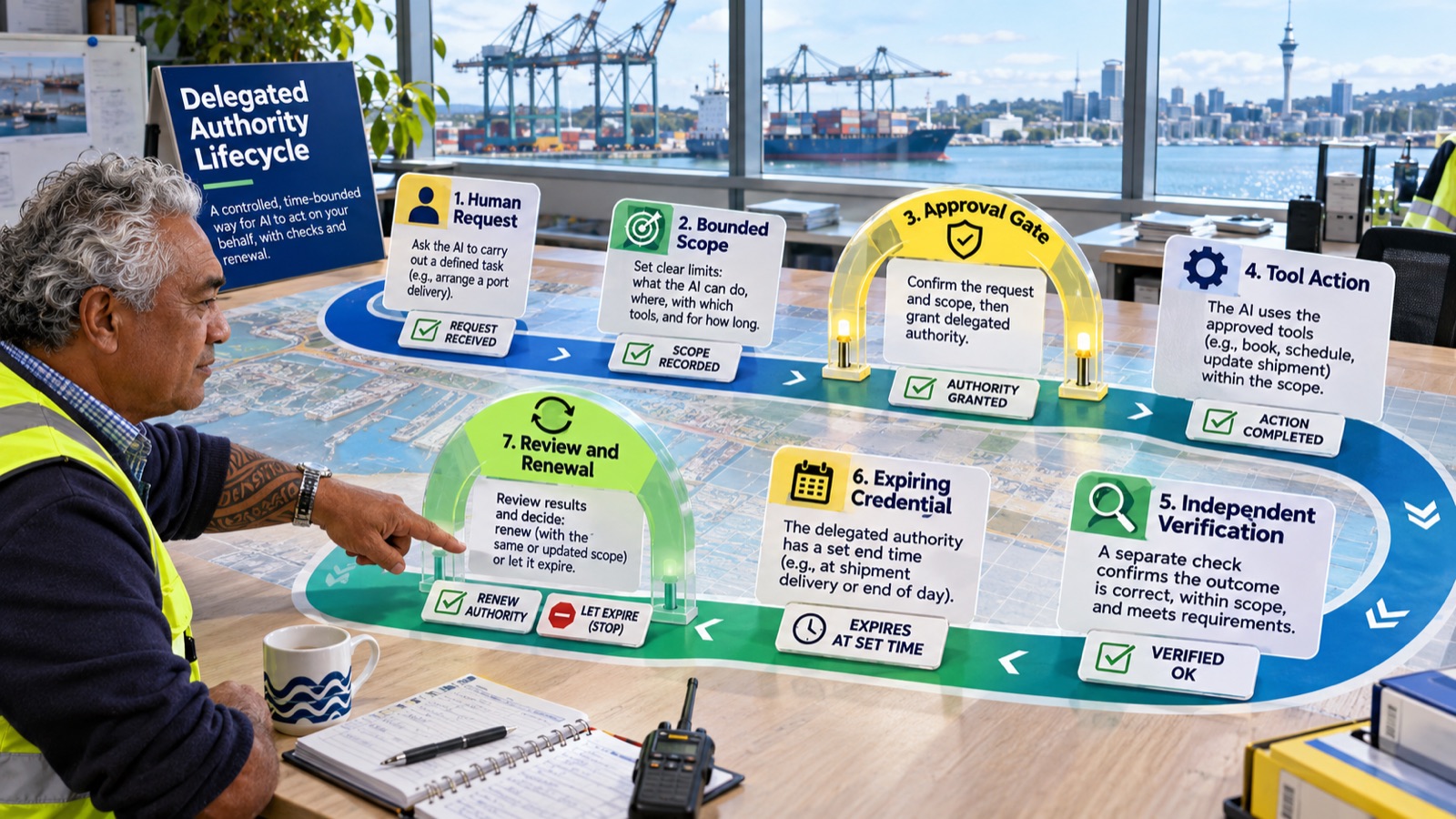
A useful delegation path binds the human request to scope, approvals, execution, independent verification, expiry, and an explicit renewal decision.
1. Establish the principal and purpose
Confirm who is requesting the work and whether that person may delegate it. A manager cannot grant an agent authority the manager does not hold. A customer service user cannot authorize access to another customer’s account. Purpose should be narrow enough to test: resolve one case, monitor one system, or schedule within one calendar window.
2. Assess consequence and choose the authority level
Estimate what can go wrong, who can be affected, how reversible the action is, and how quickly harm could spread. Then choose observe, recommend, prepare, bounded action, conditional high-impact action, or no delegation. This is where teams connect risk classification with real permissions.
3. Issue identity, scope, and policy together
The agent needs a distinct identity when possible, but identity alone is only the anchor. Bind it to task scope, allowed tools, resource boundaries, duration, approval requirements, and aggregate limits. Avoid copying a human’s full session or permanent administrator role into an agent workflow.
4. Mediate each consequential action
At execution time, a control outside the model should check the effective grant. It should verify the agent, principal, task, resource, action, amount, policy version, approval, and expiry. A valid decision should produce a traceable authorization result. A denied action should fail safely and explain the next permitted step.
5. Verify the side effect independently
Do not accept the agent’s narrative as proof that the action succeeded. Read the changed system, payment ledger, ticket state, deployment status, or external confirmation. Verification should compare the intended effect with the actual effect and identify partial, duplicated, delayed, or ambiguous outcomes.
6. Expire and revoke by default
Short-lived authority limits exposure. At expiry, invalidate the usable credential or policy grant, not merely a database flag that downstream systems ignore. Revocation tests should cover cached tokens, long-running sessions, queued jobs, child agents, and offline work that might reconnect later.
7. Review evidence and decide whether to renew
Renewal is a new governance decision. Review outcomes, exceptions, overrides, failed checks, near misses, complaints, changes to tools or data, and whether the authority is still necessary. Narrow, redesign, or retire the grant when the original purpose no longer applies.
Sub-Delegation: When One AI Agent Hands Authority to Another
Multi-agent systems create a special problem. The first agent may hold a valid mandate, then call a planner, specialist, browser agent, payment agent, or external service. If each hop receives the full original permission set, authority can spread farther than the principal intended. If the chain is not recorded, the final tool sees a credential but cannot reconstruct the mandate.
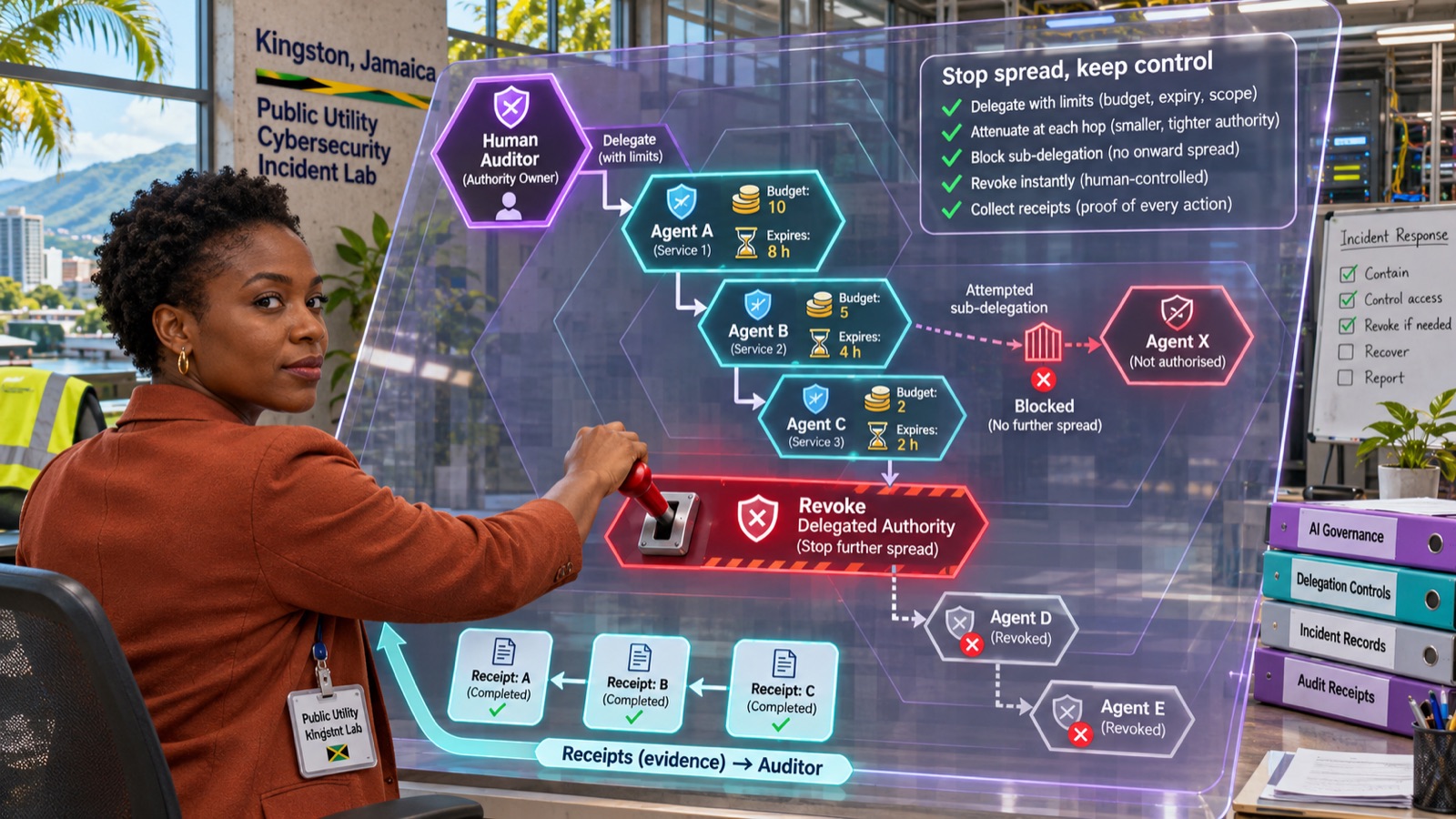
Each delegation hop should narrow authority, preserve the principal and purpose, return evidence, and remain reachable by revocation.
An emerging IETF Agentic AI use-cases Internet-Draft describes multi-hop delegation in which authorization scope must be progressively constrained at each hop. It is important to label this correctly: an Internet-Draft is work in progress, not an adopted standard. Still, the underlying design problem is immediate and practical.
Authority should attenuate, not expand
A child agent should receive only the subset required for its subtask. If the orchestrator may read invoices and propose payments, a document-extraction agent may need invoice read access but no payment capability. A payment executor may need one prepared transaction with a strict amount and recipient, not general invoice access. Scope should become smaller or equal at each hop, never silently broader.
Preserve the principal chain
Every hop should carry enough authenticated context to answer: who is the original principal, which agent delegated the subtask, what purpose applies, which limits remain, which policy version was evaluated, and when does the authority expire? This is different from copying the original user token everywhere. The chain should prove provenance while avoiding unnecessary exposure of the principal’s full credentials.
Conserve budgets and limits across branches
Parallel agents can each obey a local limit while violating the total limit. Five purchasing agents with a $500 local cap can collectively spend $2,500 unless the system reserves and reconciles a shared budget. The same issue applies to message volume, data exports, retries, API calls, environmental impact, and operational changes. Limits must be enforced at the correct aggregate level.
Control re-delegation depth
Define whether child agents may delegate again and how many hops are permitted. High-consequence actions may require a fixed, pre-approved chain. Lower-risk research tasks may allow dynamic specialists, but every participant should be authenticated, authorized, observable, and unable to inherit more authority than its parent.
Make revocation transitive
Revoking the root grant should invalidate active children, queued tasks, derived tokens, and future callbacks. If the system cannot enumerate the descendants of a delegation, it cannot reliably stop them. This is one reason an AI agent inventory and a delegation graph belong together.
Common AI Agent Delegation Failures and the Controls That Address Them
Delegation failures do not always look like an agent “going rogue.” Many are ordinary mismatches among policy, identity, context, and execution. A capable model can follow a request faithfully and still exceed authority because the request itself was vague, stale, or issued by the wrong principal.
| Failure mode | What happens | Control response |
|---|---|---|
| Prompt treated as permission | A natural-language request is accepted as authorization for every required side effect. | Separate intent from authorization. Require policy evaluation and action-specific grants. |
| Credential copying | The agent receives a human session or broad service account and inherits unrelated powers. | Use a dedicated identity and task-scoped, short-lived permissions. |
| Purpose drift | A valid tool is used for a different case, customer, dataset, or business objective. | Bind resource and action to a purpose, case identifier, and principal. |
| Approval laundering | One approval is reused for changed inputs, a larger amount, or a different action. | Bind approval cryptographically or transactionally to the exact proposed effect and expiry. |
| Permission accumulation | New tools and roles are added over time, creating excessive effective authority. | Review aggregate permissions, remove stale grants, and re-evaluate after material changes. |
| Unbounded sub-delegation | An agent hands work to unknown peers or passes its complete authority downstream. | Allowlist peers, cap depth, attenuate scope, and preserve the delegation chain. |
| Split-budget overspend | Parallel child agents each obey local limits while exceeding the total budget. | Reserve against one shared budget and reconcile across branches. |
| Stale authority | The task, user role, policy, or risk changed, but the agent’s old grant still works. | Use short expiry, event-triggered reauthorization, and continuous policy checks. |
| Revocation theater | A dashboard says disabled, but cached tokens, queued jobs, or child agents keep acting. | Test the full revocation path and confirm downstream denial. |
| Self-reported success | The agent claims completion although the external state is partial, duplicated, or wrong. | Verify the side effect independently and store the observed result. |
| Unreviewable oversight | A human sees a vague approve button without evidence, alternatives, or impact. | Provide decision context, policy reason, diff, consequence, and an easy reject or edit path. |
| Accountability vacuum | Product, security, vendor, and user each assume another party owns the outcome. | Name owners for grant, operation, monitoring, incident response, remedy, and retirement. |
These controls connect directly with AI agent runtime governance. Written policy matters only when an enforcement point evaluates it before the external side effect. Logs matter only when they preserve enough context to reconstruct the decision. Human oversight matters only when a person has time, authority, information, and a viable way to intervene.
What Is Established and What Is Still Uncertain
What teams can act on now
- Distinct identities improve attribution and policy targeting.
- Least privilege and short-lived scope reduce the impact of mistakes and attacks.
- Downstream mediation is stronger than prompt-only rules.
- Approvals should bind to exact actions and material inputs.
- Audit records should preserve principal, agent, policy, scope, action, resource, result, and time.
- Revocation needs technical testing across tokens, jobs, and child agents.
- Human roles and incident responsibilities should be explicit before deployment.
What remains unsettled
- There is no single universal delegation credential accepted across all platforms and jurisdictions.
- Legal attribution for autonomous actions varies by contract, sector, and law.
- Standards for cross-provider agent identity and multi-hop authority are still evolving.
- Organizations differ on when continuous supervision can become policy-level oversight.
- Measuring whether oversight is substantively meaningful remains difficult.
- Highly dynamic agents may change risk faster than periodic review cycles.
- Portable revocation and dispute-resolution mechanisms are not mature everywhere.
The right response to uncertainty is not to wait for a perfect universal standard. It is to adopt controls that are useful under many future standards: clear principals, minimal scope, explicit purpose, short duration, independent checks, preserved evidence, recourse, and tested withdrawal. These foundations also support the broader conditions for trustworthy AI agents.
Four Practical Delegation Examples
Customer support refunds
A support agent investigates a duplicate charge. Its delegation permits reading one customer’s order and payment history, proposing a remedy, and automatically refunding only a verified duplicate below a modest threshold. Larger or unusual refunds require a reviewer. The approval is bound to the customer, transaction, amount, reason code, and expiry. The payment ledger confirms the result, and the customer receives a contestable record.
The risky version gives the agent broad payment credentials and tells it to “make customers happy.” That instruction hides the key authority questions. Which customers? Which payment instruments? What amount? Can it issue store credit and cash? May it override fraud holds? Who reviews repeated refunds? The safe version turns those questions into enforceable policy.
Infrastructure incident response
An operations agent monitors production and may collect diagnostics, isolate one unhealthy instance, or roll back a recent deployment under defined conditions. It may not change identity policies, delete data, or expand network access. A severe event triggers a human incident commander. Every action includes the observed signal, policy decision, command, target, result, and recovery check.
Fast action matters during incidents, but speed does not justify unlimited authority. The AI agent incident response runbook explains detection, containment, recovery, and learning. Delegation defines which steps an agent may perform inside that runbook before a person takes command.
Procurement assistant
A procurement agent may compare approved vendors, request quotes, and prepare a purchase order. It may place routine orders only within an approved category, vendor list, monthly budget, unit price, delivery region, and conflict-of-interest policy. New vendors, contract changes, or unusual payment terms require procurement and finance review. The authority expires at the end of the budget period.
Sub-delegation deserves special attention. A vendor-discovery agent should not inherit purchasing authority. A negotiation specialist may propose terms but not sign. A payment service receives one approved obligation, not general access to the procurement system. Shared budget reservation prevents parallel agents from overspending.
Personal travel agent
A personal agent can search itineraries, filter by preferences, and hold refundable options. A user may allow automatic booking under a total price, with approved airlines, refundability, and schedule constraints. Passport or health information is shared only when required, with a named recipient and purpose. Major changes, nonrefundable purchases, visa declarations, or acceptance of unusual terms require confirmation.
Personal delegation also needs revocation. If the user cancels the trip or loses a device, outstanding holds, tokens, shared documents, and scheduled follow-ups should be withdrawn. The agent should not keep a broad travel credential simply because it might be useful later.
Interactive AI Agent Delegation Depth Helper
This helper does not replace a risk assessment. It gives a starting recommendation by combining consequence, reversibility, data sensitivity, and sub-delegation. Choose the closest profile for a planned agent action.
The important result is not the score. It is the conversation the score forces. If an action is consequential, hard to reverse, sensitive, and dynamically delegated, the team should not solve the risk by adding a generic “human in the loop.” It should redesign the authority boundary and the evidence presented to that human.
What an Action Receipt Should Prove
A normal application log often records that an API endpoint was called. An agent action receipt should explain why the call was legitimate. It does not need to expose hidden reasoning or sensitive prompt content. It needs enough structured evidence to reconstruct authorization and outcome.
- Original principal and accountable service owner
- Agent identity, version, deployment, and execution mode
- Delegation record or task identifier
- Purpose, case, and requested outcome
- Allowed scope and effective permissions at the moment of action
- Policy version, decision result, and reason code
- Human approval identity and exact transaction binding when required
- Tool, resource, target, amount, and material parameters
- Timestamp, expiry, nonce or correlation identifier, and delegation depth
- Observed external result, verification source, and any ambiguity
- Exceptions, retries, overrides, rollback, complaint, or contestation
The NIST AI RMF Playbook Measure guidance recommends histories and audit logs, documentation of human oversight, statistics on overrides and complaints, and tracking of policy exceptions and escalations. That is broader than agent delegation, but it supports a critical point: governance should be measurable, not merely asserted.
Useful metrics include the share of actions denied by policy, approval rates, reviewer edits, time to review, expired grants, failed revocation tests, orphaned agents, authority changes after tool updates, actions outside expected purpose, rollback frequency, complaints, and time to remedy. A low denial rate can mean a well-designed system, but it can also mean that controls are not testing anything meaningful. Metrics require interpretation.
A 90-Day Plan for Safer AI Agent Delegation
Days 1 to 30: Discover authority already in use
Inventory agents, service accounts, embedded copilots, scheduled automations, browser agents, and vendor features that can change external state. For each, identify the human or organizational principal, the service owner, the current credentials, available tools, actual downstream resources, approval points, and expiry. Prioritize systems that can spend money, communicate externally, change identity, touch sensitive data, alter production, or affect rights.
Compare documented scope with effective scope. An agent may appear limited in its own application while its service account holds broad permissions elsewhere. Include inherited roles, group memberships, plugin access, secondary tools, cached credentials, and child agents. Link this work with the organization’s agent registry and risk register.
Days 31 to 60: Build delegation contracts and enforcement points
Choose a small number of consequential workflows. Write the nine-part contract for each. Separate read, propose, prepare, approve, execute, and verify. Replace shared identities where practical. Move critical limits from prompts into policy gateways, tool wrappers, APIs, or transaction systems. Add short expiry, explicit renewal, and a real revocation path.
Design the reviewer experience. Show the exact action, evidence, policy, impact, alternatives, confidence limits when useful, and what will happen after approval. Make reject, narrow, edit, and escalate as easy as approve. Bind the approval to the material transaction so a later change cannot reuse it.
Days 61 to 90: Test failure, revocation, and recourse
Run scenarios for prompt injection, stale user roles, changed tools, duplicate effects, partial failure, ambiguous timeouts, parallel budget use, unauthorized sub-delegation, reviewer absence, and emergency shutdown. Revoke a root grant and confirm that active tokens, queued jobs, and child agents stop. Attempt the same action through a different path to find bypasses.
Test the human process too. Can the incident owner reconstruct the authority chain without asking the original developer? Can an affected person challenge an outcome through the AI contestability process? Can the organization reverse the effect or provide another remedy? Can leadership decide whether the agent should return to service?
Finish by setting review triggers. Reassess when the model, tools, data, environment, purpose, principal, law, vendor, or consequence changes. Delegation is not a certificate that remains valid forever. It is a controlled relationship that must remain aligned with actual use.
Human Control Means Governing Authority, Not Watching Every Click
AI agent delegation allows useful autonomy without pretending that autonomy creates its own legitimacy. A responsible system can let an agent work quickly while remaining clear about whose authority it exercises, what limits apply, when a person must intervene, how the action is verified, and who provides remedy when something goes wrong.
The best design is not maximum automation or maximum approval. It is the smallest sufficient authority for a defined purpose, backed by independent enforcement, useful evidence, proportional oversight, tested revocation, and named accountability. As agents operate across more systems and call one another, these basics become more important, not less.
FAQ: AI Agent Delegation and Human Control
What is AI agent delegation?
AI agent delegation is the controlled transfer of limited authority from a person or organization to an AI agent so it can perform defined actions on the principal’s behalf. A complete delegation identifies the principal, purpose, allowed and prohibited actions, resource and value limits, approvals, duration, sub-delegation rules, evidence, revocation, and accountable owners.
Is a prompt a valid authorization for an AI agent?
A prompt expresses intent, but it is usually not sufficient authorization for consequential action. Natural language can be ambiguous, manipulated, stale, or issued by someone without the right to delegate. High-impact systems should evaluate identity, scope, policy, context, limits, approvals, and expiry outside the model before committing an external effect.
What is the difference between permission and authority?
Permission is a technical capability granted to an identity, such as calling a refund API. Authority is the legitimate mandate to use that capability for a particular principal, purpose, case, amount, resource, and time. An agent can hold a valid credential yet lack authority for the action it attempts.
Can an AI agent delegate work to another AI agent?
It can if the system explicitly permits sub-delegation. The child agent should receive only the subset needed for its subtask. The principal and purpose must remain traceable, scope should narrow at every hop, aggregate limits must be conserved, delegation depth should be bounded, and revocation should reach every descendant.
Who is accountable when an AI agent exceeds its authority?
An AI agent does not eliminate human or organizational accountability. Responsibility may be distributed among leaders, deployers, service owners, developers, security teams, users, and vendors depending on the context, contract, and law. Organizations should assign responsibility for the grant, system design, oversight, incident response, remedy, and retirement before deployment.
How do you revoke an AI agent’s authority?
Disable or narrow the policy grant, invalidate relevant credentials and tokens, stop active runs, cancel queued jobs, revoke child delegations, and confirm that downstream systems deny further action. Then verify external state and investigate whether any work continued through cached sessions or alternate paths. Revocation should be tested before it is needed.
Does human approval make every agent action safe?
No. Approval can fail when reviewers lack context, are overloaded, cannot reject easily, or approve one action that later changes. Good approval presents the exact side effect, evidence, policy, consequence, and alternatives, and binds the reviewer’s decision to the final transaction. Some actions still require technical hard limits or no delegation.
What should an AI agent delegation record contain?
At minimum: principal, accountable owner, purpose, allowed resources and actions, prohibited actions, value and rate limits, approval and escalation rules, start and expiry, sub-delegation rules, evidence requirements, revocation method, verification method, incident owner, and remedy path. The record should be human-readable and enforceable by systems.
How often should delegated authority be reviewed?
Review at a fixed interval based on risk and whenever a material change occurs. Triggers include new tools, broader data, a model or vendor change, a different deployment environment, changed user role, new jurisdiction, incident, complaint, failed control, unusual usage, or a change in business purpose. High-impact standing authority deserves shorter review cycles.

