
AI Agent Change Management: How to Update Prompts, Tools, and Models Without Breaking Production Workflows
A live AI agent is never “finished.” Prompts improve, models change, tools gain fields, policies evolve, and retrieval sources move. This guide turns those ordinary changes into a controlled, evidence-led release practice instead of a gamble with a customer workflow.

AI Agent Change Management: The Quick Answer
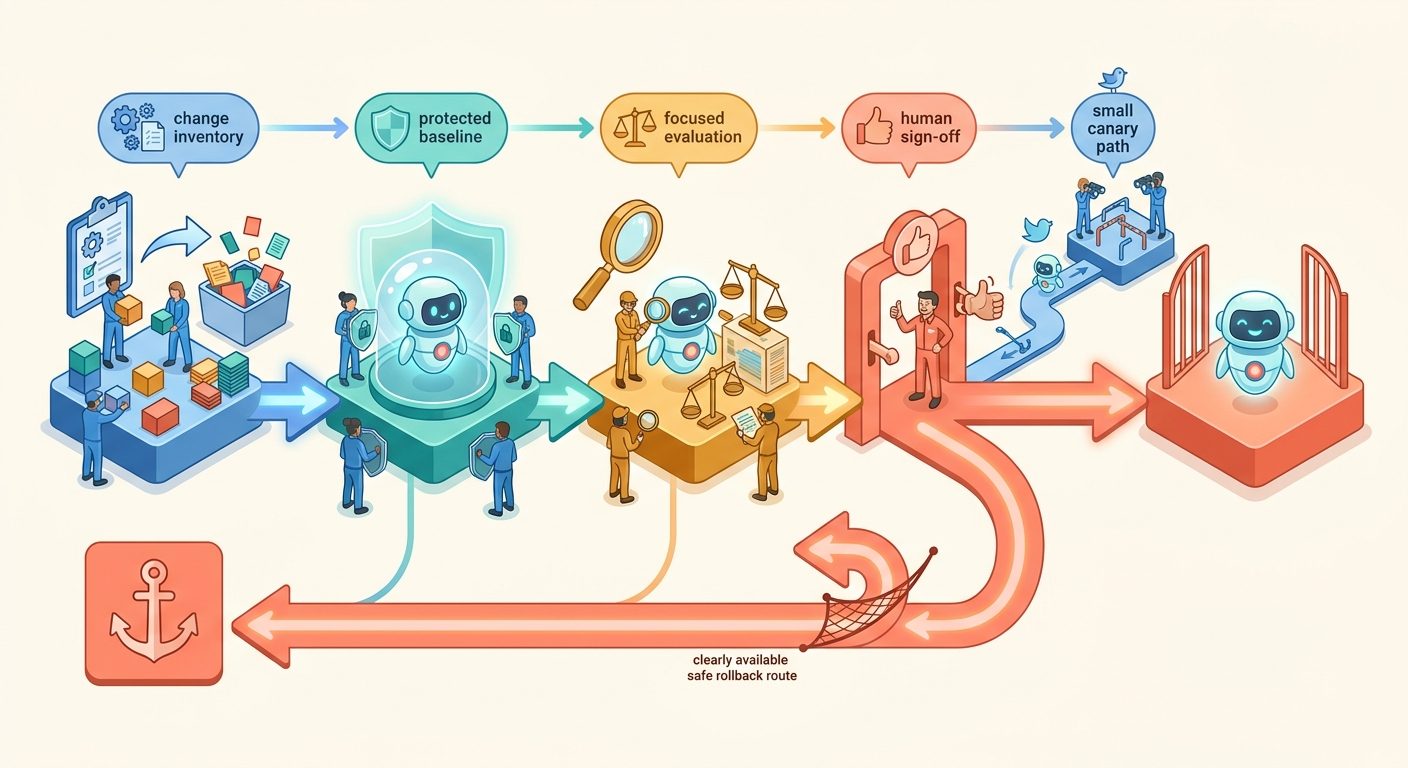
AI agent change management is the operating discipline for safely modifying an agent after it is part of a real workflow. Before a change reaches every user, a team records what changed, estimates the risk, compares the candidate against a known baseline, runs tests that reflect the work, assigns an accountable approver, releases in a controlled way, and watches the result with a defined path back.
The point is not paperwork for its own sake. An agent can behave differently when its system prompt changes by one instruction, when a tool schema adds an optional field, when a model provider updates a version, or when a knowledge source is refreshed. In a workflow that drafts customer replies, routes support cases, changes records, or asks a human for approval, those differences can alter cost, latency, safety, task completion, and the amount of cleanup a person must do.
This is a deliberately narrow companion to our pillar guide, Agentic AI Adoption: How Companies Move From Pilots to Production. That guide explains how teams make the larger move to production. This article addresses the recurring operational question after that decision: how do you keep a live agent dependable as its parts change?
What Counts as an AI Agent Change?
Teams often only create a release ticket for a model swap or a new feature. That is too narrow. An agent’s behavior is the combined result of instructions, selected model, retrieved context, tools, tool permissions, orchestration logic, memory, safety policies, user interface, and the people who review exceptions. Changing any one of those can change the outcome of the whole system.
A useful inventory begins with six families. Behavior changes include prompts, output format, routing rules, and the model. Capability changes add or alter a tool, connector, retrieval corpus, or memory source. Control changes affect permissions, approval gates, identity, redaction, or escalation. Operational changes alter timeouts, retries, budgets, queue handling, or monitoring. Experience changes change what the user sees or can override. Finally, environment changes include vendor updates, API-version moves, or database migrations that may alter a tool’s response even though the agent code did not change.
Inventorying is valuable because it converts “we tuned the agent” into a reviewable statement. For example: “We changed the CRM lookup tool from one endpoint to another, retained read-only permission, updated the field mapping, and added 20 records with missing contact data to the regression set.” That description allows an engineer, product owner, and risk reviewer to discuss the same object.
A change log also protects learning. If task success falls after three weeks, the team can compare the current configuration with the last known good version rather than reconstructing changes from chat messages. That is basic operational hygiene, but it is especially important for systems whose behavior is probabilistic and whose dependencies change frequently.
Use Risk Tiers Instead of Treating Every Edit the Same
Not every change needs the same ceremony. Requiring a full committee review for a typo in a non-actionable status message makes people bypass the process. Releasing a new payment-refund tool through the same lightweight path is equally unwise. The answer is a small number of risk tiers with consequences that people can remember.
| Change tier | Typical example | Minimum evidence | Release path |
|---|---|---|---|
| Low | Copy correction, non-functional UI label, documented prompt clarification | Peer review; focused smoke test; version note | Normal release and routine monitoring |
| Moderate | Prompt change, model-version change, retrieval refresh, tool schema adjustment | Baseline comparison; targeted regression set; owner approval | Limited rollout or feature flag; monitor key signals |
| High | New action tool, broader permission, new sensitive-data path, altered approval rule | Scenario tests including failure paths; security/privacy review as applicable; explicit rollback plan | Canary release, named on-call owner, change window where appropriate |
The labels are less important than the decision factors. Ask four questions: can the agent take an external action; can it access a new class of data; can failure create material user harm; and is the behavior change hard to detect from a single answer? A “yes” to any one should raise the evidence bar. NIST’s AI Risk Management Framework is useful here as a lens: risk management belongs across design, development, use, and evaluation, rather than at one final approval checkpoint.
Do not invent a universal pass rate. A support-triage agent and a clinical workflow do not share the same stakes, data, or acceptable failure modes. Set thresholds using the workflow’s baseline, user impact, existing service objectives, and the people responsible for corrective action.
Build a Baseline Before You Try to Improve Anything
“The new prompt looks better” is not a baseline. A baseline is a saved description of the current production configuration and its observed behavior. It lets a team distinguish a true improvement from a change in traffic, data, reviewer habits, or anecdotal impressions.
Start with a versioned configuration snapshot: model and provider identifier, instruction text, tool definitions, permission scopes, retrieval settings, orchestration graph, policy rules, and relevant feature flags. Pair it with a small but representative test set. The test set should include routine cases, high-value cases, edge cases, malformed tool responses, adversarial or irrelevant inputs where relevant, and examples that previously caused a human to intervene.
Then choose a scorecard with more than one dimension. Task fidelity is often central, but it is not the only requirement. An update that raises answer helpfulness while causing a large increase in unnecessary tool calls, latency, or escalations may be a net loss. OpenAI’s evaluation guidance frames reliable behavior as an iterative loop: specify expected behavior, test it, analyze the results, and improve. That loop is more useful when the old version is an explicit comparator.
Keep the baseline separate from a demonstration set. A demo set contains examples that make the agent look good. A release set should contain examples that could embarrass or harm the workflow if they fail. Include the latter on purpose. The most useful regression cases are often drawn from real incidents, confusing user requests, incomplete records, tool outages, and prior reviewer corrections.
Design Evaluations Around Decisions the Agent Actually Makes
A production agent does more than produce fluent text. It chooses whether to use a tool, selects arguments, interprets a response, decides whether it has enough confidence to act, and hands work to a person when it does not. Evaluation should cover those decisions, not just a final response judged in isolation.
Use layered checks
First, use deterministic checks wherever the requirement is unambiguous: valid JSON, a required citation field, correct tool schema, no action without an approval token, and no restricted field in a visible output. These checks are fast, cheap, and easy to explain. Next, use task-specific cases with human labels or rubrics for decisions that involve judgment. Finally, inspect traces for a sample of complex cases so the team sees the path: context retrieved, tools called, retry behavior, approvals requested, and final state.
Anthropic’s test-and-evaluate guidance makes a similar point: success criteria should be specific, measurable, achievable, and relevant, and test cases should mirror real task distributions including edge cases. For an agent, “helpful” is not enough. Define what the agent must do, what it must not do, and when it must pause.
Evaluate deltas, not only absolute scores
A candidate version may pass all of its isolated tests yet be worse than the previous version on a subset that matters. Compare candidate and baseline side by side on the same cases. Record gains, regressions, ties, and uncertain outcomes. If an evaluator or model-based judge is used, audit a sample of its decisions with a human reviewer; an opaque grader should not be the only authority for a high-impact release.
It is also worth creating “contract tests” for tools. When a shipping API changes a field name or returns an unfamiliar status, the agent should behave safely: request clarification, use a documented fallback, or escalate. It should not invent a success state. This is where a concise tool-context design and a failure-mode test often prevent more damage than another round of generic prompt tuning.
Turn Evidence Into a Release Decision
A change request should end in an understandable decision, not a pile of screenshots. A lightweight release evidence packet answers: what changed; why it changed; what tier applies; what baseline was used; which cases improved or regressed; who reviewed the result; how the change is being exposed; which metrics will be watched; and who can stop it.
For a moderate or high-risk change, release behind a feature flag when the architecture allows it. Start with a small, appropriate segment: internal operators, a low-stakes queue, a limited tenant, or a controlled task type. A canary is not merely “ship to 5%.” It is a hypothesis with stop rules. State in advance which signals will cause a pause, who is notified, and whether the system should fall back automatically or await a human decision.
Our AI Agent Canary Rollout Checklist covers the mechanics of limited releases in more detail. Use it alongside this article: change management supplies the evidence and ownership; a canary supplies a safer way to observe a real-world delta.
Approval is not a ritual signature. The approver should have the context and authority to make the decision. The product owner can judge intended user value; the technical owner can judge reliability and reversibility; a security, privacy, or domain reviewer may be needed when data access or regulated decisions change. Small teams can assign more than one responsibility to the same person, but the responsibilities should still be explicit.
Define Rollback Before the First User Sees the Change
Rollback sounds simple until a live agent has already written data, opened tickets, sent messages, or changed a downstream state. A credible rollback plan distinguishes behavior rollback from business remediation. Turning off the new prompt or reverting a model may stop new mistakes; it does not necessarily correct work already performed.
For every change above the low tier, answer five questions. What exact configuration is the last known good version? How is it restored: feature flag, deployment version, model routing rule, or tool permission? Who is authorized to trigger it? What live signal triggers a stop? And what happens to in-flight tasks and completed actions that may need review?
Write the answer in operational language. “Rollback if quality declines” is not a plan. “If the agent sends a customer-facing response without the required policy citation in two confirmed cases during the canary, disable the new route, return new tasks to the previous version, and place affected task IDs into a reviewer queue” is a plan. The exact threshold will vary, but the format is clear enough to act on during a busy incident.
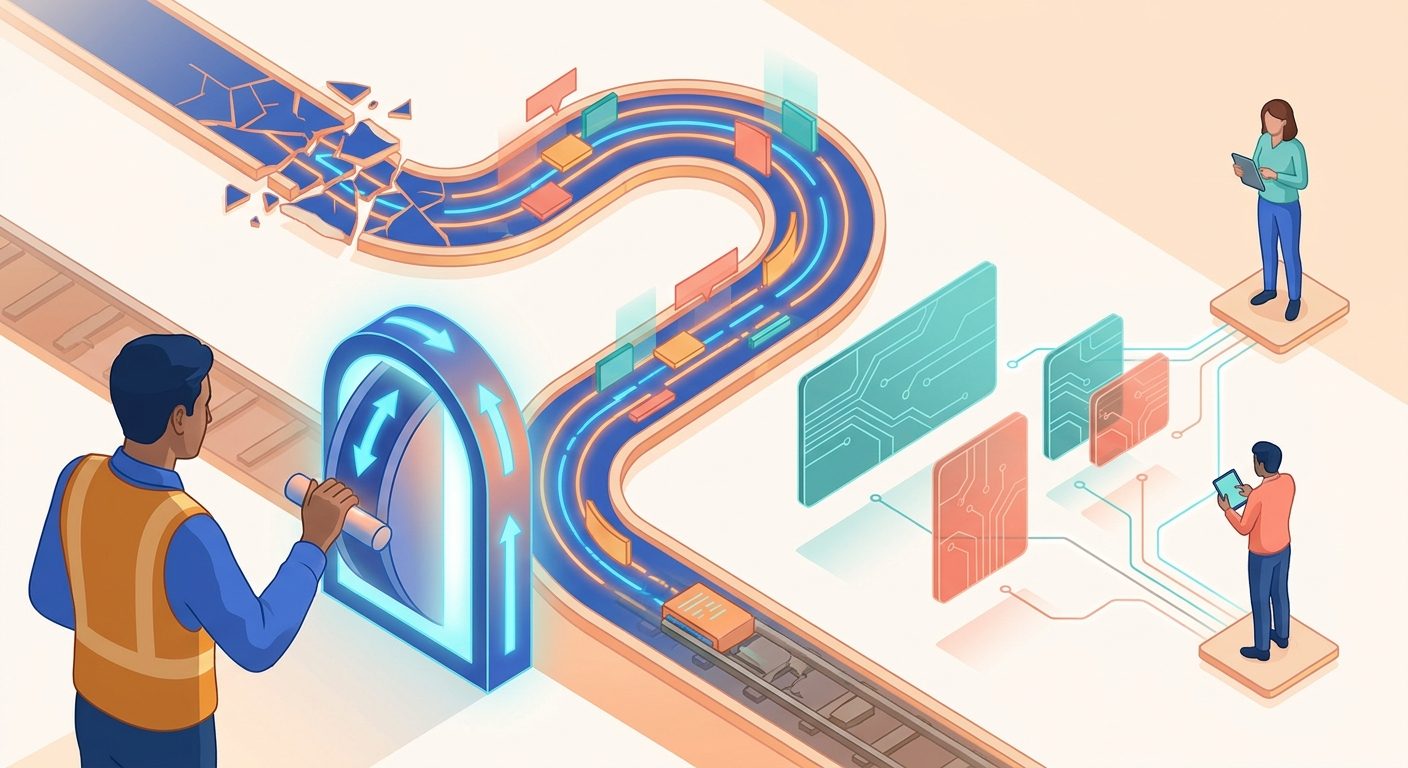
Practice at least one rollback path before relying on it. A tabletop exercise can reveal that a flag only affects new sessions, a tool’s permission cache lasts longer than expected, or a vendor model alias moved without a pinned version. These are not reasons to avoid agents. They are reasons to make reversibility part of their normal operating model.
Monitor the Metrics That Tell You Whether the Update Helped
After release, observe both the intended improvement and the possible cost of it. The scorecard should contain a small number of workflow measures, agent behavior measures, and control measures. Do not watch every possible number; choose signals that can prompt a decision.
| Signal family | Useful question | Example measure |
|---|---|---|
| Workflow outcome | Did the user get the right work completed? | Verified task completion, resolution rate, rework rate, time to a useful result |
| Agent behavior | Did the path through the system change? | Tool-call success, retries, invalid arguments, escalation rate, trace coverage |
| Experience and efficiency | Did the change create friction? | Reviewer edits, user abandonment, latency distribution, cost per completed task |
| Controls | Did safeguards hold? | Approval adherence, policy exceptions, audit-log completeness, confirmed incidents |
Modern observability should make the agent’s path inspectable, not only count final answers. The OpenTelemetry project maintains dedicated GenAI semantic conventions, reflecting the need for consistent telemetry around generative-AI systems. You do not need a particular vendor to apply the principle: preserve enough context to explain what the agent attempted, which tools were involved, and what configuration version produced the result—while respecting data-minimization and privacy requirements.
Compare like with like. A new version appearing worse during a week of unusual traffic may not be worse. Segment by task type, user group, tool availability, and whether human review was required. Read a sample of traces alongside the metrics. A metric can tell you that escalation increased; a trace and reviewer comment can tell you whether that was a welcome safety behavior or a new failure mode.
A Simple Weekly Operating Rhythm
Change management becomes sustainable when it has a predictable rhythm. Once each week, review recently released changes, open regressions, and pending configuration debt. Once each month, refresh the regression set with real incidents and reviewer corrections, retire tests that no longer represent the workflow, and confirm that rollback paths still work. After a material incident, run a blameless review focused on conditions and safeguards, not on finding a person to blame.
Keep the artifact burden proportional. A small internal summarizer may need a configuration diff, a test record, and an owner. An agent that can modify customer records or influence high-consequence decisions needs a richer evidence packet, tighter permissions, more complete logging, and domain-specific review. The scalable pattern is not one giant policy. It is a common vocabulary plus a higher bar when autonomy and impact rise.
This operating rhythm also gives teams a better way to say “not yet.” A proposed upgrade can be valuable but still lack the test cases, traceability, or rollback route needed for its risk tier. Deferring release until those pieces exist is not an innovation failure. It is how a team protects the credibility needed to scale a successful agent beyond one enthusiastic pilot.
A Practical Change Record Teams Can Use
For a working team, the most useful evidence package is often a repeatable one-page record with linked attachments. Start the record with a plain-language change summary: what is changing, which user workflow is affected, and why the team believes the change is valuable. Add a configuration diff that identifies the changed prompt, model, tool definition, retrieval source, policy rule, permission scope, or orchestration step. This sounds operational rather than strategic because it is: reviewers cannot assess a release they cannot identify.
Next, state the release hypothesis and the non-negotiable controls. A hypothesis might be that a revised tool-routing instruction reduces unnecessary escalations without lowering the rate of correctly completed tasks. The controls might be that the agent cannot widen permissions, cannot take a new external action, and must still ask for a human decision in specified cases. Framing both the hoped-for gain and the boundaries makes later monitoring more meaningful.
The evidence section should link the baseline version, the selected regression cases, the result comparison, and a short sample of traces. Include both examples that improved and examples that regressed. A reviewer should not need to infer that the team cherry-picked. If a finding remains uncertain, say so and explain the containment: perhaps the release is limited to internal users, a low-risk queue, or a task type with mandatory review.
Finally, record the decision. Name the release owner, the technical owner, any required domain or security reviewer, the rollout scope, the dashboard or trace view to watch, the stop conditions, and the rollback action. This turns the package into an operational agreement rather than a historical document. When the next update arrives, the team has a starting point instead of reconstructing the previous decision from memory.
Common Mistakes That Make AI Agent Updates Harder to Trust
The first mistake is evaluating only the final answer. For an agent, a polished answer can hide poor tool selection, retries, unnecessary data access, or a missing approval gate. Evaluate the route as well as the destination. The second is using a static test set forever. Production incidents, reviewer edits, and newly observed edge cases should become regression cases after appropriate privacy review and de-identification.
The third mistake is treating a provider change as invisible. Model aliases, API behavior, safety settings, structured-output behavior, and tool-calling conventions can all change. Pin versions where practical, record provider and configuration identifiers, and schedule a focused review when a dependency changes. The fourth is confusing a successful canary with proof that a system is safe at full scale. A canary reduces exposure and provides evidence; it does not erase uncertainty or replace ongoing monitoring.
The final mistake is putting all responsibility on one team. Product can explain value and user impact. Engineering can explain reliability and reversibility. Security and privacy teams can assess permissions and data paths. Domain reviewers can judge high-consequence outcomes. An evidence package creates a shared object for those perspectives. It should not become a way for any one group to silently transfer risk to another.
Make Every Agent Update Easier to Explain and Easier to Undo
Production AI agents will change. The responsible goal is not to freeze them; it is to make changes legible, testable, observable, and reversible. Start with a configuration inventory and a baseline. Classify the risk. Test the choices the agent actually makes. Give a named person the authority to approve and stop the release. Then watch real behavior through a narrow scorecard and preserve a practical route back.
That discipline supports the larger work of moving agentic AI from pilots to production. When a team can explain what changed, why it was released, what evidence supported it, and how it will recover if reality disagrees, the agent becomes a more trustworthy participant in the workflow—not an opaque feature that everyone hopes will keep working.
Sources and Further Reading
- NIST AI Risk Management Framework — voluntary framework for incorporating trustworthiness across AI design, development, use, and evaluation.
- OpenAI: Working with evals — guidance on specifying, running, and analyzing evaluations.
- Anthropic: Define success criteria and build evaluations — practical guidance on measurable criteria and representative tests.
- OpenTelemetry GenAI semantic conventions — reference point for consistent generative-AI telemetry.
Editorial note: examples in this guide are illustrative operating patterns, not universal thresholds or compliance advice. Configure review, testing, retention, and escalation for your domain and applicable obligations.
FAQ: AI Agent Change Management
Do prompt changes need regression tests?
Usually, yes. A prompt can alter tool selection, refusal behavior, format adherence, and escalation choices. The test depth should match the risk, but a baseline comparison and focused regression cases are sensible for any production behavior change.
When should an AI agent update use a canary rollout?
Use a canary when the change can materially affect user outcomes, operational load, permissions, costs, or safety controls, and when a limited exposure path is feasible. Define stop rules and rollback before releasing the canary.
What should an AI agent rollback restore?
Restore the last known good configuration, including the relevant model route, prompts, tool definitions, policy settings, and feature flags. Also plan remediation for actions already taken; reverting a configuration does not undo completed business work.
Who approves a production AI agent change?
The approver should have authority and relevant context. Often that means a product owner and technical owner, with security, privacy, or domain review added when permissions, data, or high-impact decisions change.
Is AI agent change management the same as MLOps?
They overlap, but agent change management focuses on the operational behavior of a workflow that combines models, prompts, tools, policies, data, and human oversight. It can use MLOps practices while adding tool actions and control decisions.
