
AI Agents vs. Agentic AI: What Is the Difference and When Does It Matter?
The labels overlap, but the design choice matters. Learn how AI agents, agentic workflows, planning, tools, memory, and human approval fit together—and how to choose the smallest safe level of autonomy.
Quick Answer: AI Agents vs. Agentic AI
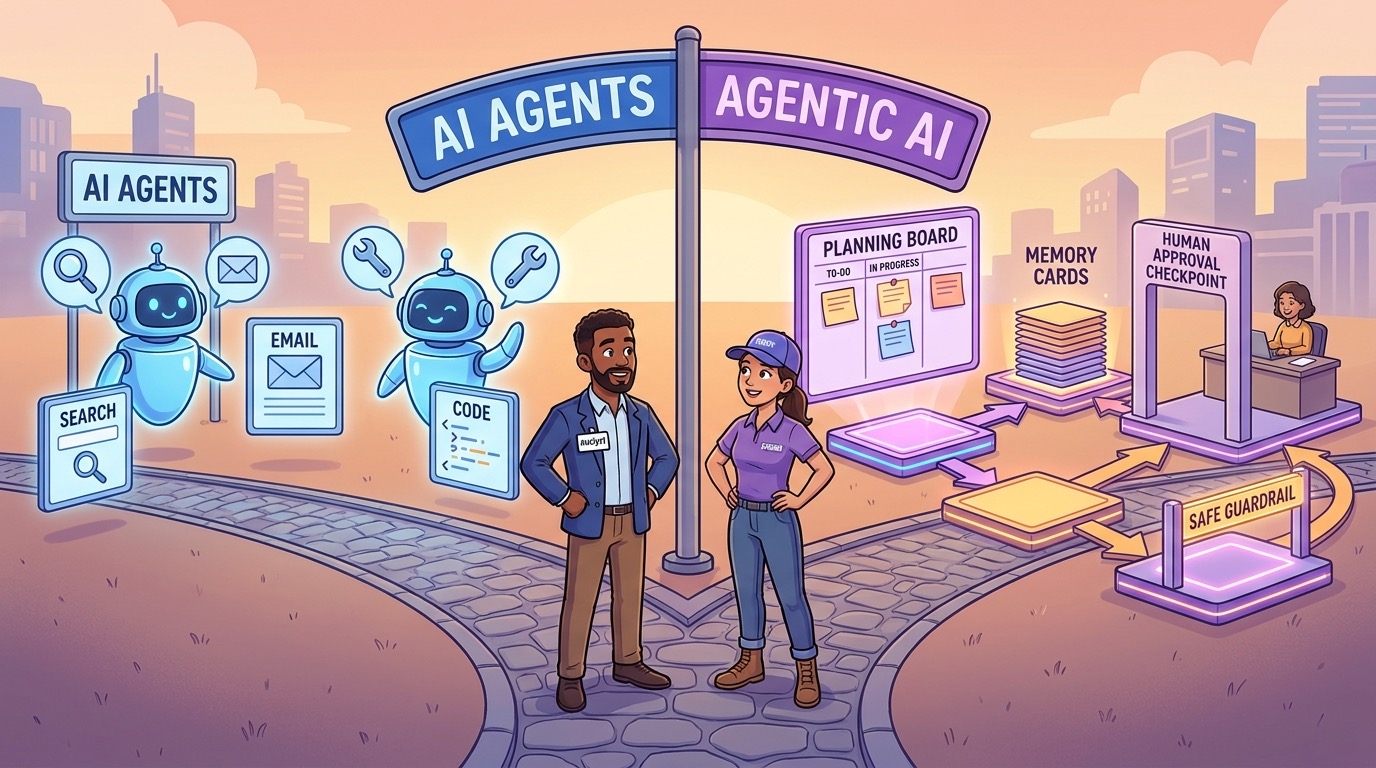
AI agents are software systems that use an AI model to pursue a defined task: they can interpret a request, select from allowed tools, take an action, check what happened, and return a result. Agentic AI is the broader approach of designing AI systems to pursue goals through planning, tool use, feedback, memory, and sometimes coordination among several agents.
In everyday use, people often use the terms interchangeably. That is understandable, but it hides an important design choice. An AI agent can be a small, bounded worker: classify a support request, look up a policy, prepare a draft, or route a ticket. An agentic AI system may manage a longer process: break a goal into steps, decide which specialist should work next, recover from a failed tool call, ask for approval, and adapt its next action from the result.
This guide explains the distinction without hype. You will see what both terms mean, where the boundary is fuzzy, how planning and memory change the picture, when multi-agent systems help, and how teams can choose a sensible starting point.
Why the Terms Are So Easy to Confuse
The vocabulary developed faster than a single standard definition. Product companies, researchers, consultants, and builders describe similar capabilities with different labels. One vendor may call a tool-using assistant an agent. Another may reserve “agentic” for a system that plans and iterates. A third may use “agentic workflow” for a conventional workflow with an LLM at several decision points. None of those labels, by itself, tells you exactly what the software can do.
That is why capability questions are more useful than brand language. Can the system take actions, or only generate text? Does it use approved tools? Does it choose the next step or follow a fixed sequence? Can it keep working after a tool fails? Does it remember earlier information? Can it delegate work to another component? Is a person required before an external action? Those answers reveal the practical level of autonomy.
IBM’s overviews of AI agents and agentic AI, along with Google Cloud’s agentic AI explainer, all emphasize goal-oriented behavior, reasoning or planning, tools, and adaptation. The shared message is not that every system needs every capability. It is that an AI system becomes more agentic as it can observe a situation, choose an action, act through an allowed interface, and use feedback to continue toward an objective.
For a reader, this matters because the labels often shape expectations. “Agentic AI” can sound like a digital employee that will independently finish anything. In reality, dependable systems usually operate in a narrow environment with clear tools, known data, explicit stop conditions, and a human owner. Clear language helps buyers and builders avoid promising autonomy where a carefully bounded assistant would be safer and more useful.
What Is an AI Agent?
An AI agent is an application that uses a model to make progress on a task rather than only answer a single prompt. At minimum, it needs an objective, information about the current situation, and one or more possible actions. In modern applications, those actions often come from tool calls: search an approved knowledge base, read a customer record, create a ticket, run a calculation, retrieve a document, or draft an update for review.
Think of an agent as a worker with a job description. A support-triage agent might receive an incoming message, identify the product and urgency, retrieve the right policy, summarize the issue, recommend a queue, and create a proposed ticket. It does not need to invent the company’s support strategy. It needs a reliable task boundary, permissioned data, and a way to hand uncertain cases to a person.
Most useful agents have a loop, even if the loop is short: observe the input; reason about the task; choose an allowed action; inspect the result; then respond, retry within limits, or escalate. This differs from an ordinary chatbot because the agent is connected to a task environment. It can affect or inspect something beyond its own generated words. But an agent does not need unlimited freedom. A one-tool, read-only agent is still an agent if it uses that tool to complete a goal.
| Component | What it does | Practical question |
|---|---|---|
| Goal | Defines the outcome the agent is trying to produce. | What counts as a successful completed task? |
| Instructions | Set role, boundaries, quality criteria, and forbidden actions. | What must the agent never do? |
| Context | Provides relevant policy, task state, user data, and history. | Which facts are trustworthy and current? |
| Tools | Let the agent retrieve information or take a permitted action. | Which actions are necessary and reversible? |
| Evaluation | Checks output and action quality before or after execution. | How will we detect a bad result? |
| Escalation | Transfers unclear, risky, or failed work to a human. | When should the agent stop? |
An agent is therefore not synonymous with a large language model. The model supplies language and reasoning capability, but the agent design supplies the job, data, action surface, and safety limits. A strong model attached to a vague goal and broad permissions can be less useful than a modest model attached to an excellent workflow.
What Is Agentic AI?
Agentic AI is a system design pattern in which AI does more than produce a one-off answer. It moves through a goal-oriented process: it assesses the situation, plans or selects a next action, uses tools or other components, evaluates feedback, and adjusts when needed. The word “agentic” describes behavior and architecture, not a single product category.
At the lower end, an agentic workflow may be a single agent with a plan-and-execute loop. It receives a research request, identifies missing information, searches trusted sources, compiles notes, and asks the user to review a draft. At the higher end, a system may use a planner, specialist agents, shared state, tool gateways, evaluations, and a human approval stage. The system has more moving parts, but the design principle is the same: use feedback to make a sequence of purposeful choices.
Agentic AI should not be confused with unrestricted autonomy. A well-designed system can be highly agentic inside carefully selected limits. For example, an operations agent can diagnose why a report failed, check a restricted runbook, retry a safe operation, and open a human-approved incident ticket. It can do meaningful work while being unable to send money, change access rights, or publish external messages. Boundaries are what make useful autonomy practical.
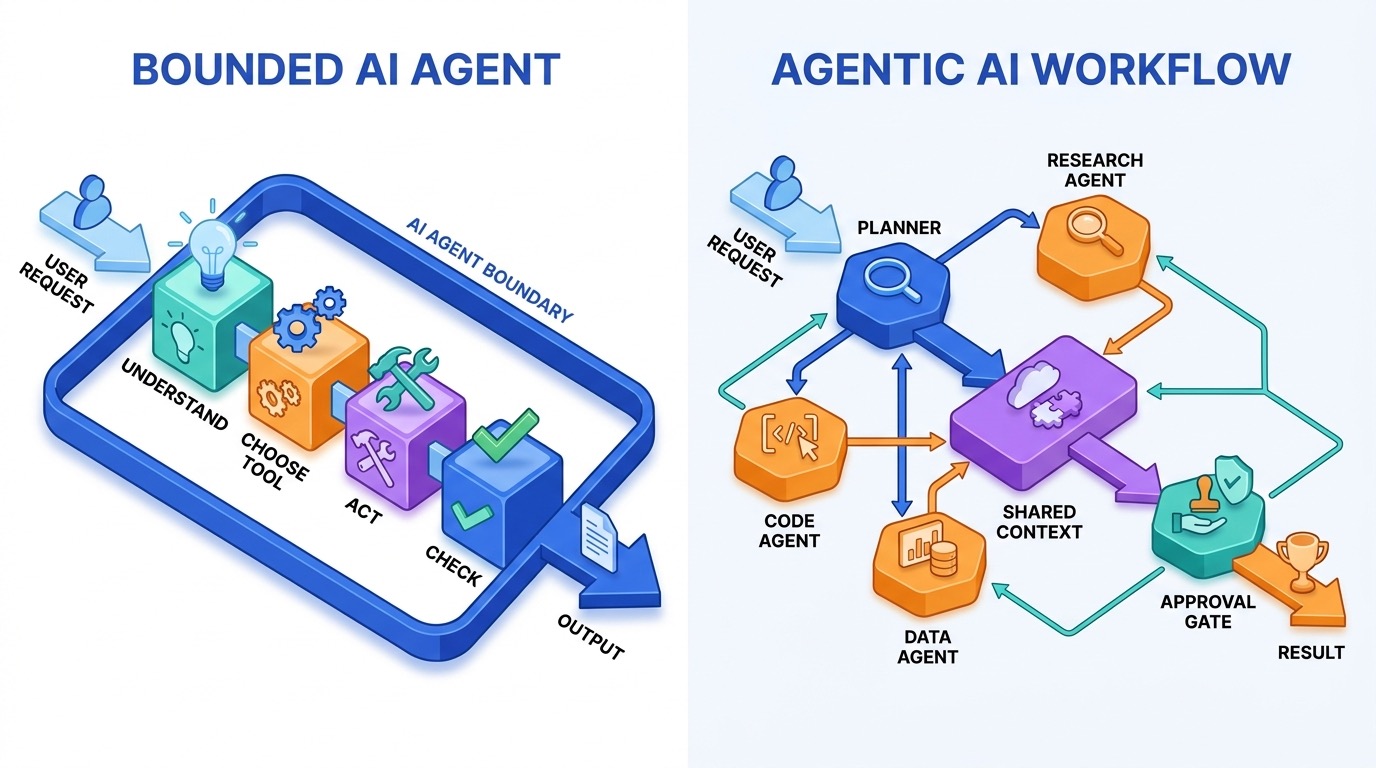
The strongest definition is operational: agentic AI is present when the system can reliably take a sequence of context-sensitive actions toward a goal, while working within controls that make its actions reviewable and interruptible. Whether that is one agent or ten matters less than whether the workflow is understandable, testable, and proportionate to the risk.
AI Agents vs. Agentic AI: The Practical Differences
| Dimension | AI agent | Agentic AI system |
|---|---|---|
| Scope | Usually a defined task or role. | Often an end-to-end goal or multi-step workflow. |
| Decision-making | May select a tool or next move within a small boundary. | May plan, reprioritize, retry, delegate, and evaluate across stages. |
| Architecture | Can be one model plus tools and instructions. | May include planners, workers, memory, orchestration, evaluators, and control layers. |
| Memory | May use only the current task context. | More often uses task state, retrieval, summaries, or governed long-term memory. |
| Human oversight | Often reviews the final output or high-risk actions. | Needs explicit approval, stop, audit, and escalation patterns across the workflow. |
| Best fit | Repeatable, bounded, measurable work. | Work that truly benefits from adaptive multi-step coordination. |
The table is a guide, not a legal boundary. A single AI agent can be very agentic if it plans and works through several feedback cycles. A multi-agent demo can be barely agentic if it simply passes text through a fixed chain with no meaningful observation or decision. That is why teams should describe systems in concrete terms: “a support agent with access to three read-only tools and a human send approval” is more informative than “an autonomous agentic platform.”
The difference also has a cost dimension. More planning, more tools, longer context, and more retries may improve a hard task, but they also add latency, operational complexity, and model usage. Agentic architecture should earn its complexity. If a deterministic workflow can handle a task, use it. If one well-instructed agent can handle it, start there. Add planning or specialist coordination only when the evidence shows that the simpler design fails.
How an Agentic Workflow Actually Works
A reliable agentic workflow is not a mysterious chain of “thinking.” It is an explicit operating process. First, the system receives a goal and enough context to understand the request. Next, it decides whether the task is in scope. If it is, the system selects a safe next action. It then observes the tool result, checks it against a quality or policy rule, and either continues, returns a result, or asks for help.
Consider a travel-expense assistant. A simple version extracts fields from a receipt and drafts an expense entry. A more agentic version might identify missing information, compare the request with policy, query a permitted exchange-rate service, calculate the reimbursement, flag exceptions, and prepare a packet for a manager. It still should not submit payment on its own. The system’s useful autonomy lies in doing the preparation consistently and making uncertainty visible.
Planning does not mean the system should make a long, elaborate plan for every task. Often the best plan is two steps: retrieve the correct record, then draft a response. Over-planning can make systems slow and brittle. The point of planning is to keep the work aligned with the goal and to expose decisions that should be observable to humans.
Verification is equally important. An agent that uses a search tool should not treat every returned page as trusted. An agent that calls a database should validate fields and permissions. An agent that drafts a message should check whether a human approval is required. This is where agentic AI becomes engineering rather than a prompt trick.
Memory, Retrieval, and Context: What They Change
Memory is often described as the feature that makes an agent feel intelligent. In production, it is better understood as a data design problem. The system needs the right information at the right time, in a form it can use safely. That information might be a conversation summary, a customer preference, a current policy, a task checklist, a tool result, or an approved knowledge-base excerpt.
Not every agent needs long-term memory. A document-classification agent may only need the document and a current taxonomy. A support assistant might need the current ticket and relevant policy. A project coordinator may need task state across several days. Giving every agent broad historical memory can introduce stale information, privacy exposure, and confusing behavior. Memory should be tied to a clear use case, retention rule, and access policy.
Retrieval is different from memory. Retrieval finds relevant information from a governed source at runtime. Memory preserves or summarizes information from prior interaction or task state. Good systems commonly use both: retrieval for authoritative facts that may change, and limited memory for continuity. For a deeper design guide, see Singularity Journey’s context engineering for AI agents.
Agentic systems make this distinction more important because a bad context choice can propagate through several actions. If the first step retrieves an outdated policy, later planning may be perfectly logical but still wrong. Builders should log which sources were used, prefer canonical sources, define freshness expectations, and make it easy for a reviewer to see why the system acted as it did.
Do You Need a Multi-Agent System?
Usually, no—not at first. Multi-agent systems are attractive because they resemble a team: one component plans, another researches, another writes, another checks quality. In some problems that separation is useful. A specialized evaluator may catch errors a general worker misses. A controlled planner may route tasks to the right domain tool. But more agents also mean more prompts, more state handoffs, more latency, more costs, and more places for an error to spread.
Start with one agent when the task has one clear objective, a limited tool set, and a single accountable owner. Add a second specialist only when it has a distinct responsibility and a measurable benefit. For example, a research workflow might separate a source-retrieval agent from a citation checker because those roles have different failure modes. A code workflow might use a generator and an independent test runner because verification should not depend on the same component that made the change.
Coordination is the hard part. Multi-agent systems need a shared definition of task state, a format for handoffs, clear ownership of final decisions, and a limit on cycles. Without those controls, agents can repeat work, contradict each other, or create a plausible but unverified final answer. A human should be able to inspect which agent acted, which tool it used, what evidence it saw, and why the workflow stopped.
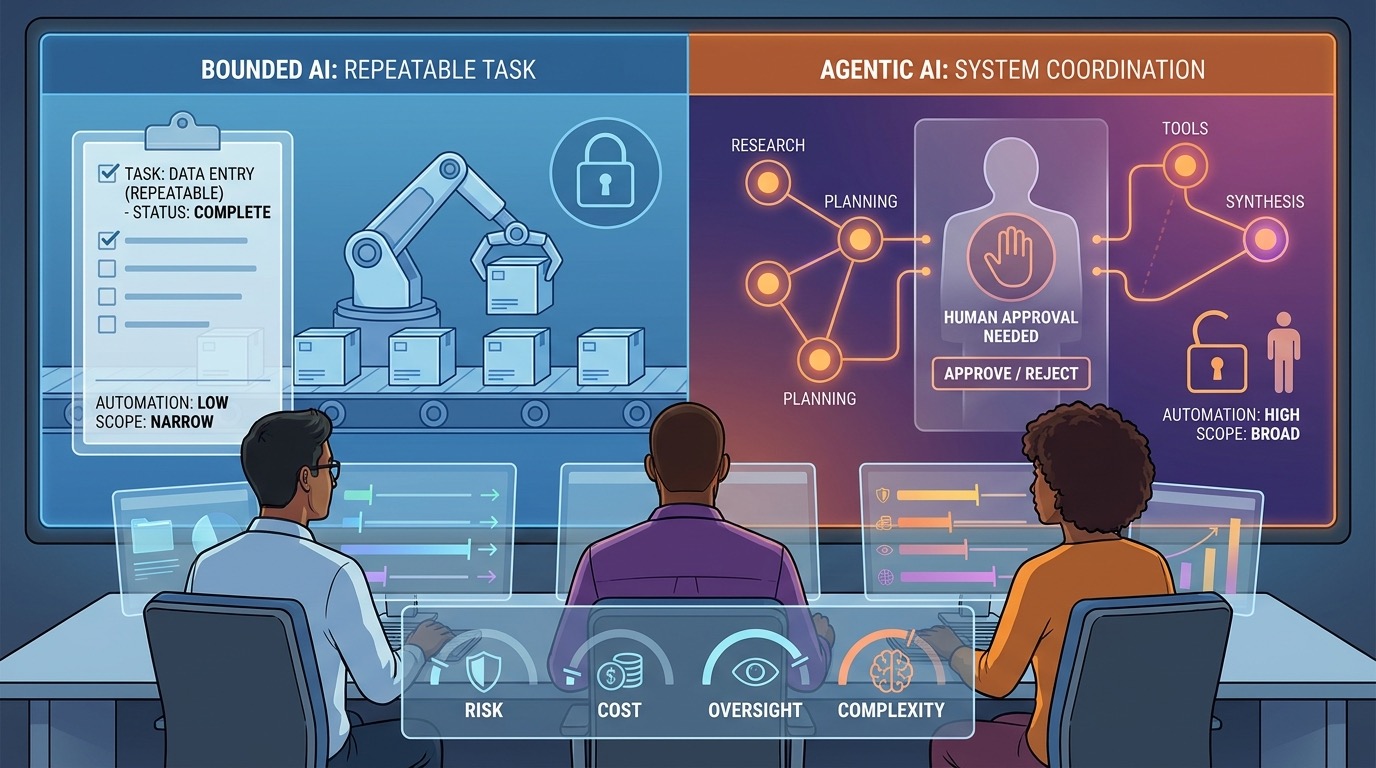
The practical test is simple: can you name the specific bottleneck that another agent will remove? If the answer is “it might be more autonomous,” keep the design simple. If the answer is “an independent policy checker prevents unsafe releases before a high-impact action,” the specialization may be justified.
Examples: Same Goal, Different Levels of Agency
Customer support
A basic assistant answers common questions from a public help center. A support agent retrieves the right article, summarizes the issue, and proposes a response. An agentic workflow also checks account status through a permissioned tool, identifies an exception, suggests a remedy, and routes the case to a human with the relevant evidence. The final customer-facing message may still require approval. The higher level of agency is useful only if it reduces handling time without making incorrect promises.
Software engineering
A coding assistant explains a function or writes a test. A coding agent can inspect a repository, edit a limited set of files, run tests, and prepare a diff. An agentic engineering workflow may take a bug report, reproduce it, identify related modules, propose a plan, make a branch-scoped change, execute a test suite, and request review. The safe design has command allowlists, isolated environments, test gates, diffs, and mandatory human merge approval.
Research and analysis
A chat model summarizes text you paste into a conversation. A research agent searches approved sources and returns a cited briefing. An agentic research workflow breaks a question into subquestions, assigns source collection, compares evidence, flags disagreements, and produces a structured draft with a source trail. The risk is not only factual error; it is source quality. A workflow that makes citation review easy is more valuable than one that produces a confident-looking answer with hidden evidence.
Operations
A simple agent can check a dashboard and describe a visible anomaly. An agentic workflow can compare the anomaly with runbook rules, inspect recent changes, run safe diagnostics, create a proposed incident record, and notify the on-call person. It should not silently make irreversible infrastructure changes merely because it can call an API. Automation level must match reversibility and impact.
These examples show why “agent” versus “agentic” is not a competition. They describe points on a design spectrum. The correct system is the one that makes the work clearer, faster, safer, and easier to verify.
The Risks of Adding More Autonomy
Autonomy compounds both value and error. An agent with read-only access can still expose sensitive information if retrieval is poorly governed. An agent with write access can create duplicate records or make incorrect updates. A system that plans across many steps can waste time and cost on a bad assumption. A multi-agent system can amplify a flawed source, because each specialist treats the prior handoff as reliable.
That is why a human-in-the-loop design is not a sign that the technology failed. It is a control pattern. The human can approve high-impact actions, resolve ambiguity, correct policy interpretation, and stop an unexpected loop. Good approval gates are specific: approve sending a message to a customer; approve changing a production setting; approve a financial commitment; approve a decision involving protected data. Vague “human oversight” is not enough.
Reliable systems also need observability. Log the task goal, instructions version, tools called, inputs and outputs subject to privacy rules, errors, retries, elapsed time, and escalation decisions. Review a sample of successful and failed runs. Create evaluation cases from real edge cases. Monitor cost per completed task, not just total usage. These practices make improvement possible and give teams evidence about whether extra agentic complexity is paying off.
For a related safety pattern, read our guide to human-in-the-loop AI agent approvals and the AI hallucination evaluation checklist. The point is not to eliminate all uncertainty. It is to identify which uncertainty is acceptable and where a person must remain responsible.
How to Choose the Right Level of Agency
Begin with the workflow, not the model. Describe the current process in plain language. What triggers the work? Which inputs are trusted? What is the desired output? Which decision points are deterministic? Which need judgment? Which actions are reversible? Which actions can harm a customer, employee, or system? Once those answers are visible, the architecture becomes easier to choose.
| If your task looks like this | Start with | Why |
|---|---|---|
| One answer from a stable knowledge source | Retrieval-assisted assistant | There is no need for tool loops or broad autonomy. |
| Repeatable task with a few allowed actions | Single bounded AI agent | It can act, verify, and escalate without coordination overhead. |
| Several dependent steps with changing state | Single agent plus explicit planner and checks | Planning adds value if steps genuinely depend on tool feedback. |
| Distinct expert checks with different failure modes | Small multi-agent workflow | Specialization can improve reliability when handoffs are structured. |
| High-impact external action | Agent-assisted workflow with human approval | Accountability and reversibility matter more than full autonomy. |
Use a pilot to test a narrow claim, not a vague promise. For example: “Can a bounded agent prepare a complete support-triage packet for this ticket class with an acceptable escalation rate?” Set a baseline, define success, collect representative cases, and review failures. If the agent does not meet the standard, improve context, instructions, tools, or scope before adding another layer of orchestration.
Do not treat agentic AI as an all-or-nothing transformation. A team can automate preparation while people make final decisions. It can use an agent for one segment of a workflow and a deterministic rules engine for another. The design can mature as evidence accumulates. This incremental approach is easier to govern and far more likely to earn trust.
Implementation Checklist for Builders and Leaders
- Name the job. Define one measurable outcome and one accountable owner.
- Draw the boundary. List permitted tools, prohibited actions, sensitive data, and stop conditions.
- Start with trusted context. Prefer approved, current sources and record provenance.
- Make actions structured. Use schemas, validation, idempotency where appropriate, and scoped permissions.
- Choose the smallest useful architecture. Add planning or more agents only to solve an observed problem.
- Build evaluation before scale. Test normal, ambiguous, adversarial, and failure cases.
- Set human approvals deliberately. Put people at high-impact and low-confidence decision points.
- Instrument the workflow. Trace tool use, failure, latency, cost, and escalation.
- Review outcomes, not demos. Measure completed work, quality, rework, and user trust.
- Plan a shutdown path. Every workflow needs a way to pause, revoke access, and recover safely.
This checklist applies whether you call the system an agent, an agentic workflow, or an AI assistant with tools. The label matters less than operational clarity. A system becomes trustworthy when its capabilities and limits are visible to the people affected by it.
The Bottom Line
AI agents and agentic AI are related, but they are not identical. An AI agent is a goal-directed worker that can use context and allowed tools to complete a defined task. Agentic AI is the broader design approach that gives one or more agents a feedback-driven process for planning, acting, checking, and adapting toward a goal.
The most important decision is not which label you use. It is how much autonomy your task truly needs. Start with a bounded agent when the work is repeatable. Use agentic workflows when adaptive, multi-step coordination produces a clear benefit. Keep people in charge of consequential decisions. Log what happens. Test before expanding access. That is how AI systems become useful collaborators rather than unpredictable demos.
Next, explore AI Agents Explained, then use the context engineering and approval-gate guides above to design a workflow that can be trusted in the real world.
Sources and Further Reading
- IBM: What are AI agents?
- IBM: What is agentic AI?
- Google Cloud: What is agentic AI?
- Anthropic: Building effective agents
- NIST: AI Risk Management Framework
Definitions vary across vendors and research communities. This article uses practical, implementation-focused distinctions and recommends confirming product-specific behavior in official documentation.
Frequently Asked Questions
Are AI agents and agentic AI the same thing?
They overlap, but they are not exactly the same. An AI agent is typically a task-oriented component that can use tools and context. Agentic AI is the broader approach of using goal-directed planning, actions, feedback, and coordination in a workflow.
Is every chatbot an AI agent?
No. A chatbot that only generates answers is not necessarily an agent. It becomes more agent-like when it can pursue a defined goal using context and permitted actions, such as retrieving records or creating a proposed ticket.
Does agentic AI require multiple agents?
No. A single agent can be agentic if it plans, uses tools, observes results, and adjusts within clear constraints. Multi-agent design is optional and should solve a specific problem.
When should a human approve an agent action?
Use approval for consequential, irreversible, customer-facing, financial, security-sensitive, or low-confidence actions. The exact gate should match the harm that a wrong action could cause.
Do AI agents need memory?
Not always. Many agents only need the current task and retrieved authoritative information. Add memory when continuity provides a clear benefit and you can govern retention, freshness, and access.
What is the safest way to start with agentic AI?
Choose one bounded, measurable workflow; use read-only or reversible tools where possible; add explicit evaluation and escalation; and keep a human accountable for high-impact decisions.
