
Single-Agent vs. Multi-Agent Systems: When One AI Agent Is Enough
Choosing an AI architecture is less about sounding sophisticated and more about making boundaries visible. This guide focuses on the practical signals that tell you when one capable agent is sufficient, when coordination earns its keep, and how to test the decision before complexity hardens into your product.
Single-Agent vs. Multi-Agent Systems: The Practical Answer
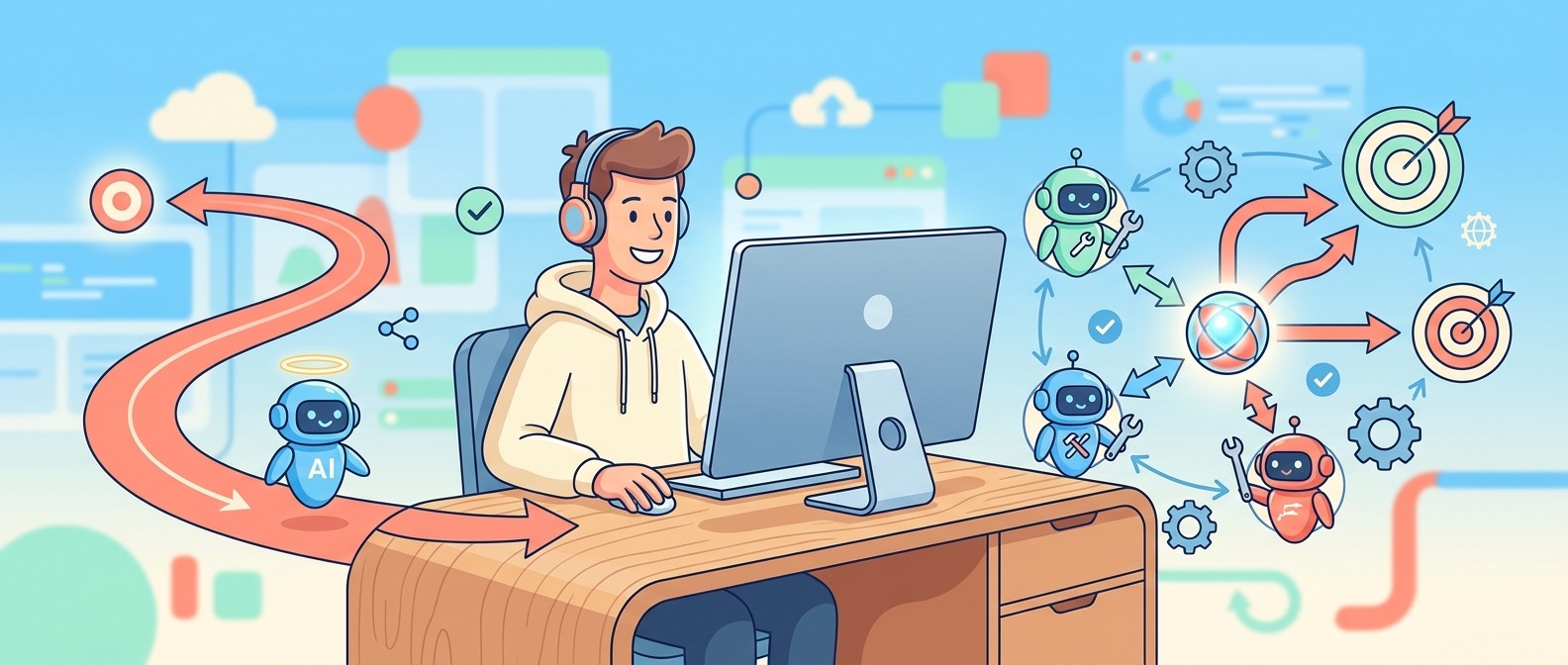
A single-agent vs multi-agent systems decision should begin with the work, not with a diagram. A single agent is often enough when one accountable process can interpret the request, access a manageable set of tools and knowledge, take a bounded sequence of actions, and return an answer that can be checked. Adding agents does not automatically make the system more capable. It adds messages, state transitions, permissions, retries, disagreement, and a new question: who decides when the specialists disagree?
Start with the smallest architecture that can meet the required quality, safety, and operating constraints. Anthropic’s guidance on effective agents makes a related distinction: predefined workflows trade toward predictability and consistency, while agents are useful when flexibility and model-driven direction are needed. It also recommends increasing complexity only when it is needed. That is an architectural discipline, not an argument against advanced systems.
This article deliberately stays narrow. For the broader language around AI agents and agentic AI, read the source pillar: AI Agents vs. Agentic AI: What Is the Difference and When Does It Matter?. Here, the question is not what these terms mean in general. It is how a builder decides whether one operational brain is enough.
Architecture Choice Is a Constraint-Matching Exercise
Teams sometimes frame the choice as a contest: one generalist agent versus several specialists. That framing hides the more useful question. Which constraints are difficult to satisfy inside one execution boundary? Constraints include the amount of relevant context, the number and similarity of tools, independent ownership of capabilities, latency expectations, required sequence controls, audit needs, and the harm caused by an incorrect action.
If none of those constraints is severe, a single agent usually has an advantage. It has one instruction hierarchy, one working state, one trace to inspect, and one place to apply an approval rule. Its limitations are visible: either it knows enough and can choose well, or it does not. By contrast, a multi-agent design can distribute complexity, but it can also distribute ambiguity. A poor result may arise from routing, an incomplete handoff, a stale summary, a specialist’s tool call, or a coordinator that interpreted a specialist response incorrectly.
LangChain’s multi-agent documentation is direct on this point: a single agent with an appropriate prompt and tools can often achieve similar results. It identifies context management, distributed development, and parallelization as reasons to use multiple agents. Those are concrete needs. “We want an agent team” is not one.
Decision Signals That Favour One Agent
The clearest sign that one agent is enough is an end-to-end task that remains understandable when written as a single job description. The agent may use retrieval, call a few tools, or follow a structured plan. None of that requires multiple autonomous components. The useful test is whether the agent can carry the relevant task state without being overloaded by unrelated policies, competing objectives, or a confusing catalog of actions.
These signals are not claims that a single agent is simple in every respect. A strong single agent can still be carefully engineered. It may have deterministic preprocessing, retrieval, validation, response templates, and human approval. The important point is that these features can surround one decision-maker without inventing additional agent identities.
Do not confuse a multi-step workflow with a multi-agent system. If the path is fixed—parse, retrieve, apply a rule, generate, validate—then code can orchestrate it deterministically. Anthropic describes workflows as predefined code paths. When the path is known, explicit orchestration can be easier to predict and test than asking multiple agents to negotiate the next move.
Decision Signals That Earn a Split
Multiple agents become reasonable when a single boundary repeatedly harms quality or maintainability in a way that specialization can isolate. LangChain highlights several of these situations: context needs that would otherwise overwhelm the model, independent teams developing capabilities, parallel subwork, too many tools for one agent to select well, and sequential constraints that must unlock actions only after conditions are met.
| Observed signal | Why one agent struggles | Smallest useful response |
|---|---|---|
| Tool overload | Similar or numerous tools make selection unreliable and broaden the permission surface. | Group tools behind a narrow specialist or expose them only after deterministic routing. |
| Large, distinct knowledge domains | Putting every policy and document in one context creates noise and hides the relevant rule. | Use a router or on-demand skill/context boundary, then retain only the relevant domain. |
| Independent capability owners | One prompt becomes a shared, fragile integration point across teams. | Define a stable interface for a maintained capability and a clear contract for results. |
| Parallel, independent subtasks | Serial execution delays an answer even though work has no dependency. | Parallelize only the independent evidence gathering and reconcile it explicitly. |
| Hard stage constraints | Some actions must never be available before verification or consent. | Use deterministic gates first; add an agent handoff only if a distinct expert is genuinely needed. |
Notice that each signal points first to a boundary, not a personality. A boundary can be a retrieval filter, a tool namespace, a deterministic router, a permission gate, a service interface, or a specialist agent. The best choice is the lightest mechanism that removes the observed failure. This prevents architecture from becoming branding.
The Coordination Overhead You Must Price In
Multi-agent systems have a cost model even when no invoice labels it “coordination.” Every delegation needs a task description. Every specialist needs enough context to act. Every response must be normalized, checked, and incorporated into the next decision. If agents call tools, the system must decide whether the coordinator, the specialist, or both are responsible for permissioning, retries, and error recovery.
That overhead produces several practical failure modes. A coordinator can send a vague handoff that omits the decisive customer fact. A specialist can return an elegant answer in a format the coordinator misreads. Two workers can inspect different versions of the same record. A router can misclassify a borderline request and send it into the wrong policy universe. An aggregation step can privilege fluent language over reliable evidence. None of these failures are exotic; they are the normal cost of adding interfaces.
Coordination also changes latency. A serial handoff tree compounds waiting time because later work cannot begin until earlier work is summarized and routed. Parallel work can reduce elapsed time, but only when tasks are actually independent and the merger does not become the new bottleneck. Plan for the reconciliation step before celebrating parallelization.
Finally, coordination creates testing work. You no longer test just the final answer. You test route selection, delegated task quality, context packaging, specialist behavior, handoff schema, conflict resolution, and recovery when one component fails. The system can still be worth it. But the burden should be included in the architecture decision rather than discovered during an incident.
Context Boundaries Matter More Than Agent Count
The most transferable design lesson is to treat context as a deliberately engineered input, not as a pile of information. LangChain describes context engineering as central to multi-agent design: each component should see the right information for its job. That principle applies equally to a single agent. A single agent with well-selected context can outperform a fragmented system whose specialists receive partial, inconsistent, or overly compressed versions of the case.
Start by listing the information classes involved: user request, account state, policy text, recent interaction history, internal notes, tool outputs, and approval status. Then ask four questions for each class. Is it necessary for the next decision? Is it authoritative? Can it contain sensitive or irrelevant material? How will the system know when it is stale? The answers define a context contract.
For a single-agent design, the contract often means retrieval filters, a case summary generated by code, and a restricted tool list. For a multi-agent design, it also means specifying what can cross a handoff. Avoid handing over an unbounded transcript by default. It makes specialist behavior harder to reproduce and risks passing irrelevant instructions or private details into domains that do not need them.
A practical rule is to keep raw evidence close to the component that needs to inspect it, while passing structured findings onward. The structured finding should identify its source, confidence or uncertainty in plain terms, the action taken, and what remains unresolved. This is not a claim that a summary is always safer or more accurate; summaries can omit nuance. It is a design prompt to decide intentionally what the next actor needs.
Tool Boundaries: The Most Common Reason to Resist a Split
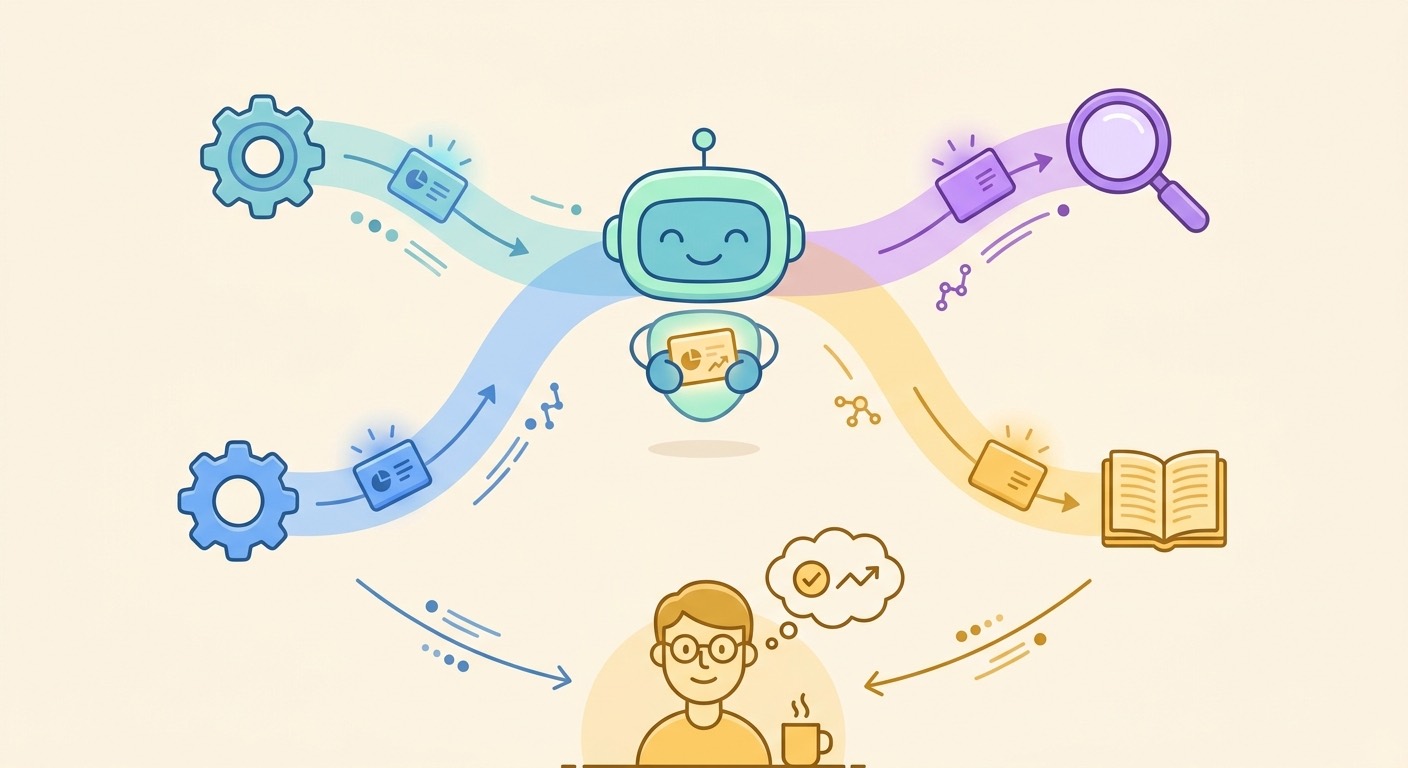
A large tool catalog is a legitimate multi-agent signal, but it does not automatically mean you need a team of agents. First reduce the catalog. Merge duplicate operations, use deterministic preconditions, remove tools that are rarely safe to invoke automatically, and make parameters explicit. Often the problem is not that one agent has too few colleagues; it is that it has been handed an unclear control panel.
Consider a support system with tools to view account status, inspect a shipment, update an address, issue a credit, reset a login, cancel a subscription, and send a reply. A single agent may handle this set well if tools have clear names and validation. But if it also receives dozens of administrative, billing, identity, compliance, and internal operations, selection and authority become harder to reason about. The answer could be a specialist with a narrow permission set. It could also be a deterministic policy service that decides which tools are exposed for this ticket category.
Separate capability from authority. A model might be capable of proposing a refund, but the system should not infer that it may execute one. The right boundary for a high-impact action is often a hard approval gate, not a “refund agent.” Deterministic controls remain valuable even in flexible architectures because they state non-negotiable rules in a form that does not depend on a model choosing to remember them.
Architecture Decision Widget
This widget is a conversation starter, not a scoring engine or a substitute for testing. It turns common design signals into a conservative recommendation. Select the condition that best describes the system you are planning, then use the explanation to identify what to validate next.
Interpret a low score as permission to begin with one agent and tight evaluation, not as a promise that it will never need to evolve. Interpret a high score as an invitation to isolate one demonstrated pain point first. A multi-agent migration does not need to happen all at once; a router, a specialist for one overloaded domain, or a parallel evidence stage may be enough.
Worked Scenario: Support Triage Without Premature Agent Sprawl
Imagine a customer support operation that receives account-access problems, delivery questions, billing disputes, product questions, and cancellation requests. The product team wants “a multi-agent support team”: one agent for billing, one for orders, one for policy, one for tone, and one coordinator. Before approving that structure, define the actual user journey.
A ticket arrives with the customer’s message and account identifier. The system needs to recognize the issue type, retrieve relevant account facts and approved policy material, decide whether an action is permitted, prepare a response, and either complete the task or route it to a human. Many of these steps are not independent conversations. They are a bounded operational workflow with a few places where model judgment is useful.
First architecture: a single accountable triage agent
Begin with a single agent that receives a compact case packet: customer message, verified account state, relevant order facts if applicable, and a retrieved policy excerpt. Give it a small set of read-only tools plus clearly gated action tools. Its instructions should require it to identify the request category, cite the evidence it used in an internal structured response, identify missing information, and produce either a customer draft, an allowed action proposal, or a human escalation.
Behind the scenes, code can perform deterministic steps before and after the agent: verify identity, retrieve approved policy versions, select tools allowed for the ticket state, validate output fields, and require human approval for actions outside an approved threshold. This is a single-agent architecture even though it has several system components. One agent carries the flexible interpretation task; code carries the fixed controls.
| Ticket situation | Single-agent behavior | Deterministic control |
|---|---|---|
| Customer asks where an order is | Read shipment status, explain the current state, ask one targeted question only if necessary. | Expose shipment lookup only for the verified account and prevent changes to delivery details. |
| Customer contests a charge | Summarize the account facts and policy-relevant issue; propose the permitted next step. | Do not execute a credit without the required approval condition. |
| Customer cannot log in | Guide the user through an approved recovery path and identify exceptions. | Use a secure verification service; never let the model bypass it. |
| Customer requests cancellation | Explain consequences based on the retrieved account state and create a clear handoff if needed. | Check contract or timing rules before exposing cancellation execution. |
What to measure before splitting
Run representative cases through this design and inspect where it fails. Does it choose the wrong tool because the catalog is confusing? Does it miss a billing policy because relevant documents are too large or too varied? Does it need independent order and account checks to happen concurrently? Are separate teams unable to release changes safely? Or is the real issue that the retrieval filter, tool descriptions, output schema, or approval rule is weak?
Only the first group of findings justifies additional agent boundaries. If billing policy is genuinely extensive and keeps contaminating general support context, create a well-defined billing specialist or skill. If order status and account checks are independent and response time matters, parallelize those evidence-gathering steps and let the primary agent reconcile structured results. If a compliance team owns a distinct capability, establish an interface it can maintain. The target is not a maximal agent team. The target is a reliable support outcome.
Failure Patterns in the Support Scenario
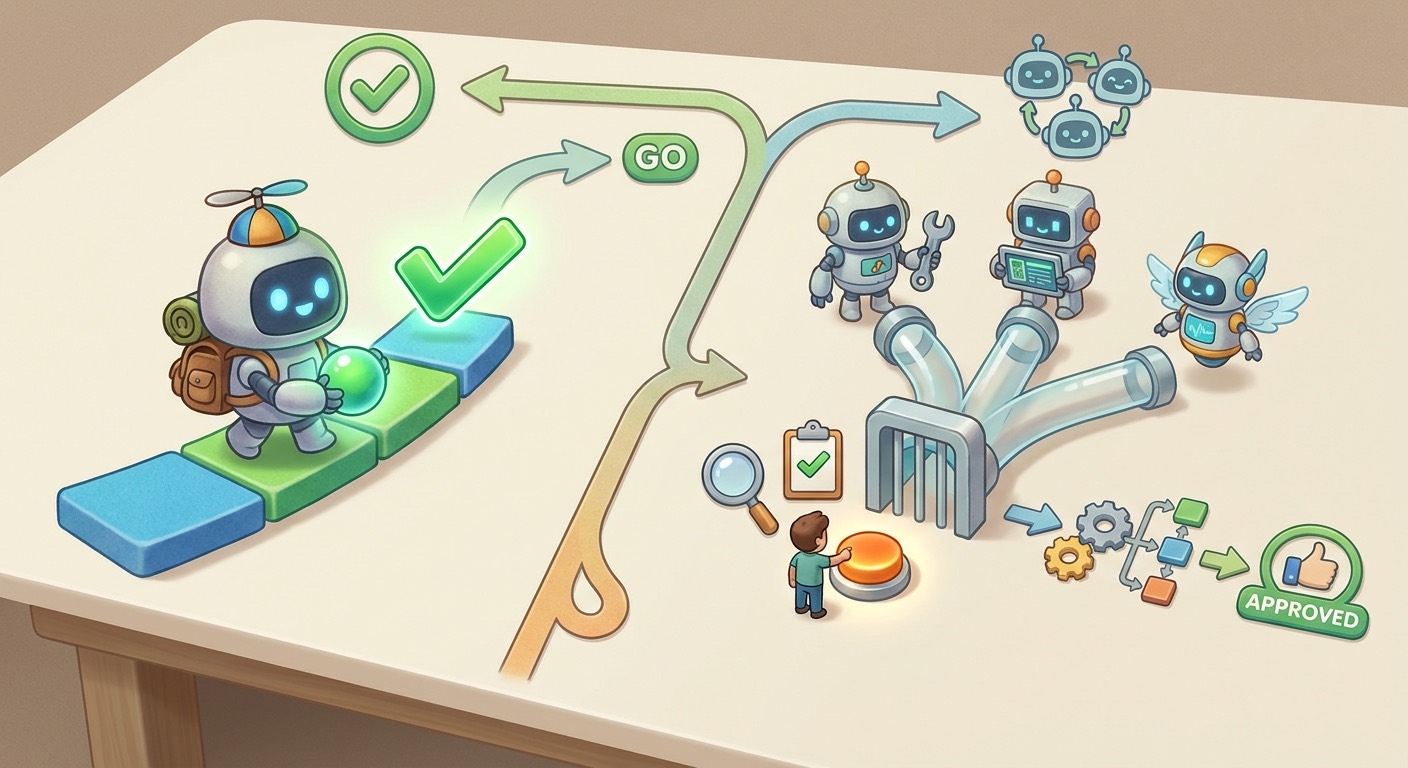
Support triage makes architecture mistakes visible because each mistake affects a real decision. One common failure is over-routing. A simple order-status question bounces through a classifier, order agent, policy agent, tone agent, and coordinator. Each handoff creates delay and another chance to lose the customer’s actual question. The remedy is to keep ordinary cases local to one accountable agent and reserve a split for demonstrated complexity.
A second failure is shared but inconsistent state. One specialist sees an old subscription status while another sees a recently updated record. The coordinator then produces a confident but contradictory response. The remedy is not merely better prompting. Define an authoritative source for each fact, record the retrieval time, and make the merger reject conflicting high-impact facts rather than smoothing them into prose.
A third failure is escalation theater. A system says it is escalating to a specialist but only passes a generic summary, so the next component repeats the same questions. A handoff must include a specific purpose, what evidence has been checked, what remains unknown, and what action is expected next. Otherwise the “specialist” is a loop.
A fourth failure is permission leakage. A coordinator asks a specialist for a recommendation, then treats the recommendation as an authorization. Keep decision support and action authority separate. In a trustworthy support system, the execution pathway should enforce the action conditions independently of which component proposed it.
Evaluation Gates: Prove the Architecture Before You Expand It
Architecture decisions should be reversible experiments, not identity commitments. Establish a baseline with the smallest plausible system. Then define the examples it must handle, the errors that matter, and the operating limits it must respect. The result does not need to be a universal score. It needs to be sufficiently specific that a proposed split can be judged against the baseline.
The NIST AI Risk Management Framework is a voluntary framework for managing risks associated with trustworthy AI. For this choice, its practical value is the reminder to make risk management part of the system lifecycle rather than a last-minute launch review. An architecture evaluation should include more than answer quality: it should also examine oversight, reliability, privacy-sensitive context handling, harmful action paths, and whether the team can understand and govern the system.
1Define a fixed evaluation set
Collect realistic cases across routine, ambiguous, high-impact, and adversarially phrased requests. Include cases that should be escalated and cases that should be refused. Keep the expected outcome at the level you can review: correct category, allowable action range, required missing information, response clarity, and escalation decision. Do not silently change the set after a system learns its quirks.
2Trace the decision path
For every test case, retain the selected context, tool calls, validated outputs, route if any, and final result. A trace is how you tell whether a multi-agent system improved the original problem or simply hid it behind another layer. Record what evidence each component received; without that, you cannot debug a context-boundary failure.
3Set a promotion gate
Do not add a specialist because a demo feels more impressive. Promote a split when the baseline shows a repeatable failure, the new boundary has an explicit contract, and the candidate system improves the relevant evaluation cases without creating unacceptable regressions in latency, cost, safety controls, or maintainability. If it does not pass that gate, keep the simpler design and fix the underlying component.
4Test failure and recovery
What happens if retrieval returns nothing, a tool is unavailable, an agent produces an invalid structured result, or two sources disagree? The answer should not be “the coordinator will figure it out.” Specify fallbacks, human escalation, and safe stopping conditions. More agents mean more partial-failure paths; test them deliberately.
Evaluation Questions for Single-Agent and Multi-Agent Designs
| Question | Single-agent checkpoint | Multi-agent checkpoint |
|---|---|---|
| Is the right context present? | Verify retrieval and case-packet selection. | Verify both selection and every handoff contract. |
| Can the system choose an action safely? | Test tool descriptions, constraints, and approval gates. | Test which component can propose, approve, and execute each action. |
| Can a reviewer explain a failure? | Inspect one trace and output schema. | Reconstruct routing, specialist inputs, outputs, and aggregation. |
| Does faster execution matter? | Measure serial path behavior. | Show that independent parallel work improves the required experience. |
| Can ownership evolve? | Assess whether one team can maintain the interfaces. | Assess whether separate ownership contracts reduce, rather than add, integration risk. |
These questions also protect against a subtle mistake: optimizing a proxy. A multi-agent system may produce more detailed intermediate text while making the user outcome worse. A single agent may look less elaborate while reliably resolving the ticket. Evaluate the outcome and the control properties, not the number of boxes on the diagram.
Limits and Non-Answers
No generic article can decide your architecture. Model capability, tool reliability, data sensitivity, operational requirements, and organizational structure differ widely. A task that works with one agent in a narrow pilot may need stronger boundaries after it expands to more policies, languages, or actions. Conversely, a system designed as multi-agent from day one may discover that most traffic follows a predictable path better handled by deterministic workflow code.
There is also no universal point at which a tool list becomes “too many.” The practical signal is observed poor tool choice, difficult maintenance, or an inability to define a clear permission model—not a magic count. Likewise, parallelization is not intrinsically better. It helps when subwork is independent and reconciliation is disciplined; otherwise it simply produces more competing outputs.
Finally, a separate agent is not a substitute for governance. NIST’s AI RMF is voluntary, and it does not prescribe your exact design. But its trustworthy-AI risk-management orientation is useful: identify risks, establish accountability, measure behavior, and manage the system throughout its lifecycle. Architecture is one control among many, alongside data practices, access controls, human oversight, testing, and incident response.
A Conservative Build Sequence
For most teams, a staged sequence creates clearer evidence than a large initial design. Build a constrained single agent around the real task. Use deterministic code for known routes, permission checks, and output validation. Select context carefully. Run it against a fixed evaluation set and inspect failures. Then make one targeted change at a time.
Begin with one agent when
- The task has one accountable outcome and shared case context.
- Tools are few, distinct, and controlled.
- A serial path meets the user need.
- One team can own prompt, tools, tests, and monitoring.
- You need a clear audit trail while learning the task.
Introduce boundaries when
- Tool overload demonstrably harms selection or authority control.
- Separate domains require distinct context contracts.
- Independent teams need stable capability interfaces.
- Independent subtasks genuinely benefit from parallel execution.
- A new boundary passes an evaluation gate against the baseline.
That sequence does not reject multi-agent systems. It treats them as an earned optimization: a response to measurable pressure rather than a default aesthetic. The simplest system that reliably fulfills the task is not a compromise. It is often the system your team can understand, test, improve, and govern.
Sources and Further Reading
- Anthropic, “Building Effective Agents” — workflow predictability, agent flexibility, and the case for starting with the simplest solution.
- LangChain documentation, “Multi-agent” — context management, distributed development, parallelization, tool overload, and specialization patterns.
- NIST AI Risk Management Framework — a voluntary framework for managing risks associated with trustworthy AI.
This article avoids numerical performance claims because architecture quality depends on the task, controls, and evaluation design. Test the design against your own representative cases before making a production decision.
Frequently Asked Questions
When is one AI agent enough?
One agent is often enough when a task has one coherent outcome, a manageable and distinct tool set, useful shared context, acceptable serial execution, and one team that can maintain the system. Start there and split only in response to a measured boundary problem.
Does a multi-agent system always perform better?
No. Multiple agents can help with context management, distributed development, parallelization, tool overload, and specialization. They also add routing, handoffs, state management, and testing work. A single agent with the right context and tools can often be sufficient.
What is the strongest signal that I need multiple agents?
A strong signal is a repeatable failure that a clear boundary can solve: for example, an overloaded tool set causing poor choices, distinct knowledge domains needing different context contracts, independent teams maintaining capabilities, or independent tasks that must run concurrently.
Should I create an agent for every business function?
Usually not. Business labels do not automatically define useful technical boundaries. First determine whether the function needs separate context, tools, permissions, ownership, or parallel work. A deterministic workflow or a narrow tool namespace may solve the problem with less coordination overhead.
How do I prevent specialist agents from losing context?
Define a handoff contract. Pass only the relevant authoritative evidence, task purpose, completed checks, unresolved questions, and expected output format. Preserve a trace so reviewers can see what each component received and returned.
Can a single-agent system still use workflows and validation?
Yes. A single agent can operate inside deterministic preprocessing, retrieval, validation, and approval steps. Fixed paths are often better represented as code, while the agent handles the flexible interpretation or decision work that remains.
How should I evaluate an architecture change?
Use a fixed set of representative cases, trace context and tool use, define safety and quality expectations, and compare the new boundary with a simpler baseline. Promote the change only when it solves a repeatable problem without unacceptable regressions.
